
Hair, Skin, and the School Photograph: A Biracial Hair Care Guide for Mixed-Texture Kids
Every mixed family keeps a version of this file — the biracial hair care routine that finally works, the skin care that respects melanin, and the calm, prepared morning of the school photograph. Here it is, gathered in one place, with love.
If you have ever stood in a bathroom at midnight searching for a biracial hair care kids mixed texture guide because tomorrow is wash day and last wash day ended in tears — yours, mostly — this article is your file.
It is the practical half of raising a mixed child well: the hair, the skin, the barber and the salon, the school and the team where your child is one of several and not the only one, and the small annual ceremony of the school photograph, done properly. None of it is mysterious once somebody shows you.
The families who do this beautifully are not doing anything exotic. They have a routine, they have the right chair to sit their child in, and they started both early. Identity — the deeper half — lives in our companion piece on raising a Black child in a white family.
This piece is the hands-on half: combs, conditioners, sunscreen, and a portrait your grandchildren will be glad you got right.
First, Know the Hair You Actually Have
Mixed-texture hair refuses generalisations, and the first act of competence is looking closely at your own child.
Care guides for mixed textures begin in the same place: a child's curls can run the full span from loose waves to tight coils — occasionally several patterns sharing a single head, and the routine has to be personalised to that head — more moisture here, more scalp care there, definition where the curl wants defining.
One child in a family may need a light leave-in and a weekly rinse; their sibling may need the full ceremony. Neither routine is the correct one. Each is correct for the hair it serves.
Write yours down once it works — products, order, timing — because the grandparent, the sitter and the other parent will all need it, and because a written routine is how a good hair day stops being an accident.
Treat the routine itself as part of the inheritance: a child who grows up watching their hair handled patiently and knowledgeably learns, without a single lecture, that what grows out of their head is worth skill and time.
The washing rhythm surprises most parents raised on daily shampoo. Mixed-texture hair generally thrives on washing every 7 to 14 days with a gentle, sulfate-free hydrating shampoo, because harsher cleansing strips the natural oils that curly hair distributes slowly and needs desperately.
Between washes, many families cleanse with conditioner alone — the co-wash — and parent-run guides describe the method plainly: washing the scalp and hair with conditioner or a co-wash instead of shampoo, which still cleans the scalp without drying the hair out.
Follow cleansing with a rich conditioner, applied generously, and — this is the detail that changes everything — detangle while the conditioner is in, never on dry hair and never in a hurry. Work in sections, four or five of them, with fingers first and then a wide-tooth comb, starting at the ends and easing upward.
A monthly deep-conditioning treatment rewards especially dry or tightly coiled hair.
And protect the work overnight: a satin sleep cap or pillowcase keeps styles intact and cuts the morning detangle to minutes, as the practical guides advise — keep a satin cap on the pillow, so the style survives the night unruffled, and detangle gently, in sections, with conditioner doing the heavy lifting.
Two cautions from the same collective wisdom: do not overload fine mixed hair with heavy oils and serums in the name of shine — weighed-down curls read as neglect, not care — and do not overwash. Start near once a week and adjust by what the hair tells you.
Protective Styles, and Teaching Hands — Yours Included
Braids, twists and other protective styles are the mixed family's quiet infrastructure. Done well — loose enough to be kind, neat enough to last — they hold moisture, prevent the daily tug-of-war, and give a child a style that is unmistakably, proudly theirs.
The hero photograph of this article is the whole philosophy in one frame: a father learning to braid at the kitchen table while the child's grandmother guides his hands.
That is how this knowledge has always travelled — hand to hand, generation to generation — and a parent who did not grow up with this hair joins the chain by being taught, not by outsourcing forever.
Learn the basics yourself even if a professional does the elaborate work: a simple two-strand twist, a tidy parting, the refresh with water and leave-in on day three. Your child will remember whose hands were gentle and unhurried. They will also, not incidentally, learn the standard: this is how long good care takes, and you are worth it.
For the fuller culture of the chair itself — how a family chooses its barber or salon and keeps one for years — our Well-Kept Self companion, The Chair: Barbers, Salons, and the Appointments That Run Black Life, is the standing reference, and Hair as Signature carries the same standard into a daughter's grown-up years.
Finding the Right Barber and Salon
The right chair is a professional who has your child's exact texture in their book already — not as an experiment, but as a speciality.
Ask other mixed families and Black parents in your school and neighbourhood networks where they go, and ask the question directly when you call: who here cuts and styles mixed-texture children's hair, and may we watch them work before we book?
A good children's stylist will talk you through the routine they recommend, tell you honestly what a style will require of you at home, and never reach for heat or chemicals as a first answer to a parent's learning curve.
Book the standing appointment — the same chair, the same hands, on a rhythm — because a stylist who knows the head watches it change as the child grows, and catches what a stranger misses.
For boys, the barbershop carries an extra dividend: it is one of the original rooms of Black life, and a son who is known there by name is being given community along with his cut.
The newer women's hair guides in this magazine — Black Hair for Women and The Styles, Now and Forever — are worth a mother's read for the grown-up end of the same education.
Skin: Moisture, Sun, and the Dermatologist Who Knows Melanin
Melanin-rich skin asks for two habits above all: moisture kept, and sun taken seriously. The daily routine is short.
Bathe in warm rather than hot water, moisturise while the skin is still damp — the melanin-rich skin guides return to this timing again and again, recommending moisturising immediately after bathing to lock in moisture, with gentle, fragrance-light products built on ingredients like shea butter and cocoa butter — and watch the familiar places: elbows, knees, the dry patches and the itchy flare-ups that show pale and ashy on deeper skin.
Eczema and irritation deserve a professional eye early rather than a shelf of experiments. On sun, retire the family myth that deeper skin needs no protection. The children's health guidance could not be clearer:
“Every child needs sun protection. The American Academy of Dermatology (AAD) recommends that all kids — regardless of their skin tone — wear sunscreen with an SPF of 30 or higher.”— KidsHealth, Rady Children's Hospital — San Diego
The same guidance notes that dark skin, for all its protective melanin, can still take a painful sunburn, and a tan is itself a sign of sun damage — and that babies under six months belong in shade and cover rather than sunscreen.
Choose a sunscreen your child will actually tolerate — the chalky cast some mineral formulas leave on brown skin is the reason tubes die half-used — reapply after swimming and sweating, and make it as unremarkable a morning step as brushing teeth.
When skin questions persist — a patch that will not settle, marks that linger after every bump and bite — see a dermatologist fluent in skin of colour, the standard our companion piece The Skin We're In sets out in full.
This is general information, gathered from the sources below — your child's own clinician, who knows their skin, has the final word.
Choosing Schools and Teams Where Your Child Is Not the Only One
The practical file extends past the bathroom mirror. When you choose a school, a team, a troop or a studio, add one question to the tour that experienced mixed families never skip: where will my child see themselves? Not as a quota — as oxygen.
A classroom with other Black and mixed children, a teacher or coach who shares their background, art on the walls and books on the shelves that include faces like theirs: these are developmental supplies, as real as the science lab.
Ask how the school handles the curriculum's wider world, who leads its family associations, and whether a parents' network exists that you can join before the first term rather than after the first incident. Our school companion, Choosing the School, walks the whole admissions circuit; bring this article's question with you when you walk it.
Then build the village on purpose around the institution: godparents who look like your child, mentors a few years ahead of them, the barber and the stylist, the families from the heritage and cultural programmes your area offers. A child can thrive as the only one for a season. No child should have to make a career of it.
The School Photograph, Done Properly
And so to the photograph — the framed proof on the piano that this whole file exists to serve. School picture day rewards calm preparation and punishes improvisation, and the photographers' own guidance is remarkably consistent.
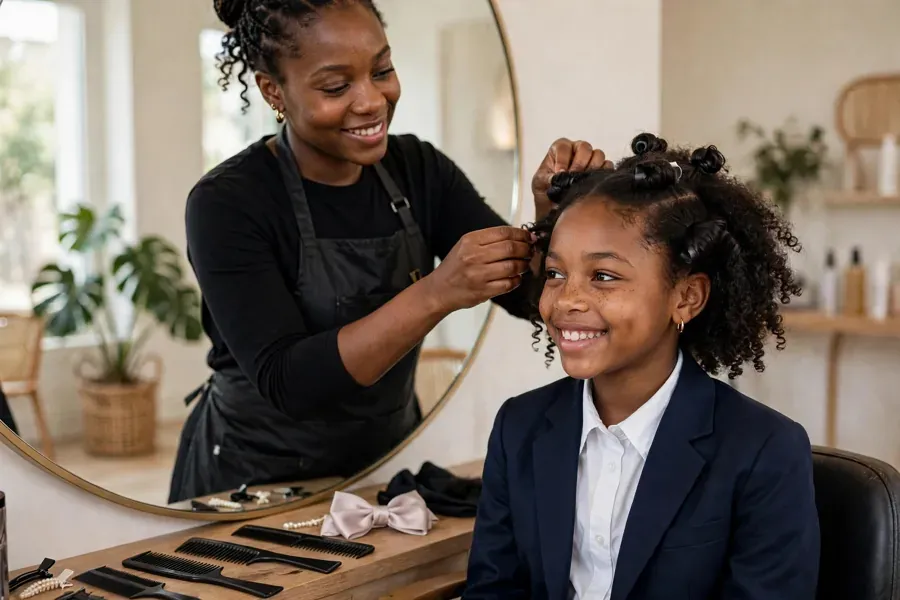
Schedule the haircut early: picture-day advice from educators puts it at at least ten days ahead of photo day, so the cut has settled and the hairline looks like your child's own, and school portrait studios give the matching instruction — avoid fresh haircuts or brand-new hairstyles, wash and prepare the hair for the day, and keep bows, ribbons and headbands small so the portrait crops to the face, not the accessory.
For mixed-texture hair, translate that into your own calendar: the wash and the detangle happen the night before, the protective style or the defined curls are set and slept in under the satin cap, and picture morning is a five-minute refresh — water, a touch of leave-in, edges tidied — never a full restyle against the clock.
Choose the outfit by the studios' rule: solid colours in medium to deep tones photograph best, neon reflects colour up into the face, solid white blows out, and if the school shoots on a green screen, green stays in the wardrobe.
Moisturise the face that morning — dry skin reads dull on camera — lay everything out the night before, feed them a real breakfast, and then, the hardest instruction of all, let the photographer do the smiling: studios ask parents not to coach a pose or a grin, because the natural expression they coax out in ten seconds is the one you will actually want in the frame.
One more thing, and it matters: insist, whenever the proofs come back, on the portrait as it is — curls at their full, glorious volume, skin at its true, rich tone. Retouching that thins the hair or lightens the child is not an improvement. Send it back.
The photograph is a record of who they were that year, and who they were was magnificent.
Keep the file current. Textures change as children grow — the toddler ringlets are not the ten-year-old's crown, and neither is the teenager's — and each change earns a fresh conversation with your stylist and a fresh page in the routine.
What does not change is the principle underneath every page: hair and skin, tended skilfully and without apology, are among the first languages in which a child learns they are cherished. Speak it fluently, and picture day takes care of itself.
Raising the Whole Child: Biracial Children, Rooted in Both Houses
Raising a Black Child in a White Family: A Gracious, Practical Guide
The Chair: Barbers, Salons, and the Appointments That Run Black Life
The Skin We're In: Melanin, Expertly Kept
Black Hair for Women
Choosing the School: Private, Boarding, and the Education That Fits Your Child
Niles and Chaz — “Tangles, Textures & TLC: How to Care for Mixed Texture Hair with Love”
Raising Biracial Babies — “How to Care for Mixed Hair”
AfroDeity — “Essential Hair Tips for Mothers of Mixed Race Kids”
KidsHealth / Rady Children's Hospital — “How to Choose & Use Sunscreen”
Sweet Peach Tree — “Skin Care Tips for Melanin-Rich Skin”
Education World — “School Photo Day Made Easy”
School Pics — “Picture Day Tips”
Questions & Answers
How do families pass down wealth and values?
Every mixed family keeps a version of this file — the biracial hair care routine that finally works, the skin care that respects melanin, and the calm, prepared morning of the school photograph. Here it is, gathered in one place, with love. It links to 9 stories and articles — open any card to read the full piece.
How do you involve children in family wealth planning?
Every mixed family keeps a version of this file — the biracial hair care routine that finally works, the skin care that respects melanin, and the calm, prepared morning of the school photograph. Here it is, gathered in one place, with love.
How do I read the full stories on Hair, Skin, and the School Photograph: A Biracial Hair Care Guide for Mixed-Texture Kids?
Choose any card on this page. Each one opens a full page of its own — the complete story or article, with its sources linked.