Raising a Black Child in a White Family: A Gracious, Practical Guide
For white parents raising a Black adopted child, this cultural guide starts where the research starts: love is the floor, not the ceiling — and the ceiling is built, deliberately and joyfully, out of barbers, books, mentors, camps and community.
This guide is written for the white parents in our wider circle — the friends, the in-laws, the families at the next table — who are raising a Black child and want to do it beautifully, and for the Black grandparents, godparents and friends who love them and get asked, often at kitchen tables, what doing it beautifully actually requires.
If you are one of those parents, begin with the good news, because the research genuinely is good news. Reviews of the outcome literature gathered for the Child Welfare Information Gateway reach a reassuring conclusion: across the ages studied, children adopted across race settle and thrive much as children adopted within their own race do.
Your child is not a risk to be managed.
Your child is a child to be raised — with one addition to the ordinary work of parenting, an addition this whole article is about: because your child will grow up in the world as a Black person, and your household is where they should first learn what a rich inheritance that is. Love is the floor of that house.
Nobody sensible doubts your floor. This article is about the ceiling — the rootedness, fluency and pride that parents build on purpose, the way established families build everything that matters: deliberately, with the right people in the room.
What the Research Actually Rewards
The same body of research that reassures also instructs, and its instructions are wonderfully concrete.
Transracial adoptions tend to flourish most when parents actively open the door to the child's birth culture and raise the family in a racially integrated community, and peer-reviewed work points the same way: the everyday practice researchers call cultural socialisation — a parent actively honouring and teaching the child's racial and ethnic heritage — tracks with stronger identity development and stronger psychological adjustment.
Notice what kind of work this is. It is not a speech, a unit at school, or a special month. It is the composition of ordinary life: who cuts the hair, who sits at the table, which books are on the shelf, which streets the family calls home ground.
The corollary the research draws is equally plain: children whose parents took a hands-off, colour-blind approach were more likely to struggle with questions of identity than children whose parents engaged their heritage head-on and with pleasure.
The adoption guidance for families puts the principle in one sentence: it is impossible to raise an adopted child of a different race well while treating race as a non-issue — so do the opposite, and talk about and celebrate the differences in your family from the day your child comes home.
Said at the level of this magazine: your child has two inheritances now, yours and theirs. A first-rate parent delivers both, in full.
Hair and Skin, Done Right — the First Language
Start where your child starts every morning: the mirror. Your child's hair and skin will follow rules your own never taught you, and learning those rules — cheerfully, early, to a professional standard — is among the most eloquent things you will ever say without words.
The family guidance is direct about it: a Black child's hair will not only look different from yours, it will require different care, and recognising and embracing that difference is part of the job.
So learn the care — the washing rhythm, the conditioning, the gentle detangle — and then put your child in the right professional hands: a Black barber or braider who knows this hair the way a great tailor knows cloth, on a standing appointment your child keeps for years.
Our companion file, Hair, Skin, and the School Photograph, carries the full practical routine, and The Chair explains why the barbershop and the salon are institutions and not errands. The classic parenting manual for transracial families teaches difference-celebration at exactly this bathroom scale, in the voice to use with a small child:
“Your hair only needs to be washed once each week; your sister's hair needs to be washed every day. You both have beautiful and different hair.”— Transracial Parenting in Foster Care and Adoption, Full Circle Adoptions
That is the register for everything in this article: factual, affectionate, unembarrassed. Differences are named early and praised specifically, so that no difference your child carries ever arrives to them first as somebody else's comment.
Mirrors in the House: Books, Art, Music, and the Table
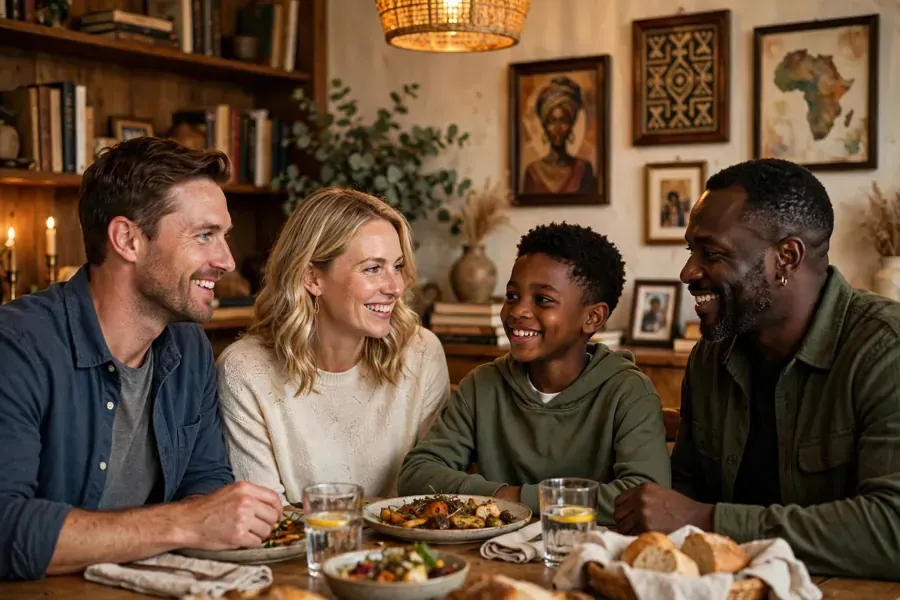
Walk through your home the way your child does and count the mirrors. Not the glass kind — the kind that show a child a face like theirs being beautiful, brilliant, funny and in charge.
The expert recommendations gathered for transracial parents read like a house furnishing plan: spend real time with people of your child's race, choose multicultural neighbourhoods, find same-race mentors and role models, press for unbiased learning materials, and cook and eat the dishes of your child's heritage.
The federal guidance for diverse adoptive families adds the domestic detail: let the child's heritage live in the faces gathered at your table and in the life of their school, fold its traditions and feast days into the family's ordinary weeks, and stock the shelves with books, toys, music and films in which the child can find themselves.
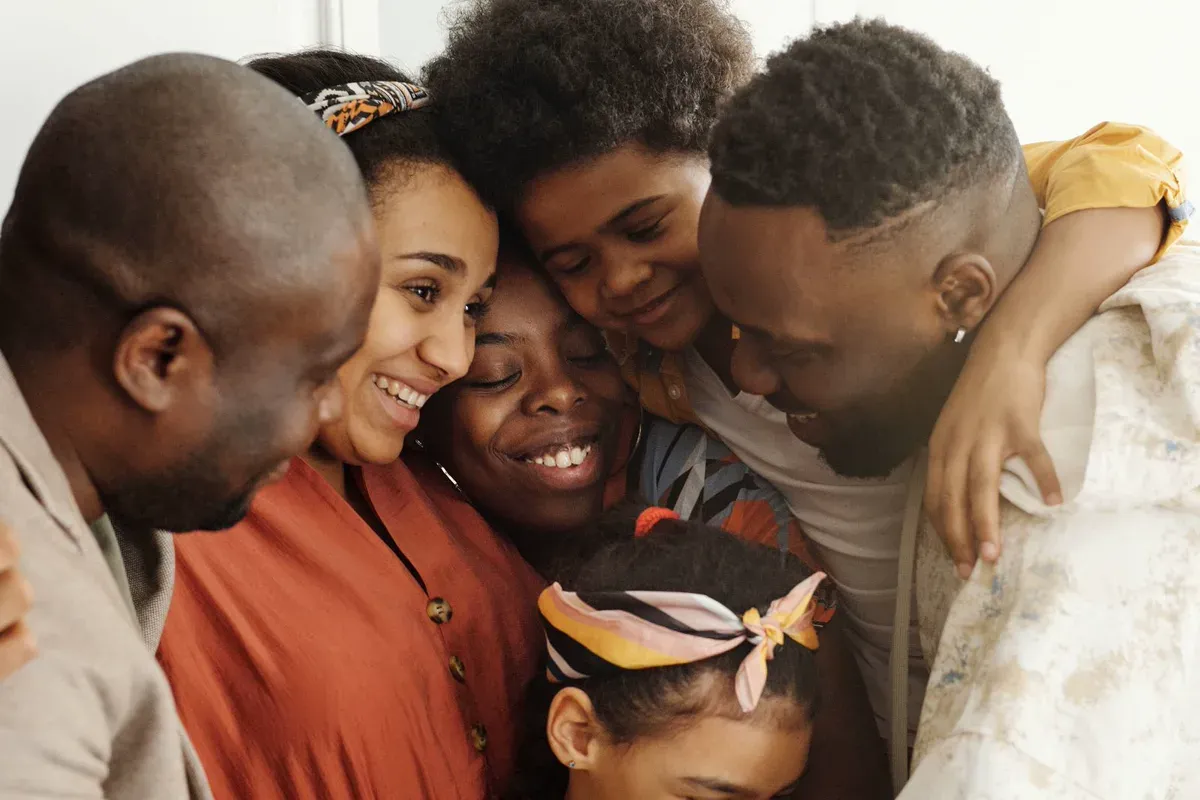
In practice, at this magazine's altitude, that means: Black art on the walls that is there because it is magnificent; a children's library where your child is the hero of half the shelf; music in the house that spans the whole glorious catalogue, learned together — the hero photograph of this piece, a mother and her teenage son happily arguing over vinyl, is not a metaphor, it is a method; and a table where the food of both your families is cooked properly and often.
Heritage that only appears as a lesson feels like homework. Heritage that is dinner, music and the pictures on the wall feels like home — because it is.
The Professional Bench: Doctors, Dentists, and Teachers Who Know Your Child
Established families build a bench for everything — a solicitor, a tailor, a mechanic they trust — and a transracial family builds one more bench on purpose: the professionals who will know your child.
Choose, where you can, a paediatrician and a dentist who have cared for Black children all their careers, and a dermatologist fluent in melanin-rich skin for the questions that will come; a clinician who has seen a thousand heads of skin and hair like your child's does not guess, and does not need your child to be the lesson.
The same instinct governs the classroom years: meet the teachers early, learn who in the building your child gravitates toward, and value the schools — see Choosing the School — where Black educators are present in real numbers, in leadership as well as in the classroom. None of this is about excluding anyone.
It is about making sure that in every professional room your child enters, at least some of the authority in that room has never once found a child like yours surprising. Children relax in rooms like that. So, you will find, do their parents.
The Village: Mentors, Godparents, Church, and Camp
No parent, of any background, raises a child alone — and the transracial family simply builds its village with intention. The pattern the adoptee voices and practitioners recommend is consistent: surround the family with positive images and media, connection with other children who look like your child, and support for their exploration of their cultural heritage — relationships, not content.
Choose godparents who bring Black adulthood close enough to watch daily. Recruit mentors a stage ahead — the university student, the young professional — for the questions a teenager will ask them before asking you.
Put down roots in a church or community where your child is one of many, and show up as a family, in the pew and at the workday, not as visitors.
In the summers, look for the heritage camps and cultural programmes built for adopted and mixed children: weeks where your child is surrounded by peers who share their exact experience, led by adults who share their background, are remembered for decades precisely because they are ordinary there.
And choose the ground you stand on: the schools, teams and streets of daily life matter here too, and our guide to choosing the school pairs with the institutions in Jack and Jill and The Links — rooms built over generations for exactly this raising. A village is not assembled in a panic at fourteen.
It is built, friend by friend, from the christening onward.
Bring the wider family with you, patiently and on purpose.
The federal guidance for diverse adoptive families is honest that while you chose this child with a great deal of thought, your extended family is being asked to arrive at the same place faster — and that relatives who were not part of the process may need time to get used to the adoption, and should be given that time.
Give it — with boundaries. Grandparents get the books you read, an invitation to the christening and the camp concert, and the same cheerful standard you hold everywhere: in this family, this child is celebrated, entirely, out loud.
Most grandparents, given a grandchild to adore and a clear family culture to join, rise to it magnificently — and become, within a year, the fiercest people in the village. The ones who need longer get love, information and patience, at a distance that keeps your child's home peaceful.
That balance — open door, steady standard — is the whole art of merging a family, and it is an art this readership has practised at every in-law summit and blended table it has ever set.
Honest Conversation, Early and Unhurried
Talk about race the way you talk about everything else that is true: early, plainly, and without flinching.
The federal guidance for diverse adoptive families advises parents to speak about race and their child's heritage in positive terms from when the child is very young, so that by school age the child has the words and the footing to answer questions on their own — including knowing which terms are simply unacceptable, and that they never have to absorb them quietly.
Keep the door open in both directions: your child should be able to bring you the playground comment, the awkward question from a stranger, the moment in the shop, and find a parent who listens first, believes them, and has thought about it before they had to.
The practitioner guidance adds your own homework to the syllabus: do the reading, take the courses, examine your own assumptions before your child is old enough to examine them for you — and be willing, as the adoptee-informed guidance puts it, to listen actively, keep learning, and speak up as your child's advocate when a situation calls for it.
Keep it in proportion, as this magazine keeps everything: race is one true thing about your child's life, spoken of honestly and lightly, inside a childhood that is mostly bicycles, examinations, jokes at the table and being known. The goal is not a child braced for the world.
The goal is a child rooted in who they are — which is the surest preparation for anything.
A last word to the Black grandparents, godparents and friends reading over a shoulder, because families like these run on your counsel: give it the way this article has tried to — specifically, warmly, and in the practical detail where love becomes visible.
The braid taught at your table, the barber you insist on, the book you put in the child's hands, the camp you help choose: that is the ceiling being built, and it is built by the whole village together. And to the parents: your child will not remember whether you did any of this perfectly.
They will remember that you did it on purpose, with pride, from the very beginning — and that in your house, everything they are was celebrated out loud. For the route by which many of these families begin, see our service companion, Chosen: Black Adoption, Told Beautifully.
Chosen: Black Adoption, Told Beautifully
Raising the Whole Child: Biracial Children, Rooted in Both Houses
Hair, Skin, and the School Photograph: The Practical Half of Raising Mixed Children
Jack and Jill, The Links: The Institutions That Raise Us
The Chair: Barbers, Salons, and the Appointments That Run Black Life
Choosing the School: Private, Boarding, and the Education That Fits Your Child
Let It Be Us — “Transracial Adoption: What Families Should Know Before They Begin”
Adoptive Families — “Raising a Child of Another Race”
American Adoptions — “Your Guide to Raising an Adopted Child of Another Race”
Child Welfare Information Gateway / Children's Bureau — “Parenting in Racially and Culturally Diverse Adoptive Families”
Full Circle Adoptions — “Transracial Parenting in Foster Care and Adoption”
Parent Herald — “Transracial Adoption: Essential Tips, Values for White Parents Raising Black Children”
Questions & Answers
How do families pass down wealth and values?
For white parents raising a Black adopted child, this cultural guide starts where the research starts: love is the floor, not the ceiling — and the ceiling is built, deliberately and joyfully, out of barbers, books, mentors, camps and community. It links to 7 stories and articles — open any card to read the full piece.
How do you involve children in family wealth planning?
For white parents raising a Black adopted child, this cultural guide starts where the research starts: love is the floor, not the ceiling — and the ceiling is built, deliberately and joyfully, out of barbers, books, mentors, camps and community.
How do I read the full stories on Raising a Black Child in a White Family: A Gracious, Practical Guide?
Choose any card on this page. Each one opens a full page of its own — the complete story or article, with its sources linked.