Chosen: Black Adoption, Told Beautifully — Process, Costs, Kinship and Open Adoption
For Black families, adoption is one of the oldest forms of choosing one another. This is the service guide: the black families adoption process, costs stated honestly, the kinship and foster routes, and open adoption — with the child's story kept theirs.
Long before there were agencies and court dates, Black families adopted — the grandmother who raised three who were not, strictly, hers; the auntie whose name the whole street used; the child at the table who simply stayed.
The formal black families adoption process, costs and all, is the modern paperwork laid over that old, honourable instinct, and this article treats it that way: as a service guide for families in our community who are ready to choose a child on paper the way our people have always chosen them in life.
You will find the routes laid out plainly — private agency, independent, foster care, kinship — the home study demystified, the money stated in honest ranges with its disagreements left visible, and the two practices that distinguish a well-told adoption from a merely completed one: openness, kept with grace, and a story that belongs to the child.
What follows is general information, gathered from the adoption sources cited below. Timelines, fees and legal steps vary by state and by route, sometimes widely — your agency and your adoption attorney, working under your state's law, are the authorities for your family's case. Nothing here is legal advice.
It is a map, drawn warmly, of ground many fine families have walked before you.
The Four Doors In
Nearly every adoption in this country enters through one of four doors, and choosing yours is the first real decision.
Through a licensed private agency, the agency matches your family with an expectant mother making an adoption plan, supports her through the pregnancy where the law allows, and walks the legal work to finalisation — the most serviced route, and priced like it.
Through an independent, attorney-facilitated adoption, your lawyer handles the matching and the court work directly, with more of the coordination on your own shoulders.
Through foster care, you are licensed as a foster parent first, and adopt — very often a child already in your home, an older child, or siblings together — through the public system, at a fraction of the private cost and with state support behind you.
And through kinship, the oldest door of all: a grandparent, aunt, uncle, godparent or family friend formalises the care they are already giving, converting love-in-fact into parenthood-in-law, with the child's world kept continuous.
Cost guides that synthesise the federal Child Welfare Information Gateway and AdoptUSKids guidance put the spread plainly: foster care adoption at roughly $0 to $2,500; the independent, attorney-led route at $8,000 to $40,000; agency infant adoption, the fullest-service door, at $30,000 to $60,000; and the international route — a fifth door, with a second country's law added — at $35,000 to $70,000.
Older federal guidance runs lower — AdoptUSKids guidance has placed both the agency and international routes inside a $5,000-to-$40,000 band — while agency fee schedules collected more recently run higher, which is why honest guides tell families to budget toward the upper end of any range they are quoted.
The disagreement itself is the information: there is no standard price, only a route, a state, and a written fee schedule you should insist on seeing in full before you sign anything.
One paragraph of that money conversation deserves its own light, because Black families deserve to hear it from a friendly source first.
Reporting by NPR has documented that some agencies historically set different fees depending on a child's race — a practice agencies defended as an incentive to place children who waited longer, and which many families, hearing of it for the first time at the fee table, found startling.
The same reporting notes the direction of travel: some states and agencies now set fees by a sliding scale tied to a family's income instead of a child's race, and others are moving toward one uniform fee charged to every family alike.
Ask any agency you interview, directly, how its fees are set and what each line pays for — reputable agencies answer in writing, and the answer tells you a great deal about the house you are dealing with. A child is never a bargain or a premium. The fee is for services.
Keep the two ideas in separate rooms and you will negotiate the whole process with a clear head.
The Home Study: Preparation, Not Interrogation
Every route runs through the home study, and every family that has finished one says the same thing: it reads more like preparation than inspection. A licensed social worker interviews everyone in the household, visits the home, reviews financial and medical records, gathers references and runs the background checks, and writes the report the court will rely on.
The published timelines agree in range if not in a single figure: one legal guide puts the study at three to six months, at $1,000 to $3,000 through a private provider and usually free through the foster system; a national agency's own guidance puts most studies at two to four months, at $2,000 to $4,000 depending on state and provider; and a state adoption programme describes the same process as an average of two to three months, moving through documentation, parent training, the home visit and a basic safety inspection.
Carry the whole range — two to six months, roughly $1,000 to $4,000 privately, often waived in foster adoption — and you will not be ambushed by any honest quote inside it. The documents are the predictable part: birth and marriage certificates, financial statements, medical clearances, references.
The variable part is you: families who gather their papers early and schedule promptly finish at the fast end of every range. After approval comes the wait for a match — the least schedulable season of the process, which is why wise families spend it preparing the house, the village and themselves rather than watching the telephone.
Once a child is placed, a social worker makes a series of post-placement visits — commonly around three — before the court finalises, and the finalisation hearing itself is the one court date in this entire story that families describe with a single word: joyful. Bring everybody. Take the photograph.
It is, in the life of a family, a founding document.
Kinship and Foster Adoption: The Village, Formalised
Give kinship its full dignity here, because in our community it is not the fallback — it is the tradition.
When a grandmother, an aunt or a devoted family friend steps forward for a child they already love, kinship adoption keeps the child's people, church, school and stories intact while giving the caregiver the legal standing to enrol, consent and protect.
Support follows the child in many states: kinship programmes describe negotiated adoption assistance for eligible children that can include ongoing monthly support, health coverage through Medicaid, help with the one-time legal and court costs of finalising, and — in some states — tuition waived at public colleges — the details are state-specific, which is exactly why a kinship family should sit down with the placing agency and an attorney before finalising, subsidy agreement in hand, rather than after.
Foster adoption deserves the same clear eyes: it is the route by which older children, sibling groups and children with particular needs find their families, it costs the least by an enormous margin, and it asks the most in preparation — training in trauma-informed care, patience with a child's history, and a household ready to be a harbour.
Families who choose it well describe it without a trace of rescue in their voices. They say: this child was ours to raise. The paperwork agreed.
Open Adoption, and the Birth Mother's Dignity
The standing principle of this magazine's adoption coverage is that the birth mother is a person of dignity in your child's story — never a complication, never a secret, never a villain in a tale told at your table. Modern practice has moved decisively her way.
Creating a Family, drawing on agency reporting, finds that about two-thirds of domestic infant adoptions involve some ongoing contact between the adoptive and birth families — in just over half, identifying information is shared directly; in most of the rest, contact runs through the agency; only a small minority are fully closed.
The research assembled from the Evan B. Donaldson Adoption Institute's work explains the direction: birth mothers with ongoing contact report more peace of mind and less grief and regret than those without, and adolescents with contact are more satisfied with their adoptions and better able to make sense of their own beginnings.
The communication inside the adoptive family matters as much as the contact itself: children raised where adoption is spoken of freely show higher self-esteem, fewer behavioural difficulties, more trust in their parents and a stronger sense of belonging. A birth mother quoted in adoption guidance for families says what the statistics cannot:
“Open adoption is a beautifully complicated process that is filled with profound hope and loss. It is anything but simple.”— Tina, a birth mother, via Lifetime Adoption
Hold both halves of her sentence.
Practically, openness is a design decision the adults make together — letters and photographs on a schedule, visits where they serve the child, an agreement honoured when it is easy and especially when it is not — and it can deepen or soften over the years as the child grows into a voice in it.
What does not change is the tone at your own table: the woman who carried your child is spoken of in your house with gratitude and respect, always, because your child is listening for how the first chapter of their life is valued in the home that continues it.
Telling the Story So It Stays Theirs
Every adopted child owns a story, and the parents' craft is to hand it over in instalments the child can carry — told early, told truthfully, told in language that grows as they do, so that no fact of their beginning ever arrives as a revelation from somebody else.
Begin in the toddler years with the simple, true shape of it — you grew in another mother's tummy, she loved you and chose us, we are your parents forever — and let the life-book tradition do its work: a book, made by you, with the photographs, the hospital bracelet, the names, the map, the letters, that the child can open at three, at nine, at sixteen, finding more in it each time because they are more.
Answer the question asked, not the ten behind it; let their curiosity set the pace; and expect the same conversation at every age to sound new, because it is being heard by a new person each time. Two disciplines protect the story's ownership.
First, privacy: the details of a child's history — the circumstances, the hard parts — belong to the child, to share with the world on their own timetable, not to the family's dinner-party repertoire; friends and relatives get the outline and the joy, and earn the rest only as the child chooses.
Second, honesty without burden: never invent a prettier beginning, and never hand a small child sorrows sized for an adult. The truth, in age-sized pieces, kindly told, is the whole method.
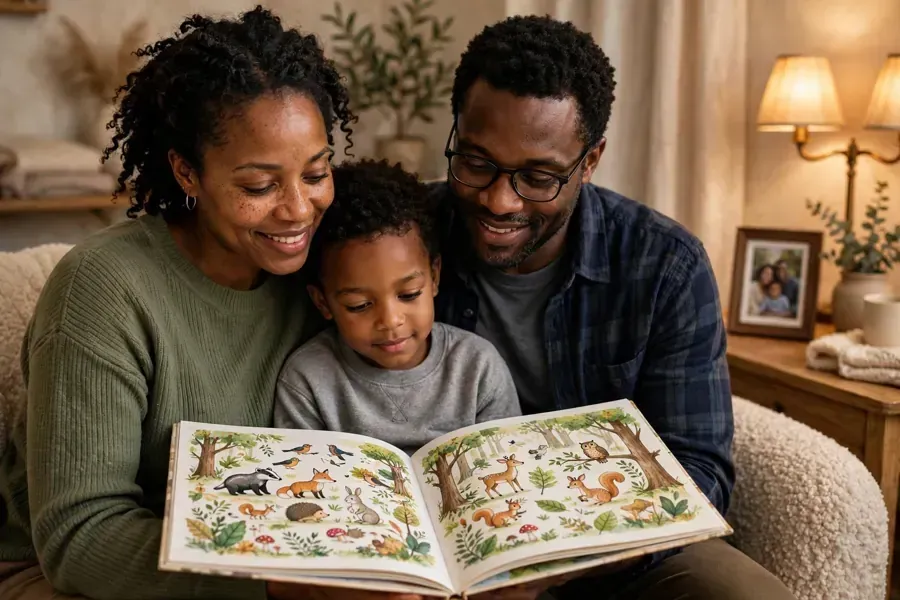
Families raising a child across a racial line will find the companion guide, Raising a Black Child in a White Family, waiting with the cultural half of this work, and every family will find its village in the institutions that raise us — because that, in the end, is what adoption at its best has always been in our community: a child, chosen on purpose, surrounded on purpose, told the truth with love, and raised — as the inset photograph of this article has it, a mother, a father and a child inside one storybook's lamplight — entirely, unmistakably at home.
Raising a Black Child in a White Family: A Gracious, Practical Guide
Hair, Skin, and the School Photograph: The Practical Half of Raising Mixed Children
Jack and Jill, The Links: The Institutions That Raise Us
The Blended House
Women of Distinction — Profile Collection
Real Cost Report — “Adoption Cost: Domestic vs International vs Foster Care Compared”
Legal Clarity — “How Long Does It Take to Finalize an Adoption?”
Lifetime Adoption — “Home Study Tips: How to Prepare and What to Expect”
AdoptionVA — “Understanding the Home Study for Foster Care and Adoption”
Creating a Family — “Open Adoption”
American Adoptions — “10 Things That Scientific Research Says About Open Adoption”
Lifetime Adoption — “Contact With Birth Parents After Adoption”
Presbyterian Children's Homes and Services — “Kinship Care”
NPR via North Country Public Radio — “Six Words: 'Black Babies Cost Less To Adopt'”
Questions & Answers
How do families pass down wealth and values?
For Black families, adoption is one of the oldest forms of choosing one another. This is the service guide: the black families adoption process, costs stated honestly, the kinship and foster routes, and open adoption — with the child's story kept theirs. It links to 5 stories and articles — open any card to read the full piece.
How do you involve children in family wealth planning?
For Black families, adoption is one of the oldest forms of choosing one another. This is the service guide: the black families adoption process, costs stated honestly, the kinship and foster routes, and open adoption — with the child's story kept theirs.
How do I read the full stories on Chosen: Black Adoption, Told Beautifully — Process, Costs, Kinship and Open Adoption?
Choose any card on this page. Each one opens a full page of its own — the complete story or article, with its sources linked.