
Harvard: The Legacy Question, Answered Honestly — Black Students, Legacy Admissions and a Visiting Guide
This Harvard Black students, legacy admissions and visiting guide opens the Ivy League run of our Education Series: the oldest university in America, the Black scholars who claimed it, and what legacy really means for our families now.
Let us begin this Harvard Black students, legacy admissions and visiting guide the way our families actually begin the conversation — around a table, with a brilliant child in the room and one honest question in the air: is that place for us, and if it is, how do we get in and what will it truly cost?
Harvard, founded in 1636 in Cambridge, Massachusetts, is the oldest institution of higher education in the United States, and its name still does what no other name in education does. But the Bourgeois Society reader does not trade in mystique; we trade in record.
So here is the record: the Black firsts who broke this ground, the institution Black scholars built inside it, the legacy preference examined without flinching — because some of our readers now hold the legacy — and the practical business of visiting and attending. Read it as what it is: an inheritance briefing.
The Ground: 1636, and the Long Road In
Harvard College admitted its first students in 1636. Its first Black undergraduate arrived more than two centuries later: reference accounts of the university’s history record that Beverly Garnett Williams became the first Black student formally matriculated at Harvard in 1847, and Richard Theodore Greener became the first Black graduate of Harvard College, receiving his A.B. in 1870.
Harvard’s own library, answering the question directly, gives families the fuller roll of firsts to carry with pride: the first Black degree recipients came in 1869 — Edwin C. J. Howard in Medicine, George L. Ruffin in Law and Robert T. Freeman in Dental, with Ruffin and Freeman the first Black graduates in their fields in the country — Greener’s College A.B. followed in 1870, and W. E. B. Du Bois took both the first A.M. and the first Ph.D. awarded to a Black scholar at Harvard, in 1895.
Sit with the shape of that. Before emancipation’s generation had finished its work, Black scholars were already taking Harvard degrees in medicine, law and dentistry — and then, in Du Bois, Harvard produced the mind that would define the century’s argument about Black life itself.
The Hutchins Center’s biography of its namesake’s inspiration traces the making of him: Du Bois enrolled at Harvard in 1888 as a junior, took his B.A. cum laude in 1890, his M.A. in 1891 and his Ph.D. in 1895, and published his doctoral thesis on the suppression of the African slave trade as the inaugural volume of the Harvard Historical Studies series.
That is not a footnote in Harvard’s history. It is one of its load-bearing walls.
Black Life There: Resistance, Community, and the House Du Bois Built
Honesty, briefly, as our register requires: the road was not smooth, and the university’s own Legacy of Slavery report says so in its scholars’ voices.
Ewart G. Guinier — who would later chair Harvard’s Department of Afro-American Studies at its founding in 1969 — arrived in 1929, turned down a full scholarship elsewhere to come, worked his way through, and still remembered his first freshman assembly decades later:
“There seemed to be a thousand people in the hall. I was the only Black.”— Ewart G. Guinier, recalled in Harvard’s Legacy of Slavery report, “Black Students at Harvard: A Legacy of Resistance”
What matters for our families is what that generation did with the isolation: they built.
Guinier’s department became, in time, the Hutchins Center for African and African American Research — established in 1975 as the W. E. B. Du Bois Research Institute, the oldest research centre of its kind — fellowships, archives, a gallery, and a standing intellectual home for the study of people of African descent at the summit of American scholarship.
The Crimson’s history of the era adds the growth line: in the wake of the Civil Rights Movement, Black enrolment at Harvard roughly doubled between the classes of 1972 and 1975, and a concentration in Afro-American Studies was first offered to the Class of 1972.
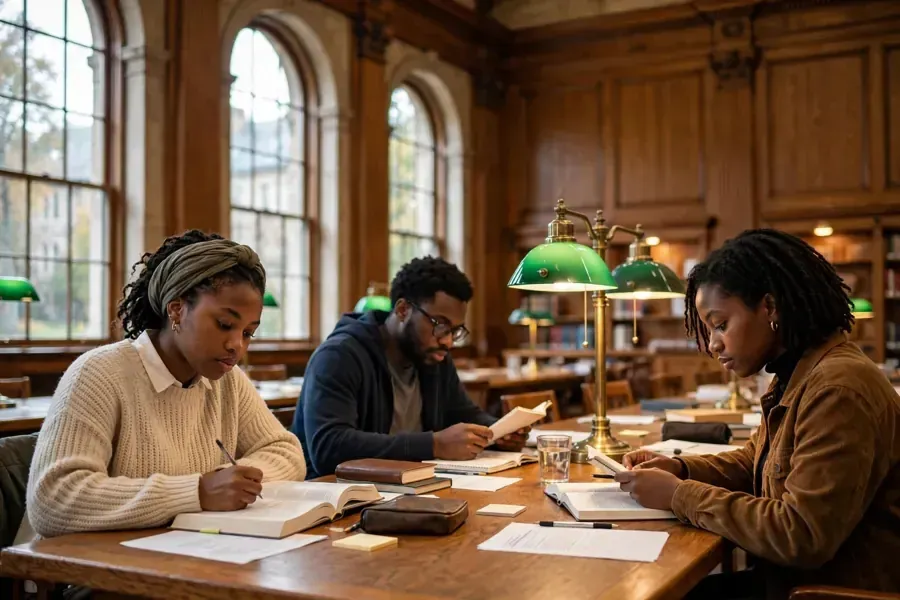
Today’s Black Harvard — the associations, the cultural calendar, the alumni network that receives each new class — descends directly from that building work. A student arriving now does not arrive, as Guinier did, alone in the hall. She arrives to an institution inside the institution, a century and a half deep, that has been expecting her.
The Alumni: From Du Bois to the White House, by Way of Harvard Law
The alumni roll Harvard’s own Law School published on election night 2008 remains the cleanest telling of the modern line: Barack Obama, class of 1991, arrived at Harvard Law after years as a community organiser in Chicago, was elected the first African-American president of the Harvard Law Review, and went on to the presidency of the United States; Michelle Obama, class of 1988, became the first Harvard Law alumna to serve as First Lady.
University-wide alumni references place them in the longer constellation — Barack Obama (J.D. 1991) and Michelle Obama (J.D. 1988) alongside figures such as astrophysicist and communicator Neil deGrasse Tyson (B.A. 1980) — and behind them stand the founders of the line itself: Du Bois; Monroe Trotter; Alain Locke, the first Black Rhodes Scholar and the dean of the Harlem Renaissance’s philosophy.
For a Bourgeois Society family, the point of this roll is not celebrity. It is calibration. Harvard’s Black alumni include a president, a first lady, the founder of modern Black scholarship and the architects of its cultural renaissance — which means a Black student at Harvard is never a guest in someone else’s story.
The story, in part, is hers.
The Legacy Question, Answered Honestly
Now the question in this entry’s title, answered with the documents rather than the folklore. Harvard does consider legacy status, and the measured size of the preference is unusually well documented because it was aired in court.
Admissions analysts summarising the records from the affirmative-action litigation report that legacy applicants were admitted at 33.6% — about 5.7 times the non-legacy rate — in the cycles examined, while Harvard’s overall admit rate sits in the low single digits; the same reporting notes the practice now sits under a federal civil-rights investigation and sustained public pressure, so families should confirm the policy in force for their own application year.
Two truths follow, and our readers deserve both. First, legacy is a tailwind among the already-qualified, never a ticket: a third of legacy applicants in those records were admitted, which means two-thirds — children of alumni, fully credentialed — were not.
Second, and this is the sentence this magazine exists to print: Black families are now on both sides of that door. The generations who entered Harvard from Guinier’s lone seat in the hall onward have produced alumni whose children apply as legacies themselves.
Whatever one thinks of the policy — and it is contested, factually and fairly, in the open — the inheritance framing is ours to state plainly: legacy at Harvard is no longer somebody else’s heirloom. Our families built a share of it, at full price, over 175 years.
Apply with the record excellent, the essays honest, and no illusions in either direction.
Life Inside: The Houses Where Harvard Is Actually Lived
Prospective families fixate on admission and skip the living — a mistake, because Harvard is lived in its Houses.
Visitor accounts of the residential system describe the rhythm every undergraduate knows: in the second semester of the first year, on Housing Day, each student receives a sophomore-year affiliation to one of Harvard’s twelve Houses, and each House holds between 350 and 500 students — a home of its own inside the university, with its own dining hall, common rooms, tutors and traditions.
The first year belongs to Harvard Yard, in the freshman dormitories around the Old Yard; the three years after belong to a House, most of them along or near the Charles River.
For a Black student, the practical meaning is double community from the start: a House small enough to know her name and cook her birthday into its calendar, inside a university large enough to hold the Hutchins Center, the Black alumni network and every professional school in America within walking distance. When you visit, do not only photograph the Yard.
Ask a student which House she prays for on Housing Day, and listen to how she answers. That answer — part joke, part genuine longing — is Harvard’s culture telling on itself, and it is the culture your child would actually be joining.
Visiting: Harvard Yard, Done Properly
Visit Cambridge as a prospective family, not as tourists with a checklist.
Visitor guides summarising the university’s own offerings describe the shape of the day: official student-led historical tours of Harvard are offered to the public free of charge, campus visits for prospective students pair an information session and question time with admissions staff and students with a student-led tour, and visitors may also walk the grounds freely or use the university’s app for a self-guided route.
Tour providers who work the Yard daily add what to look for once you are inside the gates: Harvard Yard itself, the Charles River, and the residential House system — the close communities within the larger university where undergraduate life is actually lived — with roughly 22,000 students across the College and the graduate and professional schools.
Our counsel: take the official tour in the morning, then spend the afternoon unscripted. Sit in the Yard and watch who your child watches. Walk to the Hutchins Center’s gallery.
Eat in Harvard Square, where the bookshops alone will tell a bookish teenager everything she needs to know. Stay across the river in Boston or in Cambridge itself if you can — the city is a co-teacher here, and a family deciding on four years should hear both of its voices, the seminar room and the street.
Attending: Selectivity and the Real Price, With the Sources Named
The numbers, attributed as always.
On selectivity, published figures agree in shape and differ in decimal: analysts of Harvard’s own data describe an acceptance rate in the region of four to five percent in recent cycles, with admitted classes drawn from tens of thousands of applicants worldwide — a reach for every applicant, legacies included, and a reason to build a list, never a single-name altar.
On cost, the headline and the truth diverge so widely at Harvard that families must hold both.
Cost guides working from Harvard’s own Common Data Set reporting describe a billed cost of attendance above $82,000 a year at the sticker level — and, in the same reporting, a need-blind admissions process, aid meeting full demonstrated need, more than half of students receiving financial aid with an average grant above $59,000, and families earning below $85,000 a year paying nothing.
Read that twice. For a great many Bourgeois Society households — including affluent ones with real assets and ordinary incomes — Harvard’s net price can undercut a flagship public university’s. The correct family procedure is unglamorous and decisive: run Harvard’s own net-price calculator with your real figures before anyone falls in love or despairs.
Then decide with the record, the fit and the arithmetic all on the table — which is, after all, exactly how the people in this article got here. The Ivy run continues next door in spirit and down the road in fact, at Yale.
Yale: The Residential College Life, in Full Colour
Tennessee State University: The Land-Grant Aristocrats
Howard University: The Mecca
Choosing the School
The First Gate: Preschool
Raising Heirs, Not Dependents
Harvard Library, Ask a Librarian — “Who Was the First African American to Graduate from Harvard?”
Hutchins Center, Harvard — “W. E. B. Du Bois”
Radcliffe Institute / Harvard Legacy of Slavery Report — “Black Students at Harvard: A Legacy of Resistance”
The Harvard Crimson — “‘The White Man’s College’: How Antisemitism Shaped Harvard’s Legacy Admissions”
Oriel Admissions — “Harvard Legacy Admissions: How Much It Helps”
Harvard Law School — “Barack Obama ’91 Will Be the 44th President of the United States”
uhomes — “Harvard University Notable Alumni”
SpainExchange, summarising Harvard Visitor Center offerings — “Can You Visit Harvard as a Tourist?”
SchoolScoops — “Harvard University Tours”
College Council — “How Much Does Harvard Cost? Tuition, Living Expenses, Scholarships, and Financial Aid”
SpainExchange, summarising Harvard visitor guidance — “Can You Walk on Harvard Campus?”
Questions & Answers
How do families pass down wealth and values?
This Harvard Black students, legacy admissions and visiting guide opens the Ivy League run of our Education Series: the oldest university in America, the Black scholars who claimed it, and what legacy really means for our families now. It links to 7 stories and articles — open any card to read the full piece.
How do you involve children in family wealth planning?
This Harvard Black students, legacy admissions and visiting guide opens the Ivy League run of our Education Series: the oldest university in America, the Black scholars who claimed it, and what legacy really means for our families now.
How do I read the full stories on Harvard: The Legacy Question, Answered Honestly — Black Students, Legacy Admissions and a…?
Choose any card on this page. Each one opens a full page of its own — the complete story or article, with its sources linked.