
Dartmouth Black Students, Alumni and a Visiting Guide: The Mountain School and Its Black Lineage
The smallest of the Ivies keeps the longest memory. This Dartmouth black students alumni visiting guide walks the Green in Hanover — the 1769 charter, a Black lineage that begins in 1828, the Shabazz Center, and what it honestly takes to get in and to belong.
Every family that drives up the Connecticut River valley to Hanover asks the same question in a different way: will our child be at home here?
Our Dartmouth black students alumni visiting guide is built to answer it properly — with the history first, because at Dartmouth the history is unusually long, and with the practical things second: the tour, the town, the money, and the community your student will actually find on the ground.
Dartmouth is the mountain school of the Ivy League, set in a small New Hampshire town where the college is the town, and that intimacy cuts both ways. Everybody knows everybody. For the right student, that is the whole point.
A Charter Written for Native Youth
Dartmouth's founding story is unlike any other Ivy's, and a family should know it whole. The Rev. Eleazar Wheelock, a Congregational minister from Connecticut, founded Moor's Indian Charity School in 1754 to educate Native young people, and the Mohegan minister Samson Occom — Wheelock's own student — helped raise the funds in Britain that made a college possible.
On December 13, 1769, a royal charter in the name of King George III established the college "for the education and instruction of youth of the Indian tribes in this land" — in reading, writing and all parts of learning — "and also of English youth and any others."
Named for William Legge, the second Earl of Dartmouth, the college is the nation's ninth oldest and the last founded under colonial rule; it granted its first degrees in 1771.
Honesty is part of this magazine's standard, so two facts belong in the same paragraph. Dartmouth's own admissions history page records that Wheelock built the college in part with the uncompensated labour of enslaved men and women of African descent, and that later funding came from sources tied to the Atlantic slave trade.
It also records that the founding vision centred on Native students later gave way to an exclusive focus on young men of European descent.
The college tells this story about itself, plainly, on its own site — and a family visiting Hanover should hear it in that spirit: not as an indictment to carry around the Green, but as the ground truth of an old institution that is still, visibly, working out what its charter promised.
The hopeful thread is also the college's own.
That same Dartmouth page notes that students of African descent were admitted continuously beginning in 1824, decades before the other Ivies followed, that Dartmouth revived its founding commitment to Native American students in 1970 — its Indigenous community now draws students from more than 70 tribal nations — and that full coeducation began in 1972.
Black life at Dartmouth, in other words, is not a recent addition to the place. It is one of the oldest stories the college has.
The Black Lineage, Name by Name
The lineage begins, remarkably, before emancipation. The Black Alumni of Dartmouth Association's historical exhibit records Edward Mitchell of the Class of 1828 as the first Black graduate of the Ivy League, a Baptist clergyman.
Behind and around him stands a whole antebellum generation that most visitors have never heard named: Samuel Ford McGill, who took his medical degree in 1839; Thomas Paul Jr. of the Class of 1841, a Garrison abolitionist who became headmaster of Boston's African Free School; and Augustus Washington of the Class of 1847, who learned the daguerreotype camera on a winter break from Dartmouth and went on to make the famous portrait of John Brown before emigrating to Liberia, where his photographs of Liberian citizens are preserved today at the National Portrait Gallery.
These were not tokens in a brochure. They were men who carried a Dartmouth education into abolition, medicine, teaching and nation-building while slavery still stood.
The line continues into the modern professions.
Ernest Everett Just of the Class of 1907 graduated magna cum laude and Phi Beta Kappa — the exhibit notes, with quiet understatement, that he alone graduated with that honour yet did not deliver a commencement address — and became one of the most eminent biologists of his era, a founder-figure of modern cell biology whose research prefigured epigenetics, based for much of his career at Howard University.
Beside him in that same exhibit stands James Major Colson Jr. of the Class of 1883, who graduated with Phi Beta Kappa honours, joined the faculty of the institute that became Virginia Union University, and was recommended by W. E. B. Du Bois to the American Negro Academy.
The pattern is worth naming for our readers: generation after generation, Dartmouth's Black graduates have gone out and built institutions of their own — schools, practices, movements. That is the inheritance a student joins here.
And the contemporary names need no introduction at the family table.
Dartmouth's own admissions writers point to Shonda Rhimes of the Class of 1991, who majored in English literature with creative writing, was active in the Black Underground Theatre and Arts Association, and now sits on the college's Board of Trustees — the creator of Grey's Anatomy, Scandal and Bridgerton's Shondaland, formed in Hanover.
Mindy Kaling of the Class of 2001, who switched to theatre and sang with the Rockapellas, is named in the same breath. When your daughter asks whether a place like this produces people like her, the answer is on the college's own page.
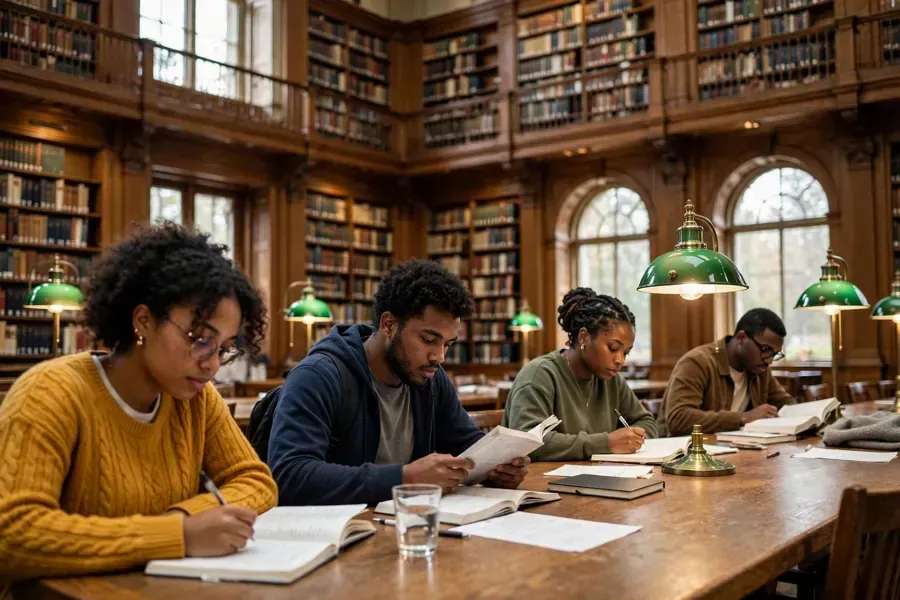
Black Life on the Ground: Shabazz, the AAm, the Studies
What did Black students build for themselves once they arrived in real numbers? Dartmouth's own course exhibits tell the story with affection. In the late 1960s, Black students asked for a house of their own — and the college said yes.
The El Hajj Malik El Shabazz Center, named for Malcolm X and known to generations of students simply as the AAm, after the Afro-American Society, became and remains today the Shabazz Center for Intellectual Inquiry, a living-learning community for Black students — the place students crossed through several times a day, where the cookouts, dances, speakers and card games happened, and where, as one alumna remembered, when the power went out mid-game, somebody simply lit candles and the game went on.
The same student generation won a Black Studies program, established in 1970, which brought increasing numbers of Black faculty to Hanover.
"The Black community was very close...Nobody wanted anyone to fail."— Wanda Powell, Class of 1973, in Dartmouth's Black Lives course exhibit
Hold that sentence; it is the most useful sentence in this guide. Dartmouth's Black community is small — small enough that its members have historically known one another by name — and the tradition its alumni describe is one of deliberate mutual carrying: study groups, honest counsel, a house with candles in the drawer.
The Black Alumni of Dartmouth Association, whose historical exhibit we cite throughout this article, is the alumni body that keeps that carrying going after graduation, and the college's African and African American studies offerings give the community its intellectual home. For a student who wants a big anonymous city, Hanover will feel close.
For a student who wants to be known, it is hard to beat.
The Distinction: A College, on Purpose
Dartmouth's honest distinction is focus.
It is a research university with four graduate and professional schools — Geisel medicine, Thayer engineering, Tuck business, and the Guarini graduate school — but it calls itself a college and keeps the undergraduate at the centre: roughly four and a half thousand undergraduates, classes taught on a quarter calendar, and a student-faculty ratio that published summaries of the college's Common Data Set put at seven to one.
The calendar quirk every applicant must understand is the D-Plan: four ten-week terms a year, including a summer term — students are in residence for the summer after sophomore year and may take other terms away for internships, research or study abroad.
It makes Dartmouth students unusually available for off-season internships, and it means the community reassembles in new combinations every ten weeks.
Add the outdoors — the Appalachian Trail runs through the town, the Dartmouth Outing Club is the oldest and largest collegiate outing organisation in the country, and the college owns a skiway — and you have the mountain school's real curriculum: scholarship, weather, and each other.
Attending: The Numbers, Attributed
Now the ledger, with every figure carrying its source, because this magazine does not invent numbers. Admissions guidance published by Shemmassian Consulting puts Dartmouth's undergraduate population at 4,447 in the fall of 2023, and reports the Class of 2028 cycle plainly: 31,656 applications, 1,710 acceptances — an acceptance rate of 5.4 percent.
The same source puts the full cost of attendance for 2025–26 at $95,490, tuition, room, board and fees together.
Read the next sentence twice, because it changes the arithmetic for our families: Dartmouth promises to meet 100 percent of demonstrated need, and Shemmassian reports that students whose families earn under $125,000 a year typically have their entire cost of attendance covered without loans, with the average financial aid award among the Class of 2028 at $69,152.
The sticker is a mountain; the net price, for most families who qualify, is a different and much smaller hill. Run the college's own net-price calculator before you rule anything in or out.
On composition: summaries of Dartmouth's 2024–25 Common Data Set put Black or African American students at about seven percent of undergraduates. Figures move from cycle to cycle and by the population counted, so treat any single percentage as a snapshot with a source attached, not a promise.
What does not move is the structure: a Shabazz Center that has anchored Black residential and intellectual life for half a century, an alumni association organised around this exact community, and a graduating tradition of Black students building institutions. Judge the place by those, and by what you see on the ground when you visit.
Visiting Hanover
Go in term time, on a weekday, when the Green is doing its ordinary work — that is the visit that tells the truth.
Book the admissions tour and information session, then give yourselves unscripted hours: sit in the library reading room, eat where students eat, and walk the full length of the Green to feel the scale — everything at Dartmouth is a short walk, which is precisely its charm and its demand.
Family-visit guidance collected by SchoolScoops notes that rooms nearest campus book first and prices climb sharply around move-in, family weekend, graduation and home football weekends, so reserve early; the same guidance names the usual family bases — the Hanover Inn, the Six South Street Hotel and the Norwich Inn across the river in Vermont.
Dartmouth's own departmental lodging lists describe the Hanover Inn, on the Green itself, as the college's own hotel — there is no closer pillow to the life you are inspecting. If the inn is full, Lebanon, a few miles south, is the practical overflow.
And if you cannot travel, the alumni office's visiting page offers virtual tours led by admissions guides — a sensible first look before you commit to the valley.
One last piece of counsel, the kind this magazine exists to give. Dartmouth will ask your child to love a small place completely — its winters, its woods, its ten-week sprints, its everybody-knows-everybody Green.
The Black students who have thrived there, from Edward Mitchell in 1828 to the Shabazz generation to Shonda Rhimes, share a trait worth looking for in your own child: they did not wait for the institution to make room. They made room — a school, a science, a society, a television empire — and then held the door.
If that sentence sounds like your family, Hanover deserves its weekend.
Cornell: Any Person, Any Study — the Founding Ground
Penn: Wharton, and the City Around It
Howard University: The Mecca
Choosing the School
The First Gate: Preschool
Raising Heirs, Not Dependents
Dartmouth Admissions — "Dartmouth Values"
Wikipedia — "Dartmouth College" (charter of December 13, 1769)
Black Alumni of Dartmouth Association — Historical Black Alumni, Antebellum
Black Alumni of Dartmouth Association — Historical Black Alumni (Just, Colson)
Black Alumni of Dartmouth Association — Historical Black Alumni (Paul, Washington)
Dartmouth Library Course Exhibits — "Building the Black Community"
Dartmouth Admissions — "Notable Dartmouth Alumni"
Shemmassian Consulting — "How to Get Into Dartmouth"
Road2College — "Dartmouth Common Data Set"
Marrs College Admission Advisors — "Dartmouth College"
SchoolScoops — "Dartmouth College Tours"
Questions & Answers
How do families pass down wealth and values?
The smallest of the Ivies keeps the longest memory. This Dartmouth black students alumni visiting guide walks the Green in Hanover — the 1769 charter, a Black lineage that begins in 1828, the Shabazz Center, and what it honestly takes to get in and to belong. It links to 7 stories and articles — open any card to read the full piece.
How do you involve children in family wealth planning?
The smallest of the Ivies keeps the longest memory. This Dartmouth black students alumni visiting guide walks the Green in Hanover — the 1769 charter, a Black lineage that begins in 1828, the Shabazz Center, and what it honestly takes to get in and to belong.
How do I read the full stories on Dartmouth Black Students, Alumni and a Visiting Guide: The Mountain School and Its Black…?
Choose any card on this page. Each one opens a full page of its own — the complete story or article, with its sources linked.