
The Anniversary, the Christening, the Homecoming: Marking Milestones Properly
Christening etiquette, godparents and gifts, and the wider art of milestone celebrations — the mid-size occasions of family life, done at full standard, with guest lists, intention, and photography that becomes the family archive.
Between the wedding and the reunion sits a whole calendar of occasions that families remember longest precisely because nobody thought they needed a production team: the christening, the silver anniversary, the homecoming weekend.
This guide to christening etiquette, godparents and gifts — and to milestone celebrations generally — starts from a simple conviction: the mid-size milestone deserves the same seriousness as the large one, scaled honestly. Done properly, these are not smaller parties.
They are the days on which a family tells itself who it is: who holds the baby, who is asked to stand for her, who has been married long enough to be toasted in silver, who comes home. Mark them carelessly and they blur.
Mark them properly and they become the photographs on the wall, the stories at every later table, the archive your grandchildren will inherit.
Here is how the christening runs, how godparents are chosen with intention, what gifts actually last, how an anniversary earns its scale, how a homecoming is hosted rather than merely attended — and how the photography turns one good day into a permanent family possession.
The Christening: The Order of the Day
A christening has two movements — the service and the gathering after it — and the second exists to honour the first, never to compete with it.
Debrett's, the British etiquette authority, sets the reception's shape with characteristic calm: parties after the service may include a lunch, possibly a buffet, or tea after an afternoon ceremony, kept fairly informal and not all that long, because the baby's routine needs to be considered — and held near the church, at a hotel or a private house, so nobody's celebration involves a cross-town expedition with a newborn.
Follow that logic and the day designs itself: a morning service, a lunch that begins while the baby is still charming, champagne and wine alongside tea, coffee and soft drinks, a christening cake — tradition, Debrett's notes, once saved the top layer of the wedding cake to be re-iced for exactly this purpose — and an early, graceful close.
The guest list is the family's inner architecture: grandparents, godparents, the closest kin and the friends who will actually be in this child's life. A christening is not a networking event. Everyone in the room should be someone the child will one day be glad was there.
Dress the day one notch below a wedding and one above Sunday ordinary — which, for a family that dresses across generations, is its own small art; our companion piece on dressing the generations takes up exactly that choreography.
Have somewhere beautiful to receive presents, since guests will bring them whether or not they were expected to, and do not open them in the room — the day belongs to the baby, not the inventory. A godparent may toast the child; long speeches are unusual and unnecessary.
And send the thank-you letters promptly — Debrett's is firm on the point, and so are we. The christening photograph in our hero image — grandmother holding the baby on the church steps, three generations in their best — is not an accident of the day. It is the day's whole purpose, made visible.
Plan for it: steps, light, and five unhurried minutes before lunch.
Godparents, Chosen With Intention
Of every decision inside a christening, the godparents are the one that cannot be revised — which is why the choice deserves more than sentiment. Church guidance is usefully blunt about what the role actually is.
The Diocese of Wheeling-Charleston's etiquette notes recall the question put to godparents at the font — whether they are prepared to assist the parents in raising the child in the practice of the faith — and advise parents to choose the person whose own life best models that faith and who can offer real assistance, rather than the name that flatters the family's social register.
The formal requirements in Catholic practice, as the same guidance summarises the Code of Canon Law, ask that a sponsor be appointed with the intention of fulfilling the role, be at least sixteen, and be a confirmed Catholic who has received the Eucharist and lives a life of faith befitting the office — and not be the child's own parent.
Denominations differ in their particulars, and your own clergy are the authority for your family's service; the universal point survives every variation: a godparent is a working appointment, not an honorary title.
Choose, then, for character and constancy: the person who shows up, whose counsel you would actually take, whose example you would be proud for your child to absorb, and who will still be standing close in twenty years.
Ask in person — over coffee or dinner, never by group message — and say plainly what the role means in your family: presence at the milestones, guidance as the child grows, a door that is always open. Name one honest thing more: godparenthood and legal guardianship are different instruments.
If you also intend your child's godparents to raise her should the worst happen, that wish belongs in your will, discussed separately and written down properly; assuming everyone understands is how good intentions dissolve.
Give the person you ask genuine room to consider, and receive a hesitant answer with grace — a reluctant godparent helps no one, and the friendship matters more than the ceremony. When the answer is yes, mark it: a letter from you, kept, saying why you chose them. Children grow up and read such letters.
Choose people worthy of the reading.
Gifts That Become Keepsakes
Christening gifts follow an old and sensible grammar: the closer the relationship, the more permanent the gift.
Etiquette guidance for guests is reassuringly relaxed — an invitation itself signals that the family counts you close, and a gift is an appropriate way to mark the occasion, though a guest who has already given a welcome gift for the baby is not obliged to give again.
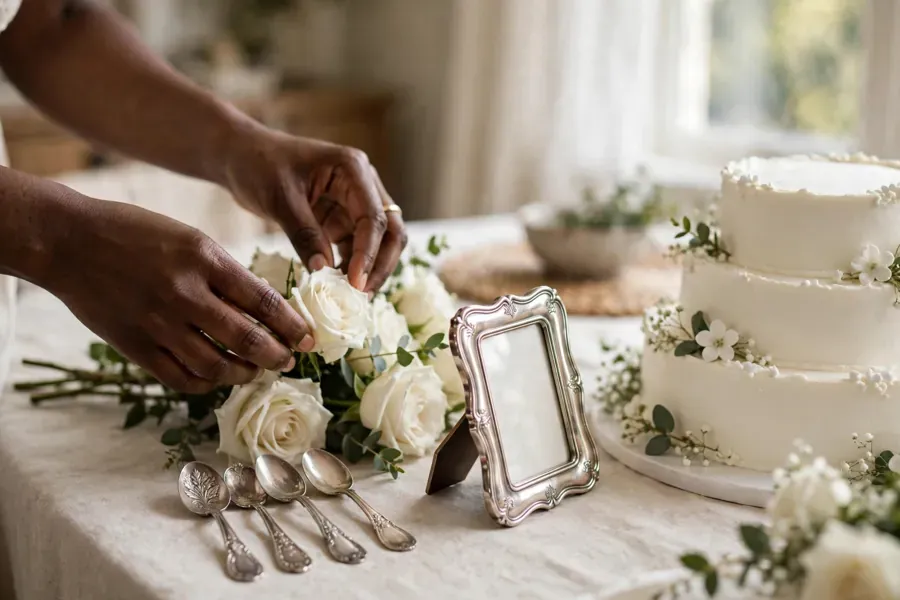
For godparents, the expectation is real and the tradition is specific: traditional godparent gifts include silver spoons, eating utensils, and plates and bowls — keepsakes that can be engraved with the child's name, the dates of birth and christening, and a special message from the godparent.
Engraving is the whole point: an unmarked object is a purchase, but an engraved one is a document.
The same guidance notes the graceful return current — it is appropriate for the parents to give the godparents a token of gratitude for taking on the role — a framed photograph from the day serves beautifully, and costs the family nothing but thought.
Modern guides widen the keepsake shelf without breaking its logic.
A christening guide from Special Moment lists the enduring categories: a religious item such as a Bible, a rosary or a cross; a personalised gift like jewellery or a photo frame; or a financial contribution towards the child's education or future, in the form of a savings bond, a savings-account contribution or an education fund.
That last category deserves emphasis, because it is the godparent gift most aligned with this magazine's philosophy: silver for the shelf, and a start on the child's future in the same envelope. What to avoid is equally clear across the etiquette sources — toys and everyday clothing undersell the day.
A christening gift should be the kind of thing that is still in the family, with its story attached, when the baby is christening babies of her own. Buy for that horizon and you will not go wrong.
The Anniversary, at Its Proper Scale
The anniversary is the milestone a couple gives themselves, and its governing principle is proportion: the celebration should match the weight of the years.
Party planners at Joy put the calibration plainly: the best anniversary party matches the milestone year — a first anniversary calls for something intimate and personal, while a twenty-fifth or fiftieth warrants a full celebration with family and friends. In between, let the traditional materials direct the theme — they exist for exactly this purpose.
The anniversary-gift histories trace the custom to medieval Germany, where wives received silver wreaths on their twenty-fifth anniversary and gold wreaths on their fiftieth, before the Victorians expanded the list and a comprehensive year-by-year version was published in 1937.
The ladder still reads beautifully as a party brief: paper at one year, wood at five, crystal at fifteen, china at twenty, silver at twenty-five, pearl at thirty, ruby at forty, gold at fifty, diamond at sixty. Build the room, the menu and the gift around the material and the evening acquires a coherence guests feel without being told.
At the full-scale end — silver, gold — an anniversary party borrows the wedding's machinery at half its anxiety: a proper invitation, a room that flatters candlelight, the original attendants at the top table if life has kept them close, photographs from the wedding day displayed where the grandchildren can interrogate them, and a renewal of vows for couples who want the day to say something, not merely serve something.
Keep the speeches short and in the family. Commission the cake in the year's material colours; put the couple's song in a musician's hands rather than a playlist's shuffle.
And do the arithmetic of gratitude that distinguishes this occasion from every other: the guest list of a fiftieth anniversary is a map of a shared life — the friends who were at the wedding, the children who were its result, the community it built. Invite the map, all of it, while it can still come.
The Homecoming: Hosting the Return
The third milestone in our title runs on a different engine: nobody hosts a homecoming alone, because a homecoming is a community returning to itself.
The HBCU tradition is the grand American example — described in iHeart's history of the weekend as a celebration of the Black experience, pride and fellowship — an autumn family reunion with buffets, sporting events, parades and step shows, at which generations of alumni come back to embrace the institution and one another.
HBCU historian Marybeth Gasman, quoted in the same account, captures why the weekend lands so deep:
“HBCU homecomings are incredibly special — big, showy, rich, and warm in terms of the way they make alumni feel.”— Marybeth Gasman, HBCU historian, via iHeart
The family that takes homecoming seriously treats its own house as part of the campus: the Friday-night gathering for the friends who flew in, beds and sofas assigned like a small hotel, a Saturday tailgate with the family's dishes done at full standard, and a Sunday table before the departures.
The same discipline serves the smaller homecomings of ordinary life — the daughter back from her first semester, the son returned from a posting abroad, the elder brought home to the house she made. Mark the return itself: their favourite meal, the photograph at the door, the room made ready before they arrive rather than after.
A homecoming is the milestone with no ceremony attached, which is precisely why it needs one invented. Families that invent it find their members inventing reasons to come home.
Photography: The Archive Is the Point
Every occasion in this article shares one vendor, and it is the one families most often leave to chance: the photographer. A milestone happens once; the photographs are the form in which it survives, which makes the hiring decision an archival one.
Portrait professionals give the selection method in order: evaluate experience and expertise — especially with children, whose natural expressions require patience and skill — assess communication and rapport in a consultation before booking, and discuss logistics and pricing in full, including location, timing and the number of images you will receive.
Add the milestone-specific briefs: give the photographer a written list of the groupings that must not be missed (all four generations together; the godparents with the child; the anniversary couple alone, in the pose of their wedding photograph), agree where the formal portraits will happen and at what hour the light is kind, and settle delivery, printing rights and file formats in the contract — the questions professional bodies advise asking before any family session, not after it.
Then finish the archival job yourselves, because a gallery link is not an archive. Print the best frames — an album for the couple or the parents, framed portraits for the grandparents, the christening portrait where the child will grow up seeing it.
Store the digital masters in two places, named and dated, with a simple index of who is in them; the names are the part future generations cannot reconstruct. This is the thread that runs through the anniversary, the christening and the homecoming alike: a milestone is an event, but a marked milestone is an inheritance.
Guest lists drawn with intention, godparents chosen for a lifetime, gifts engraved for a shelf that outlasts us, and photographs kept like documents — that is the whole craft. The rest is lunch, and lunch, done properly, takes care of itself.
For the reply that starts it all, see our companion piece on the RSVP as a contract — milestones run on answers given promptly and meant.
The RSVP Is a Contract
Dressing the Generations
Funerals, Done Right
Women of Distinction — Profile Collection
Our Everyday Life — “Gift Etiquette for a Catholic Christening”
Special Moment — “Guide to Christenings”
Diocese of Wheeling-Charleston — “Etiquette: Choosing a Godparent”
Debrett's — “Rites of Passage: Christenings”
Manly Bands — “Wedding Anniversary Gifts by Year: Traditional, Modern & Ring Ideas”
Joy — “Wedding Anniversary Party Ideas: 35 Ways to Celebrate Every Milestone”
iHeart — “HBCU Homecoming: The History, Impact & What It Means to the Black Community”
Touched by Light Photography — “How to Choose the Right Photographer for Your Family Portraits”
Questions & Answers
How do families pass down wealth and values?
Christening etiquette, godparents and gifts, and the wider art of milestone celebrations — the mid-size occasions of family life, done at full standard, with guest lists, intention, and photography that becomes the family archive. It links to 4 stories and articles — open any card to read the full piece.
How do you involve children in family wealth planning?
Christening etiquette, godparents and gifts, and the wider art of milestone celebrations — the mid-size occasions of family life, done at full standard, with guest lists, intention, and photography that becomes the family archive.
How do I read the full stories on The Anniversary, the Christening, the Homecoming: Marking Milestones Properly?
Choose any card on this page. Each one opens a full page of its own — the complete story or article, with its sources linked.