
Family Reunions at the Level They Deserve: How to Plan a Luxury Family Reunion, Resort Heritage and All
How to plan a luxury family reunion at a resort — a heritage itinerary, the talent show produced, elders honoured on camera forever, and the photograph on the steps.
Some families have a reunion. Others produce one — and the difference is not money, it is intention.
Learning how to plan a luxury family reunion, resort heritage and all, means honouring the deepest tradition in Black family life with the production standard it deserves: a committee with real officers, a place worthy of the gathering, the elders recorded on camera while their voices are still here to record, and a photograph on the steps that great-grandchildren will one day hold.
The cookout is not being abandoned. It is being promoted.
Why This Tradition Runs Deep
No reunion tradition on earth carries the history this one does.
As the AP African American Studies materials on family reunions record, the gatherings began after emancipation, when relatives separated by the domestic slave trade searched for one another through newspapers, word of mouth and the Freedmen's Bureau, which operated from 1865 to 1872 — and the searches and gatherings were driven by Black families themselves.
The Randolph Report's history of the tradition adds the archival detail: under columns titled "Information Wanted" and "Lost Friends," thousands of advertisements were placed naming the lost, and preservation projects such as Last Seen: Finding Family After Slavery have recorded over 5,000 of those primary-source ads.
The Great Migration scattered families across the country and made summer the season of return; in 1986, Dr. Dorothy Height and the National Council of Negro Women established the National Black Family Reunion to reinforce the historic strengths and traditional values of the Black family. That is the inheritance.
A family that books a resort for its reunion is not leaving that story behind — it is giving the story better rooms.
The Committee and the Calendar
Upgrade the structure before you upgrade anything else. Encyclopaedia.com's account of the American family reunion describes how, as reunions grew, families took to holding a meeting near the close of each gathering to elect officers for the next, entrusting a family historian with recording the event and keeping the genealogy current, and appointing a fundraising committee to carry the costs.
Keep all of that — it is the tradition's own governance — and give it a producer's calendar.
Planning guidance from reunion planning specialists runs on the same spine: form the committee and set the budget nine to twelve months out; build the guest list and communications six to eight months out; book vendors and caterers by four to five; send formal invitations with an RSVP deadline at two to three; confirm headcounts a month ahead.
The National Family Reunion Institute is equally practical about money: registration fees can carry the organising costs, and families offset them with fundraising through the year and mementos sold at the reunion itself. One account, clearly kept, published to the family. Nothing corrodes a reunion like money handled in whispers.
The Season and the Rhythm
Reunions have a season, and it chose itself long ago. Encyclopaedia.com notes that reunions are usually held in June, July or August — to correspond with family vacations and good weather — and run anywhere from one to three days.
The Great Migration set the deeper pattern, as the Randolph Report's history tells it: as families spread from the rural South to the urban North and beyond, summer became the designated season to travel back home. The upgraded reunion keeps the season and professionalises the rhythm around it.
Three days is the working standard at resort level — arrival and the welcome evening, the full day of programme, the photograph and the closing meal — long enough for the cousins to find each other properly, short enough that nobody's leave is consumed.
Families large enough to draw from several regions rotate the ground: the ancestral hometown in one cycle, a resort within reach of the largest branch in the next, so the travelling — and the spending — is shared across the family over the years, and every branch gets a reunion it can drive to.
Whatever the rhythm, it is announced at the closing meal and held. A reunion that drifts a year "until things settle" discovers that things never settle; the calendar is the commitment.
Choosing the Ground
The venue decision is really one question, and the Ensemble Travel reunion guide puts it exactly: do you want to be very close together, or are you all happy to opt into select activities, like a signature meal or two? Answer honestly and the format chooses itself.
A full buyout of a small resort or a great villa puts everyone under one roofline — the elders' veranda, the children's pool, one long table for the signature dinner — and suits families who gather to be together.
A room block at a full-service resort suits the clan that wants its own doors to close at night, with the reunion convening at set hours. An all-inclusive or a cruise carries the logistics for you.
The Top Villas' reunion guide makes the villa case well: a spacious private house gives the family the run of the place, with a pre-booked concierge handling transfers and groceries, a private chef for one swanky evening in, and the pool and firepit doing the evening work.
Whichever ground you choose, negotiate it as what it is — a multi-room, multi-day, multi-year customer — and put accessibility first in the site inspection: step-free routes to the elders' rooms, shade at the gathering lawn, quiet rooms near the noise for the babies.
The Heritage Itinerary
A reunion at this level carries one itinerary inside the other. The outer one is pleasure: the signature dinner, the boat, the golf, the spa morning for the aunties. The inner one is the reason — heritage, deliberately programmed.
Travel to the ancestral place if the family has one within reach: the hometown, the church, the ground. The Ensemble guide suggests the pairings that work for a broad age range — walking tours with a historian, cultural performances, learning to cook a traditional meal with a local family — alongside the archival visits the family's genealogists will want.
It also gives the planner's benediction every committee should have framed:
You can't please everybody completely, but you can please everyone just a little bit.— Reunion planner Hawkraven, via Ensemble Travel
Build the days the way the multi-generational travel specialists advise: one shared experience, one optional activity, one shared meal, and protected free time — because an itinerary where everyone must do everything together is the fastest known way to make a hundred relatives tired of one another. Downtime is not a gap in the programme.
For grandparents, new parents and teenagers alike, it is the programme's mercy.
The Talent Show, Produced
Every family has the talent show; the upgraded reunion simply produces it like it matters.
A real stage or a proper cleared space, a sound system that reaches the back row, a running order printed in the programme, a host from the family with the timing of a professional, and categories that let every generation enter — the elders' line dance, the children's act, the cousins' band that has been promising since the last reunion.
The National Family Reunion Institute's activity lists run from fashion shows and music to workshops led by family members on everything from investing to parenting — use them; the reunion is also the family's own conference. Record all of it. The talent show footage of one decade is the treasure of the next.
Elders on Camera, Forever
If the budget holds one luxury above all others, it is this: the archive.
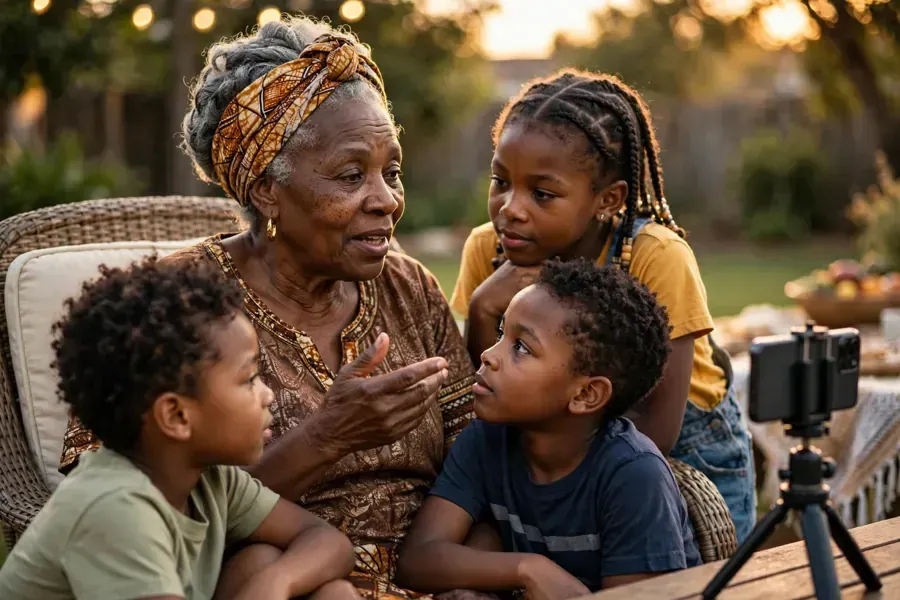
EventCortex's family reunion planning guide calls oral-history capture the single most underrated element of the modern reunion, and prescribes the method — an interview corner with two chairs, good lighting and a phone on a tripod, elders rotating through fifteen-minute recorded interviews: how they met their spouse, their earliest family memory, the most important lesson a parent taught them, the biggest historical event they lived through, and one story they have never told before.
Edit it into a family-history film and send it to every attendee. Pair it with a professional photographer booked for the peak hours, with a shot list in priority order: the full group photograph first, before anyone leaves; then branch by branch; then the generations — all the elders together, all the great-grandchildren together; candids throughout.
The Institute's guidance agrees on the principle: interview the elders and tape what they say, and videotape the activities, for the sake of future generations. Voices are the one reunion asset that cannot be rebooked.
The Photograph on the Steps
Then the image this whole production exists to make: the family arranged on the steps, elders seated in front in white, every branch accounted for, taken between frames while everyone is still laughing.
Schedule it like a ceremony — announced from the first day, timed to the late light, with a caller who knows every name and a wrangler for the children. Print it large for the elders before the year turns.
It becomes, instantly, the family's portrait of record — the one on the wall that tells the youngest child exactly where in the arrangement they belong.
The Money, Made Fair
A reunion at this level costs real money, and the committee's hardest production task is keeping it from costing the family its breadth.
The answer the tradition itself supplies is structure: a registration fee set early and published plainly, fundraising through the year for the common costs — the venue, the signature dinner, the photographer, the archive — and rooms carried by each household at the level it can hold.
Build a quiet access fund into the budget, administered by two officers and never discussed in particulars, so that the elder on a pension and the cousin between jobs are in the photograph without anyone's dignity being itemised.
The Institute's guidance treats the mechanics as ordinary — deposits for sites and souvenirs planned ahead, mementos priced to help carry expenses — and ordinary is exactly the register to keep. What the family is buying, together, is the one asset none of them can buy alone: everybody, in one place, at the same time.
The Family-History Archive, Built All Year
The archive should not be an event-weekend scramble; it is a committee that works all year.
A family reunion history committee guide lays out the standing apparatus: a questionnaire sent with the first invitation, so every household returns its branch's births, marriages, photographs and corrections before anyone travels; a family tree displayed where the gathering flows past it, which becomes the weekend's natural congregation point; a guest book at the door that outlives the event; and name tags carrying each person's branch, which quietly solve the reunion's oldest problem — the cousins nobody can place.
The family's own genealogist, almost every family has one, presents the year's findings as a programme item, with the new discoveries given their moment. Treat the archive as the reunion's permanent staff: rooms change, resorts change, the record only grows.
The Archive, and the Next One
Close the production properly. Within the season, every household receives the package: the group photograph, the branch portraits, the elders' film, the family tree as the historian now keeps it, and a reunion yearbook if your committee has the hands for one — EventCortex notes the yearbook's double service, a tangible memory that also builds anticipation for the next gathering.
Then, at the closing meal, do what families have done since the gatherings grew large: elect the officers, set the next date, and hand the historian the weekend's records. The reunion upgraded is not a reunion replaced. The grill still comes out.
The stories still run long. What changes is that nothing is left to chance or to memory alone — the family arrives like guests, is honoured like elders, and is recorded like history. Because it is.
The Grand Tour, Our Way
Private Islands & Full Buyouts
Marking Milestones Properly
Fiveable — "Family Reunions: AP African American Studies Definition"
The Randolph Report — "African American Family Reunions: A Living Legacy"
Wikipedia — "National Black Family Reunion"
Encyclopedia.com — "Family Reunions"
BSimb Frames — "Your Ultimate Guide to Planning a Memorable Family Reunion"
National Family Reunion Institute — "Get Organized"
Ensemble Travel, via Onanta Forbes — "How to Plan a Destination Family Reunion"
The Top Villas — "How Do You Make a Family Reunion Special?"
1000 Mile Travel — "The Ultimate Guide to Planning a Luxury Multi-Generational Family Vacation"
EventCortex — "Family Reunion Planning Guide"
Family Reunion Florida — "Family Reunion History Committee"
Questions & Answers
How do families pass down wealth and values?
How to plan a luxury family reunion at a resort — a heritage itinerary, the talent show produced, elders honoured on camera forever, and the photograph on the steps. It links to 4 stories and articles — open any card to read the full piece.
How do you involve children in family wealth planning?
How to plan a luxury family reunion at a resort — a heritage itinerary, the talent show produced, elders honoured on camera forever, and the photograph on the steps.
How do I read the full stories on Family Reunions at the Level They Deserve: How to Plan a Luxury Family Reunion, Resort…?
Choose any card on this page. Each one opens a full page of its own — the complete story or article, with its sources linked.