Cufflinks and the Black-Tie Affair: The Best Cufflinks and the Definitive Black-Tie Guide
The best cufflinks for black tie are the smallest jewellery a man owns and the detail every photograph finds. Here is what to wear to a black tie event — cufflinks, studs, shirt, waist covering and shoes — settled properly, once.
Ask a room of well-dressed men what to wear to a black tie event and most will describe the tuxedo. Ask the tailors and jewellers who dress them, and the conversation starts smaller — at the cuff.
Cufflinks and their matching shirt studs are the only jewellery black tie actually requires, which makes them the rare accessory that is both mandatory and personal: the one place in a strict uniform where a man's taste is permitted to show, in miniature, in gold and stone.
This guide is the companion to our black-tie system piece: it settles the best cufflinks for black tie — the materials hierarchy, the great houses, the vintage market — and then walks the full small-print of evening correctness, from the shirt's bib front to the socks, so that nothing in the frame is left to chance.
Prices are given only as the named sources list them, because in this market a price without a source is just a rumour with a number in it.
The Materials Hierarchy: Onyx, Mother-of-Pearl, Gold
Evening jewellery obeys a hierarchy the menswear guides state with unusual unanimity.
Cato's formal-event essentials guide ranks the top choices for cufflinks and shirt studs as onyx, mother-of-pearl and gold — onyx adding depth and contrast against the white shirt, mother-of-pearl offering subtle elegance, and gold making the statement, best kept minimal — with an explicit warning against flashy or novelty designs, which break the sophisticated tone true black tie requires.
FashionSizzle's black-tie wedding guide gives the working shortlist in the same spirit: cufflinks and shirt studs should be elegant and understated, with silver, black, mother-of-pearl and onyx as the dependable choices. The logic is optical as much as ceremonial.
Black tie is a study in black and white; the cufflink sits exactly at the border between the two, and onyx continues the black of the jacket into the cuff while mother-of-pearl continues the white of the shirt — either way the jewellery extends the architecture instead of interrupting it.
Gold is the sanctioned exception, warm against the skin and the candlelight, and the houses below show how far that exception can be taken tastefully.
The Great Houses, and What Their Work Lists For
At the top of the market, two London names anchor the modern cufflink drawer.
Deakin & Francis, the heritage jeweller, works the classic forms — knots, ovals, engine-turned faces — in precious metal and stone, and its evening pieces carry serious prices as the press lists them: Gentleman's Journal's cufflink round-up lists Deakin & Francis 18ct gold round cufflinks with sapphire and crystal at £3,470, and the house's yellow gold mother-of-pearl and sapphire cufflinks at £3,920 — the latter being precisely the black-tie formula, pearl face and gold body, executed at jeweller level.
The same round-up shows the accessible end of good taste: Turnbull & Asser's spotted navy-and-white silver enamelled cufflinks at £195, proof that correctness does not require four figures.
The Jewellery Editor's cufflink selection widens the field to the great jewellery houses and independent makers: Deakin & Francis ladybird cufflinks in onyx and mother of pearl at £2,605, Verdura gold honeybee cufflinks at $7,500, David Webb gold cufflinks at £3,200, Trianon four-shell blue topaz cufflinks at $3,600, and Todd Reed raw diamond cufflinks at $8,800.
Tateossian, the contemporary London specialist, occupies the inventive middle — mechanical and architectural designs in steel, silver and stone — and its stud sets, which pair cufflinks with matching shirt studs, answer the coordination question before it is asked.
For black tie specifically, buy in this order: first the correct pair (onyx or mother-of-pearl, gold or silver body, double-sided), then the beautiful pair. The correct pair will be worn for decades; the beautiful pair earns its place across a season of galas.
Double-Sided Beats Toggle: The Construction Question
Beneath the face of the cufflink sits its mechanism, and evening dress has a verdict on that too.
OnStage's black-tie guide recommends double-sided cufflinks over the more common T-bar style for a more polished look — the reasoning being that a double-sided link presents a finished face on both sides of the cuff, where a toggle bar shows its hardware to the room every time the wrist turns.
The guide's materials counsel matches the hierarchy above: precious metals such as yellow gold, rose gold, white gold or platinum for sophistication, diamonds or precious stones — emeralds, rubies, sapphires — for those investing further, and semi-precious stones such as onyx, hematite or dark mother of pearl for refined, understated charm.
Chain-linked double-sided links, the oldest construction, drape the most elegantly and ask the most patience; rigid-bar double-sided links are the practical classic. Either way, the studs should match the links in metal and stone — a set, bought or assembled as one, is what separates evening jewellery from a drawer of near-misses.
The Vintage Market: Where the Great Pairs Live Now
The most interesting cufflinks in any room are frequently the oldest, and the vintage market is where a knowledgeable buyer finds Cartier, Dunhill, Tiffany & Co. and the great American makers of the last century at prices set by auction rather than boutique. 1stDibs' double-sided cufflink marketplace — which lists pieces by Tiffany & Co., Cartier and their peers among its most sought-after, in gold across vintage and contemporary examples — reports double-sided cufflinks selling on average for $1,973 on the platform, typically $225 at the low end and $15,315 at the highest, figures we cite as that marketplace reports them.
Vintage buying has its own small-print: examine enamel for chips, stones for tightness, hinges and chains for wear, and hallmarks for authenticity; a pair with its original box and a maker's signature commands its premium honestly.
Art Deco pairs — platinum, onyx, rock crystal — are the connoisseur's black-tie answer, made for exactly this dress code in its first golden age, and they carry a further advantage no boutique can sell: nobody else at the gala will be wearing them.
The Shirt: Where Most Black Tie Quietly Fails
Cufflinks presuppose the shirt built to receive them, and here the guides are blunt. Alberto Nardoni's black-tie guide states the rule without hedging: a standard business dress shirt does not belong at a black-tie event.
A proper black-tie shirt carries a bib front — piqué or pleated — French cuffs for cufflinks, a wing collar or turndown collar, and ideally a fly front that hides the buttons; the shirt is white, piqué being the most formal and traditional weave, pleats the slightly softer modern pairing — and French cuffs, the guide notes, are non-negotiable, because they are what gives you the opportunity to wear cufflinks at all.
Where the shirt takes studs rather than a fly front, the studs are the cufflinks' partners: same metal, same stone, no improvisation.
The trousers complete the frame the shirt begins — matching the jacket in colour and fabric, with a single satin or grosgrain stripe down each outseam, a clean fit with little or no break, and never a belt: braces, or a tailored waistband, keep the line unbroken.
The Waist Covering, the Bow Tie, the Shoes, the Socks
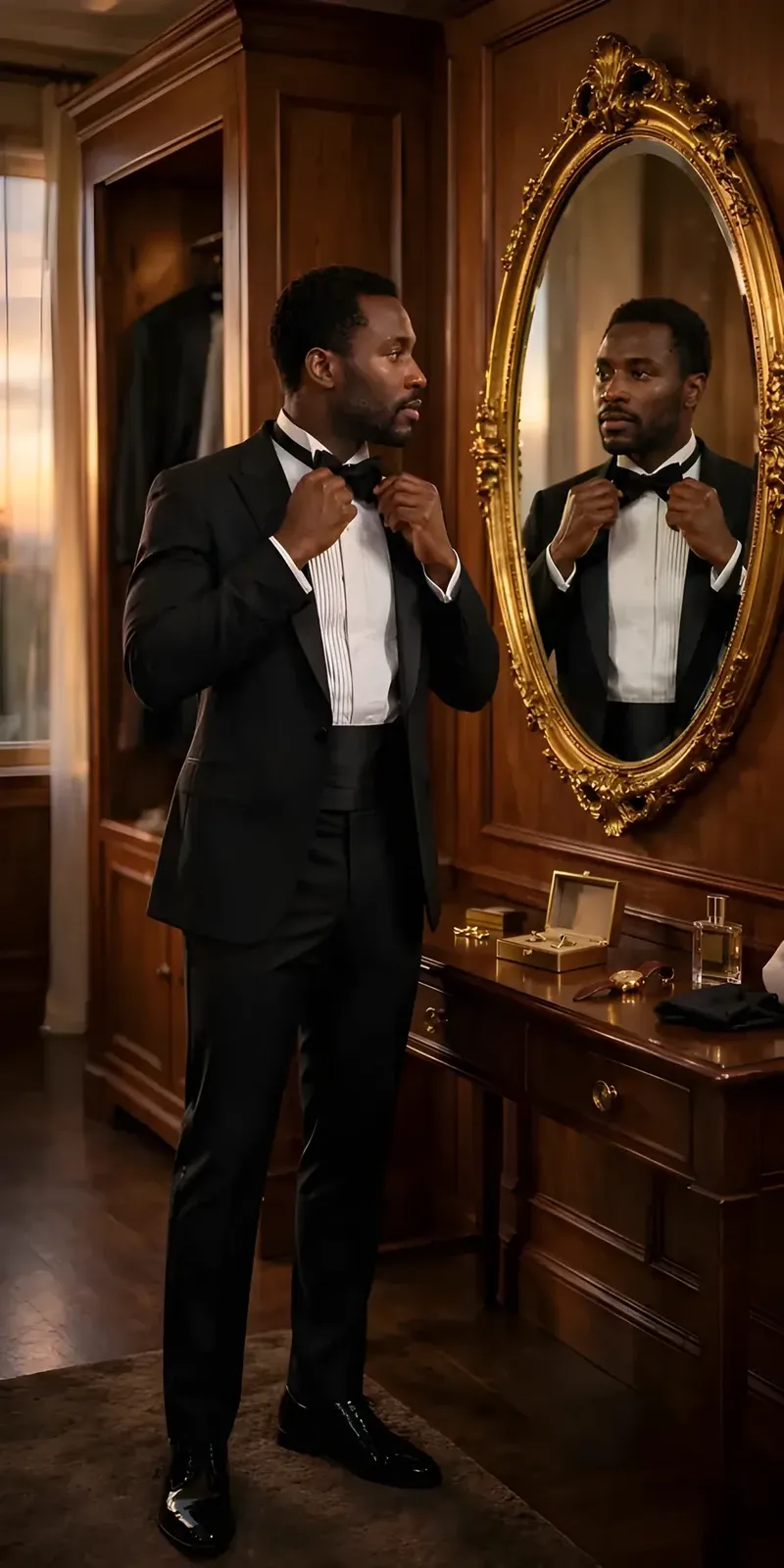
A tuxedo is incomplete without a cummerbund or a waistcoat unless the jacket is double-breasted.— Beauties Ltd, "Black Tie Attire Explained: The Do's and Don'ts of Formal Wear"
Beauties Ltd's do's-and-don'ts guide gives the waist rule its canonical form in the sentence quoted above: the cummerbund or waistcoat ensures a seamless, elongated look and prevents the awkward triangle of shirt showing between jacket button and waistband.
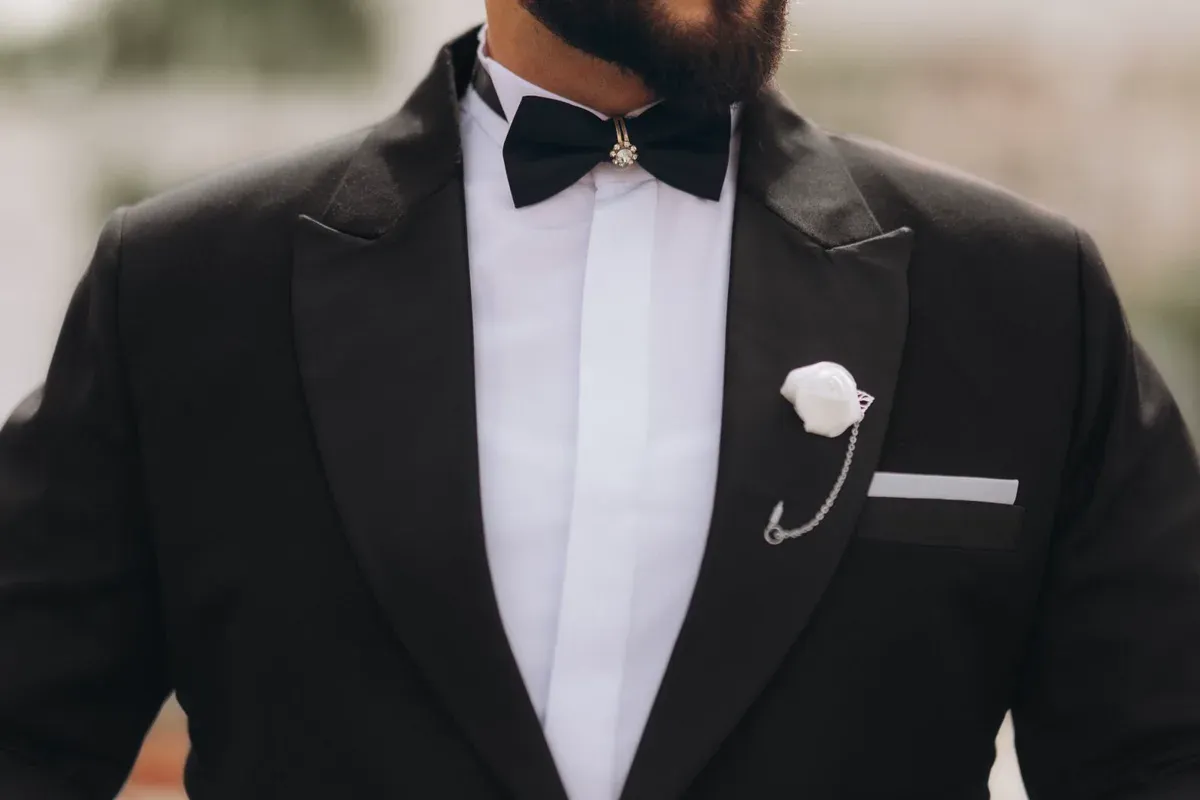
The same guide settles the bow tie — a pre-tied or clip-on version instantly cheapens the look; tie your own — and the shoes: highly polished black patent leather or calfskin Oxfords, with square-toe shoes, loafers, derbies and excess detailing all ruled out.
The Tie Company's black-tie guide adds the bow tie's proportion rule — its width should match the lapels of the tuxedo — and the finishing kit: classic silver or black onyx cufflinks, a neatly folded white pocket square (Cato's guide specifies white linen in the flat TV fold, no puff, no exceptions), black dress socks in silk or fine cotton, and a simple dress watch on a black leather strap if one is worn at all.
Cato's guide is strictest on the last hidden detail: over-the-calf length is non-negotiable, so no bare skin shows when you sit or cross your legs — black silk or fine wool, no patterns.
The pocket square, the watch and the jewellery obey one law between them: minimal and classic, because black tie does not reward personal flair at the expense of the code — gold, silver or onyx cufflinks, a crisp white square, and restraint everywhere else.
Gala, Wedding, State Affair: What Actually Changes
The code flexes at its edges, and knowing where is the mark of the experienced guest.
At a gala — the code's home ground — the full classic applies, with midnight blue as the sanctioned alternative to black, appearing especially rich under evening light, as FashionSizzle's wedding guide notes while listing the acceptable variations: deep navy, a white or ivory dinner jacket with black trousers in warm settings, velvet or subtle jacquard where the invitation's spirit allows, and jewel tones only where "creative black tie" is actually specified.
At a black-tie wedding, the couple's instructions outrank the canon; restraint is the courtesy, and nothing in your dress should compete with the principals.
At the state level, the code tightens toward its elder sibling: Cazo Tailor's comparative guide to black tie and white tie reserves white tie for the ultra-formal tier — royal gatherings and state events — while black tie serves the weddings, galas and fine dining of the social season; wearing black tie to a white-tie occasion is the one unforgivable direction of error.
Within black tie at that altitude, the jewellery answers with its most formal register: mother-of-pearl cufflinks and studs, the white-tie pairing Cazo names, are equally at home — and a set in gold with black onyx, the combination the same guide commends for black tie, remains the statesman's middle path.
For the full outfit system this jewellery completes, read Black Tie, Built Properly; for the wrist's part in the picture, The Watch on the Wrist; for the code behind the invitation's wording, Dress Codes, Decoded; and for the lady's counterpart in considered jewellery, Jewellery With Intent.
The Errors That Photograph Forever
Close with the failures, because black tie's cruelties are all small and all permanent once photographed. A black suit worn as a tuxedo substitute — Beauties Ltd rules it out outright, lacking the satin or grosgrain lapels, striped trousers and formal structure that define evening wear. A business shirt, for the reasons above.
A pre-tied bow tie. A belt. Novelty cufflinks — the tiny aeroplanes, the jokey stones — against Cato's explicit warning, trading a lifetime accessory for a five-minute laugh.
A coloured or puffed pocket square where white linen, flat-folded, was required. Ankle socks. And the meta-error beneath them all: treating the details as decoration rather than as the dress code itself.
Black tie is not a suit with accessories added; it is a system in which the cufflink, the stud, the cummerbund and the shoe are load-bearing.
Build the system once, properly — one correct pair of onyx or pearl links, one matching stud set, one vintage treasure when the market offers it — and every invitation for the rest of your life becomes the easiest dressing decision you own.
Black Tie, Built Properly
The Watch on the Wrist
Dress Codes, Decoded
Jewellery With Intent
Cato's — "Formal Event Essentials: Guide to Elevate Your Black-Tie Attire"
Gentleman's Journal — "Why It's Time to Invest in These Statement Cufflinks"
The Jewellery Editor — Cufflink Selection, Father's Day Gift Ideas
OnStage Entertainment — "What to Wear to a Black Tie Event"
1stDibs — Double-Sided Cufflinks Marketplace
Alberto Nardoni — "What to Wear to a Black-Tie Event"
Beauties Ltd — "Black Tie Attire Explained: The Do's and Don'ts of Formal Wear"
The Tie Company — "Black Tie Dress Code for Men"
FashionSizzle — "What to Wear to a Black-Tie Wedding: Complete Attire Guide"
Cazo Tailor — "Black Tie and White Tie: A Gentleman's Guide to Formal Wear"
Questions & Answers
What makes a gentleman in the modern world?
The best cufflinks for black tie are the smallest jewellery a man owns and the detail every photograph finds. Here is what to wear to a black tie event — cufflinks, studs, shirt, waist covering and shoes — settled properly, once. It links to 5 stories and articles — open any card to read the full piece.
How should a gentleman dress and carry himself?
The best cufflinks for black tie are the smallest jewellery a man owns and the detail every photograph finds. Here is what to wear to a black tie event — cufflinks, studs, shirt, waist covering and shoes — settled properly, once.
How do I read the full stories on Cufflinks and the Black-Tie Affair: The Best Cufflinks and the Definitive Black-Tie Guide?
Choose any card on this page. Each one opens a full page of its own — the complete story or article, with its sources linked.