
Silver, On Purpose: Going Gray Gracefully — Black Women, Silver Hair Style, and Aging Out Loud
Going gray gracefully is not a surrender — for Black women, silver hair style is a decision, made on purpose and worn out loud: the transition planned like a season, the makeup recalibrated by decade, the wardrobe edited to match.
There is a moment — you know it if you have lived it — when the woman in the salon mirror stops asking how to cover the silver and starts asking how to wear it. That is the whole subject of this piece.
Going gray gracefully, for Black women whose silver hair style becomes a signature rather than a secret, is not about letting anything go. It is about taking charge of a change that was coming anyway and giving it your name, your cut, your colourist, and your calendar.
The women in our Women of Distinction profiles who wear their silver in boardrooms, at galas, and on gallery floors did not drift into it. They decided.
This is how the decision is done well — and it begins, as our companion piece on the skin itself argued, with care rather than camouflage: if you have not read it, start with The Skin We're In, then come back here for the crown.
First, the Mindset: A Journey, Not an Event
Every colourist who does this work well says the same thing in different words: the transition is a season, not an appointment. Celebrity hairstylist Emilio Uribe, whose clients include Beyoncé, puts the expectation plainly in Parade's guide to letting hair go gray:
think of your gray hair transition as a journey. It is a process, and absolutely does not happen overnight.— Emilio Uribe, celebrity hairstylist, via Parade
Uribe's practical counsel travels with that patience: keep your colourist genuinely on board with the vision, treat regular trims as non-negotiable, and invest in products made for gray hair rather than asking your old routine to improvise.
His colleague Robin Emtage adds the texture truth every silver client learns — gray hair tends toward dryness, so hydrating, sulfate-free cleansing, real conditioning, and leave-in moisture become the daily standard, not the occasional treat.
Hold those two ideas together — patience about the calendar, seriousness about the care — and the rest of this piece is simply working out the details.
It also helps to know you are in distinguished company, and in a lineage.
Writing in The Zoe Report, Rebecca Carroll reflects on her own gray arriving and places it in a cultural inheritance — Toni Morrison's glorious crown among the reference points — in words that have become a touchstone for women making this decision: "I welcome my gray, as it begins to travel through the roots of this storied hair on my head".
That is the register of this whole guide. Silver is not the absence of colour. Against melanin-rich skin, it is one of the most striking colours a woman can wear — which is precisely why it deserves a plan.
The Transition: Four Honest Routes
There is no single correct way across; there is the way that fits your hair, your length, and your temperament. The transition guides agree on the menu. The first route is the grow-out: stop colouring, keep cutting on schedule, and let the silver arrive at its own pace while trims steadily retire the dyed ends.
Haste Hair's complete transition guide is candid about the timelines — a decisive short cut can complete the change in a matter of months, while a slow blend can take more than a year — and about the pitfalls: bleaching everything at once invites breakage, skipping trims lets split ends advertise the in-between stage, and blue-toned shampoos are too dark for most grays, where purple is the correct neutraliser.
The second route, and the one most women at this level choose, is blending. A colourist who specialises in gray transitions weaves the two colours together so no hard line ever forms.
Wella's professional guidance on transitioning clients to gray describes the craft in detail: because every woman's gray pattern is unique, face-framing highlights can be placed where her silver actually concentrates, with a demi-permanent toner matched to her natural gray applied root to tip — so that as more silver grows through, it reads as intentional from the first week.
The same guidance is firm about what to avoid: a single block of permanent colour simply resets the whole transition, sending you back to a fresh grow-out line. Blending appointments are maintenance, yes — but they are maintenance with an end date, which dyeing for cover never had.
The third route is acceleration: for women with strong contrast between dyed lengths and silver roots who would rather finish quickly, a colourist can lift the coloured hair toward silver in a planned series of sessions.
It is the fastest road and the most demanding — it belongs in expert hands, with the hair's condition assessed honestly first, and it is not the route for fragile hair. The fourth route is the celebrated one: the cut.
A pixie or a sleek bob removes most of the dyed length at a stroke and turns the transition into a debut. Transition guides consistently note that shorter, layered, textured cuts diffuse the contrast while the change completes — and many women discover, to their own surprise, that the cut they chose as a bridge becomes the signature they keep.
Whichever route you take, photograph your progress and keep the trim appointments sacred; the in-between months are where resolve is tested, and a great cut is what carries you through them looking deliberate.
Keeping Silver Bright: The Care Standard
Silver has two enemies: dryness and yellowing. Both are manageable, and the professional guidance is consistent. On tone: gray hair picks up yellow from sun, heat, pollution, and mineral-heavy water, and violet pigment is the counterweight.
Wella's gray-hair care guide recommends a purple-toning shampoo worked in and left for a few minutes to neutralise yellow tinges so silver reads clean and bright, a weekly mask through the mid-lengths and ends for smoothness and shine, a nourishing oil for the glassy finish gray hair shows so well, and — underlined — never skipping UV and heat protectant, since sun and hot tools are among the most common causes of the yellowing in the first place.
Used once or twice a week rather than daily, a toning shampoo corrects without drying or over-toning; your moisturising shampoo carries the other washes.
On texture: expect your silver to feel different from the hair you remember — often drier, sometimes wirier, occasionally softer.
This is the hair's new character, not damage, and the answer is the moisture discipline from our hair-care companion, Black Hair for Women: The Care Beneath the Style: gentle cleansing on a schedule your scalp sets, deep conditioning as a standing appointment, leave-in moisture sealed lightly, heat kept honest and protected, and satin at night.
A gloss treatment at the salon is the finishing touch many silver clients swear by — clear shine that makes the colour look lit rather than flat. And choose cuts that show the silver's pattern rather than fighting it: the streak at the temple, the salt-and-pepper crown, the full white cloud — each is a design.
A stylist who has done silver transitions before — the kind of house we teach you to judge in The Chair — will cut to the pattern you actually have.
Makeup, Recalibrated by Decade
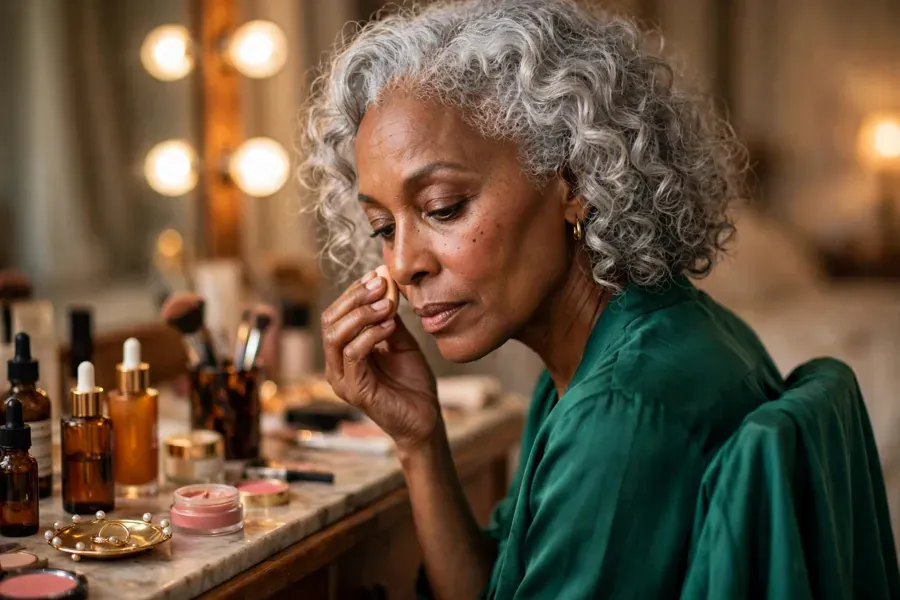
Silver changes the light around your face, and makeup that was perfect at forty-five can quietly argue with it at sixty. The mature-makeup guides converge on the same recalibration, and it is refreshingly subtractive.
Makeup Tutorials' guide for women over 50 retires the dated moves — heavy powder everywhere, harsh dark lip liner under pale lipstick, black liner ringing the waterline, frosted shadow, over-drawn brows — and replaces them with warmer, softer instruments: powder only where shine actually gathers, satin and soft-matte shadow, brown or soft-gray definition at the lash line, peachy and warm-pink blush, and brows kept natural and softly filled.
The foundation advice matters most with silver hair, because contrast has changed: light-to-medium, hydrating, flexible formulas that even the tone while letting skin show through, applied sparingly where needed rather than as a full mask.
Facial Adviser's over-60 guide makes the same swaps in a useful shorthand — cream blush placed higher on the cheek instead of powder placed low, soft pencil or powder liner instead of a heavy liquid line, creamy lipstick with liner instead of flat matte — and adds the practical kindnesses: fingers and a damp sponge blend cream products beautifully, a magnifying mirror in good light helps, and stepping back to judge the whole face at conversational distance keeps the result elegant rather than engineered.
By the decade, then: in your fifties, trade coverage for luminosity and let blush do the lifting; in your sixties, trade powder for cream almost everywhere and warm the palette as silver cools the frame; in your seventies, simplify to the few products that return colour and definition — a creamy lip, a soft brow, mascara, light — and let beautiful skin, kept as we described in The Skin We're In, carry the rest.
Silver hair plus heavy makeup reads as effort. Silver hair plus considered makeup reads as authority.
The Wardrobe Edit: Colour Against Silver
The same recalibration runs through the closet, and here silver becomes an outright advantage.
Colour guidance for women dressing with gray hair makes a point worth framing: silver acts as a neutral frame, so clear, saturated colour — the jewel family of sapphire, emerald, amethyst, ruby and deep teal — reads rich and intentional against it, where it might have competed with darker hair.
The working edit at fifty, sixty, and seventy is less about replacing a wardrobe than about re-sequencing it. Build the base on the neutrals that flatter silver — navy for structure without harshness, ivory or soft white for lift, charcoal for depth — and move your strongest colours to the neckline, where colour does its real work on the face.
Shades that once served you can blur against gray when worn at the collar; they are not banished, they are demoted — worn below the waist, or lifted with a scarf, a blouse, or jewellery in a clearer tone at the face.
Texture and silhouette complete the edit, and here the earlier lessons of this series hold: the wardrobe architecture of The Silhouette Wardrobe — clothes cut to the woman you are now, not archived for the woman of a decade ago — matters more, not less, as the decades turn.
Tailoring is the silver woman's best friend: a cream suit that fits like a decision, sleeves and hems at their exact lengths, fabrics with enough body to hold a line.
And take the generational view our series sets out in Dressing the Generations: the goal at every age is not to dress younger but to dress truer — the same standard, recalibrated. Women who made age itself the brand understood this instinctively.
Morrison's silver locs were not a concession; they were a crown worn in public for decades, inseparable from the authority of the woman beneath them. That is available to any woman who treats the change as a design brief rather than a decline.
Aging Out Loud, Stated Plainly
So here is the whole of it. Decide, with a colourist who respects the decision. Choose your route — grow it, blend it, accelerate it, or cut your way there — and keep the trims and the photographs while it completes.
Keep the silver bright with violet toning and honest moisture, and keep it soft with the care standard you would give any prized fabric. Recalibrate the makeup warmer, creamier, lighter. Re-sequence the wardrobe so clear colour frames the face and tailoring carries the silhouette.
And then wear it the way the women who inspired this piece wear theirs: not as a statement you explain, but as a fact you enjoy. Silver, on purpose, is not the end of being looked at. For the woman who does it well, it is a new and better reason.
The Skin We're In: Hyperpigmentation, Melanin Experts, and the Dermatologist Who Gets It
Black Hair for Women: The Care Beneath the Style
The Silhouette Wardrobe
Women of Distinction — The Profiles Collection
Parade — "How To Let Your Hair Go Gray, Celebrity Hair Stylists Explain"
Wella Professionals — "Help Your Clients Transition to Gray Hair"
Haste Hair — "Transitioning to Gray Hair: The Complete Modern Guide"
Wella — "Why You Need a Shampoo For Grey Hair"
The Zoe Report — "Going Gray Is A Revelation"
Makeup Tutorials — "Makeup for Women Over 50: Flattering Tips for Mature Skin"
Facial Adviser — "Makeup Tips for Women Over 60: What Works Now"
FreshLifeWire — "Choosing Flattering Colors for Graying Hair Complexions: A Guide"
Questions & Answers
How should a lady carry herself in public?
Going gray gracefully is not a surrender — for Black women, silver hair style is a decision, made on purpose and worn out loud: the transition planned like a season, the makeup recalibrated by decade, the wardrobe edited to match. It links to 6 stories and articles — open any card to read the full piece.
What should a lady wear on the street?
Going gray gracefully is not a surrender — for Black women, silver hair style is a decision, made on purpose and worn out loud: the transition planned like a season, the makeup recalibrated by decade, the wardrobe edited to match.
How do I read the full stories on Silver, On Purpose: Going Gray Gracefully — Black Women, Silver Hair Style, and Aging Out…?
Choose any card on this page. Each one opens a full page of its own — the complete story or article, with its sources linked.