
Weaves and Wigs, Done Right: The Invisible Install
The best sew-in weave and lace-front wig install is the one nobody can identify — a natural look built on honest hair, a flat foundation, and lace that disappears. Here is the quality standard, from sourcing to take-down.
There is a compliment every woman who wears hair knows by heart, and it is not a compliment about the hair at all. It is the pause, the close look, and the words: that is a weave?
The invisible install — the best sew-in weave and wig work, judged by the lace-front natural look it achieves — is a craft with a standard, and the standard can be learned.
Master installers and wig makers describe the same architecture again and again: hair sourced honestly and graded truthfully, a foundation braided flat and without punishing tension, a method chosen for the life the hair will actually live, lace customised until it melts, and maintenance treated as part of the install rather than an afterthought.
This guide walks that architecture in order, so the next unit — sew-in, closure, frontal, or full wig — is bought, built, and kept the way the top tier does it.
First, the Hair Itself: Sourcing Without the Fairy Tales
Every install begins before the chair, at the bundle. The vocabulary of the hair trade sounds like a ranking and behaves like a riddle, so it deserves plain translation. Mayvenn's guide to hair types puts the key distinction cleanly: virgin and Remy describe two different things.
Virgin describes chemical history — hair that has never been dyed, permed, or chemically processed. Remy describes collection — hair gathered so the cuticles stay intact and every strand runs root to tip in the same direction.
The two labels stack: as K-Hair's factory-floor explainer puts it, all virgin hair is Remy, but not all Remy hair is virgin, because Remy hair may have been lightly processed or coloured after collection.
Non-Remy hair sits below both: strands gathered from mixed sources with cuticles running in mixed directions, which is why it tangles and mats — the cuticle scales catch against each other with every movement.
Why the distinction is worth money comes down to behaviour over time. Cuticle-aligned hair tangles minimally, takes heat well, and — in the virgin case — lifts cleanly in colour work because nothing has been done to the strand before.
The comparison tables in the trade guides credit virgin hair with a working life of a year or more under proper care and multiple reinstalls, Remy with several months to a year, and non-Remy with weeks to a couple of months before it stops being worth the chair time.
Then there are the letter-and-number grades — 7A, 9A, 10A and beyond — which the honest corners of the trade treat with open caution: grading is not regulated, and two bundles wearing the same grade label from different suppliers can be very different hair. The buyer's tests are older than the labels.
Hair that is truly aligned runs smooth from root to tip and resists the reverse stroke; full bundles weigh what a full bundle should weigh; and a price far below the market for claimed virgin, single-donor hair is information in itself. Buy the behaviour, not the badge.
The Methods, Compared Honestly
With hair in hand, the method is a decision about lifestyle as much as looks. The traditional sew-in — natural hair braided into cornrows, wefts sewn track by track onto the braids — remains the durable classic: no adhesive on the skin, weeks of wear, and the wearer's own hair rested underneath.
A closure sew-in adds a small lace piece at the crown so no leave-out hair is heat-styled to blend; a frontal sew-in extends that lace ear to ear, and frontal guides describe the payoff as free parting — middle, left, or right — with the hairline itself mimicked by the piece, which is also why frontals serve women whose own edges are being rested.
Full wigs divide by how they stay on. A glued lace front, in Mayvenn's lace-front guide, typically holds one to two weeks before it needs lifting and relaying, with sweat, oil, and washing shortening the run.
The same guide sets the sewn-in unit at four to six weeks, and the wig grip — a velvet band the unit holds onto — as the daily-wear option, on in about ten minutes and off at night, with no adhesive on the skin at all.
Glueless and grip-based units have quietly become the connoisseur's travel and protective answer: the hair rests, the edges are never bonded, and the morning routine is measured in minutes.
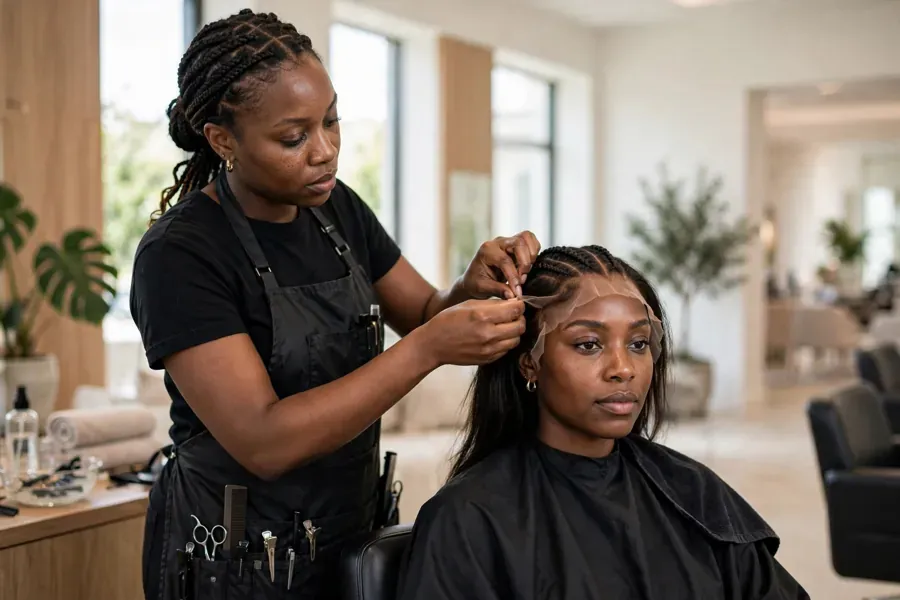
Lace That Disappears
The melt is where good money is either honoured or wasted, and it is mostly customisation, not price. The lace itself comes in families the trade describes consistently.
HD lace — the ultra-thin material long sold as Swiss lace — is thinner, softer, and more transparent than traditional lace, designed to vanish against the scalp so the hairline reads as skin in person and on camera; transparent lace, the standard lace in a clear shade, is slightly thicker and usually asks for more help — tint, makeup, or knot work — to reach the same disappearance.
The trade-off is delicacy: the thinner the lace, the more invisible the finish and the gentler the handling it demands, while the sturdier laces forgive daily wear.
Around the lace, the craft steps repeat across every serious installer's account: place the unit first and cut the lace only once it sits where it will live, following the wearer's own hairline rather than a straight line; pluck the part and hairline so the density mimics growth rather than a doll's edge; tint the lace to the skin it will sit on; and lay the perimeter with patience.
Mayvenn's guide is blunt about where naturalness is actually decided — flat preparation underneath, lace cut along the real hairline, ear tabs where the ears are — and notes that plucking and baby-hair work matter more than the price of the unit.
The Foundation No One Sees
Underneath every invisible install is a braid pattern doing invisible work. Installer guides describe the natural hair braided flat — horizontal or spiral patterns for sew-ins — so the wefts lie close and the finished silhouette has no bulk at the crown, with a stocking cap over the braids giving thread something to hold that is not the wearer's hair.
The foundation is also where protection is won or lost, and here the craft and the clinic briefly agree.
The maintenance literature is direct that damage around an install rarely comes from the unit itself: it comes from adhesive pulled off dry instead of dissolved, from cornrows braided too tight at the hairline, and from bonded units worn continuously without breaks.
A painful install is not a rite of passage; it is a defect, and the take-down rules below exist because tension sustained for weeks is the known road to traction damage at the edges.
Maintenance: The Install Is a Relationship
Top-tier hair is kept, not merely worn, and the published care protocols read like variations on one theme — clean, conditioned, detangled gently, dried fully, protected at night.
Wealthy Hair's care guide for weaves and full lace wigs sets a wash rhythm of every seven to ten days, with sulfate-free shampoo, the scalp cleansed between sew-in tracks, and suds allowed to run through the lengths rather than scrubbing them; detangling runs in sections, from the ends toward the roots, before washing.
Protective-style maintenance guidance widens the lens to the hair underneath: Perfect Locks' protocol describes a light leave-in sprayed between the tracks or braids every two to three days, a lightweight scalp oil weekly, the scalp washed every one to two weeks with diluted shampoo from an applicator bottle, and complete drying before the style is covered — because a damp foundation under a unit is buildup and odour waiting to happen.
Night discipline is the cheapest luxury in the whole system: a satin bonnet or silk pillowcase, every night, against the friction that frizzes perimeters and thins edges. Heat, when it comes, comes with protectant and restraint.
None of this is glamorous, and all of it is the difference between hair that lasts a season and hair that lasts the year its price promised.
The Take-Down, and Knowing When
Every install carries an expiry date, and the maintenance literature states it without negotiation: most protective styles carry an eight-week maximum, because new growth past that point increases tension at the roots — the calendar is honoured regardless of how good the style still looks, with one to two weeks of recovery for the natural hair after a sew-in comes down.
The removal itself is a craft step, not an exit: adhesive is saturated with remover and given time to dissolve, and the lace lifted gently; edges are lost to impatience at this exact moment more than at any other.
Units that come off are washed, conditioned, dried completely, and stored on a stand away from heat and dust, ready for the next install — the reinstallability that justified the virgin and Remy grades in the first place.
The Wig Wardrobe
At the top of the market, the endpoint of all this knowledge is a wardrobe rather than a unit: a small rotation built the way a shoe rotation is built, each piece with an assignment. A glueless everyday unit for the working week, gentle on edges and fast in the morning.
A frontal or HD-lace piece for evenings and photographs, where the hairline will be seen up close. A travel unit that tolerates being packed, steamed back to life, and worn without a stylist in reach.
And through it all, the protective logic that links this craft to the health of the hair beneath it — styling as rest, not as strain.
For the clinical side of that bargain — traction and the forms of hair loss that styling can aggravate, and wigs used as a bridge while hair recovers — our companion piece on alopecia in Black women takes the subject to the dermatologists.
Here, in the atelier, the standard is simpler to state and harder to fake: honest hair, flat foundations, lace that disappears, care that never skips, and a take-down kept like an appointment with oneself.
Sew-In or Unit? Reading the Calendar Honestly
The final choice between a sew-in and a removable unit is rarely about which looks better — a master can make either disappear — and almost always about the calendar it has to survive. The sew-in suits the settled season: weeks in one city, a standing appointment for maintenance, no desire to think about hair in the mornings.
Its costs are commitment and access — the scalp underneath can be cleansed and moisturised, as the protocols above describe, but not reached completely until the take-down.
The removable unit suits the moving life: travel across climates, workouts that demand a bare scalp at night, a scalp that wants air and hands on it daily, or a wearer who simply likes changing length and texture the way she changes shoes. Its cost is the nightly discipline of removal, storage, and morning placement.
Neither is the premium choice in the abstract. The premium choice is the honest match — method fitted to the life, hair grade fitted to the method's lifespan, and a take-down or rotation plan written into the diary on the day of the install, not negotiated later with a mirror.
That is what done right finally means: not the most expensive hair in the room, but the hair whose whole life, from bundle to take-down, was planned by someone who knew the standard.
Hair as Signature
Black Hair for Women: The Care Beneath the Style
The Styles, Now and Forever
Choosing the Salon: The Buyer's Guide
Alopecia in Black Women: The Honest Map
Mayvenn — "How to Put On a Lace Front Wig: Glue, Grip or Sew-In"
Mayvenn — "Virgin vs. Remy vs. Yaki Hair: What's the Difference?"
K-Hair — "Remy Hair Vs Virgin Hair: What's The Real Difference"
Perfect Locks — "Maintaining Protective Styles"
Wealthy Hair — "Your Foolproof Guide to Caring for Your Hair Weaves and Full Lace Wigs"
She's Happy Hair — "HD Lace vs. Transparent Lace: What's the Difference?"
Sunber Hair — "How To Sew In Weave With Lace Frontal?"
Questions & Answers
How should a lady carry herself in public?
The best sew-in weave and lace-front wig install is the one nobody can identify — a natural look built on honest hair, a flat foundation, and lace that disappears. Here is the quality standard, from sourcing to take-down. It links to 6 stories and articles — open any card to read the full piece.
What should a lady wear on the street?
The best sew-in weave and lace-front wig install is the one nobody can identify — a natural look built on honest hair, a flat foundation, and lace that disappears. Here is the quality standard, from sourcing to take-down.
How do I read the full stories on Weaves and Wigs, Done Right: The Invisible Install?
Choose any card on this page. Each one opens a full page of its own — the complete story or article, with its sources linked.