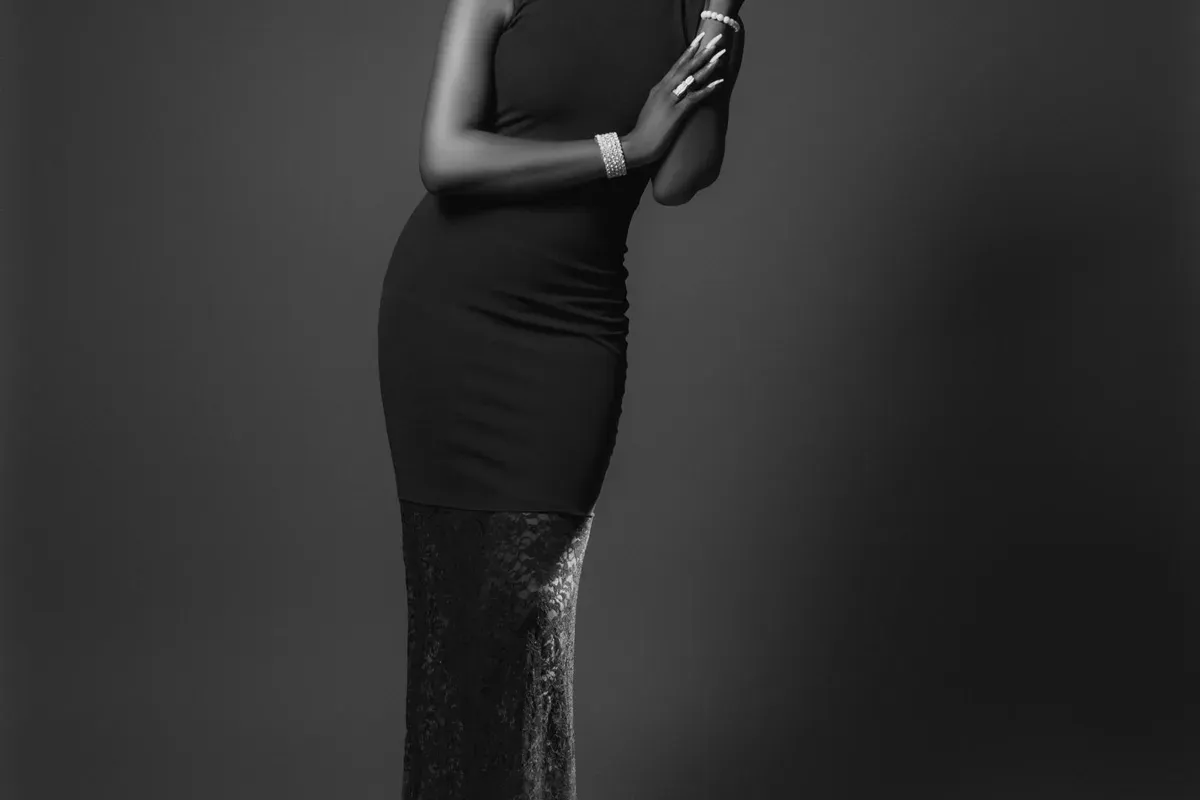
Dressing Like a Lady, Part VI: Shoes and Bags — the Rotation and the Care
A luxury handbag wardrobe is not built by accumulation — it is built by rotation: the right seven shapes, heels chosen for the whole evening, and leather care so faithful that today's bag becomes your daughter's.
Open the dressing room of a woman who is always, effortlessly, correctly accessorised and you will not find abundance. You will find order.
A luxury handbag wardrobe at this level is a small, deliberate company of pieces — each one chosen for a job, each one rested between performances, each one cared for with the unhurried consistency you would give anything you intended to hand down.
The shoes beneath them obey the same constitution: a rotation, not a favourite pair worn to death; heel heights selected with the whole evening in mind, not just the entrance; and a care ritual so brief and regular that it stops feeling like maintenance and starts feeling like manners. This is Part VI of our Dress Like a Lady series.
Part I built the silhouette wardrobe on exactly this logic — twelve pieces, endlessly recombined — and your accessories deserve the same respect: fewer, better, and looked after like the heirlooms they are busy becoming.
The word to hold onto is rotation, because rotation is where luxury and longevity shake hands. A bag carried every day for a year ages faster than three bags carried in turn, and not only because each rests — because rest itself is a form of care for leather, letting it dry, recover its shape, and breathe.
The same is true of shoes, where the science is frankly blunt about what daily wear does to a pair.
What follows is the full system: the bag wardrobe from boardroom to clutch, the heel heights that survive an evening, the shoe rotation, and the care — storage, conditioning, and professional restoration — that keeps leather goods heirloom-grade across decades rather than seasons.
The Bag Wardrobe: Seven Shapes, Every Room
Begin with the architecture. Wardrobe guides that have actually counted converge on a satisfying answer: seven types of bag cover almost every occasion a wardrobe has to handle — the tote, the crossbody, the clutch, the backpack, the satchel, the hobo, and the weekender — and each one solves a problem the others cannot. The tote carries volume.
The crossbody frees your hands. The clutch finishes an evening look. The satchel brings structure to a meeting; the hobo relaxes a weekend; the weekender turns a two-day trip into a single graceful piece of luggage.
Most women own three or four of these by accident. The lady owns all seven on purpose, in the right order: the two workhorses first — a structured tote or satchel for the boardroom, a crossbody for travel and hands-full days — then the clutch, then the rest as life requires.
Two principles from the same guidance deserve to be underlined before you buy anything.
The first is the honest trade-off at the heart of every bag decision: capacity and security work against each other — the tote holds the most and protects the least, the crossbody nearly the reverse, so choose by what the day actually demands rather than by habit.
The second is subtler and more powerful: structure decides formality more than material does. A structured satchel in canvas reads more formal than an unstructured hobo in the finest leather — which means the silhouette of the bag, not its price tag, is what the room registers first.
Build the wardrobe in a disciplined palette — black, a deep brown or cognac, one cream or stone neutral, and let your signature colour live in a clutch or two — and every one of the seven shapes will sit comfortably beside every silhouette in Part I: The Silhouette Wardrobe.
That is the whole trick of the women who never look accessorised-by-accident: the bags were chosen as a system, once, and then simply kept.
Heel Heights That Survive an Evening
Now the shoes, and let us begin with the number that separates a grand entrance from a grand evening.
Podiatrist Dr. Saylee Tulpule, quoted in a survey of comfortable heel design, gives the working ceiling plainly: the most comfortable high heels are three inches or shorter, because higher heels increase pressure on the foot and worsen problems like bunions and hammertoes.
Treat three inches as the altitude at which elegance and endurance can still share a shoe, and build your rotation in storeys beneath it.
The kitten heel — roughly an inch and a half to two and a half — is the day-into-evening diplomat: enough lift to lengthen the line of a trouser or a midi dress, little enough pitch to walk a gallery, a reception line, and a dance floor without negotiation.
The block heel is the evening's workhorse, distributing weight across a wider base so that stability stops being something you perform. And the true stiletto, the four-inch exclamation point? Keep one magnificent pair, by all means — for the photograph, the seated dinner, the short and glorious appearance.
Just do not ask it to do a whole evening's work, and do not pretend the car-to-door shuffle is a mystery of aging. It is arithmetic, and arithmetic can be planned around.
Fit and construction matter as much as height. A cushioned insole, a pitch that does not throw your whole weight onto the ball of the foot, an ankle strap that holds the shoe to you rather than you to the shoe — these are the unglamorous details that decide whether you are still standing comfortably at the evening's last conversation.
Break new shoes in at home across several short wears before their debut; leather softens to your foot on your schedule or on the evening's, and only one of those is kind.
Keep, in the car or the coat check of your life, the elegant flat you actually like — not as surrender, but as the mark of a woman who plans her whole evening, exit included. Presence is very hard to project from a woman whose feet are negotiating a surrender of their own.
The Rotation: Rest Is a Form of Care
Here is the discipline that ties the whole article together, and the gentleman's side of this magazine learned it long ago — our companion piece, Shoes: The Rotation, is built on it. Leather is skin.
A day inside a shoe or a long afternoon on your arm leaves it warm, damp, and pressed out of its intended shape, and leather that never fully dries begins to break down from the inside, where no polish or conditioner can reach.
The leather-care specialists at The Vou state the routine's foundation without decoration: rest between wears — a day per pair, longer after rain or a hot day — lets the lining dry out, which is what stops the leather degrading, and the rotation is the single biggest gain in the whole care routine.
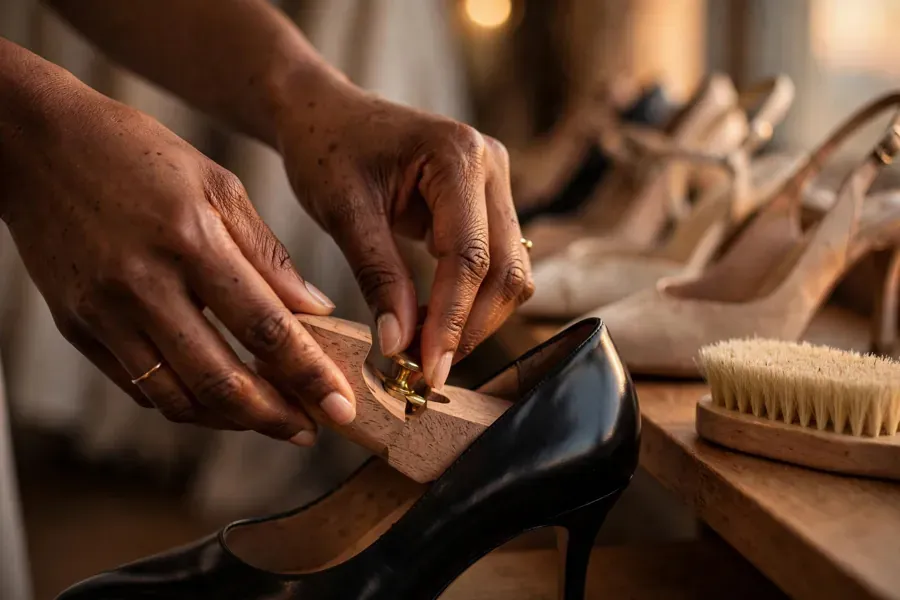
Shoe trees go in the moment the shoes come off, while they are still warm: they hold the shape, flatten the toe crease, and draw moisture out of the lining. Cedar, specifically — it absorbs moisture as plastic never will — and a full-shaped tree rather than a narrow spring contraption.
They may be your favourites but you must never wear the same pair of shoes two days in a row.— Oliver Sweeney, shoemaker's guide to the shoe tree, via the linked source
The shoemaker's version of the rule is even simpler to organise a week around: shoes can take a full twenty-four hours to dry before the next wearing, so the ideal rotation is one pair on your feet, one pair resting with shoe trees in, and the rest in their boxes.
Three pairs in honest rotation — your black pump, your neutral, your evening shoe — will outlast and out-look six pairs worn in a blur of favourites. The bags ask for the same courtesy, and for the same reason.
Handbag storage specialists advise rotating a collection every few months at minimum: even stored bags benefit from occasional use, because rotating the collection lets the leather breathe, prevents permanent creases from forming in one position, and gives you the opportunity to inspect each bag for developing issues. Rotation, in other words, is not only rest.
It is inspection — the moment you notice the loosening stitch, the dry patch, the tarnishing clasp, while each is still a small repair and not a eulogy.
Care That Keeps Leather Heirloom-Grade
Storage is where heirlooms are made or quietly ruined, and the rules are few enough to memorise. Store bags upright, never stacked — stacking causes permanent dents, scratches, and shape distortion — with each bag given its own space and breathing room around it.
Stuff the interior to hold the silhouette: acid-free tissue, a purse pillow, or clean cotton, supporting the structure without straining the seams. Keep each bag in its breathable dust bag, never in plastic, which traps moisture and invites mildew.
Wrap chains, clasps, and metal hardware in soft cloth or tissue so they cannot scratch the leather or tarnish against it, and tuck heavy chains inside the bag rather than letting them hang and pull.
The room matters as much as the method: handbags should be kept upright in a cool, dry place away from direct sunlight, heaters, and vents, since heat dries leather out and humidity invites mould, with consistent temperature and good air circulation doing the quiet protective work.
Never hang a bag by its straps for storage — the leather stretches and the silhouette distorts — and refresh the stuffing each season as you rotate.
The daily and monthly rituals are brief. Wipe a leather bag down with a soft, dry cloth after use, because surface dirt left in place becomes tomorrow's abrasion; condition smooth leather every couple of months to keep it supple and ahead of cracking, thinking of the leather as skin that needs hydration to stay alive-looking.
If a bag gets wet, the rule is patience: blot the excess water gently and let the bag air-dry naturally — never a hair dryer, never direct heat, which can warp the leather. Light scratches often buff down with a microfiber cloth and the leather's own oils; deeper injuries are not home projects.
And when a piece you love develops the kind of damage that matters — deep stains, ink, a failing zipper, corners worn through — send it to the professionals without embarrassment or delay.
Specialist guidance on long-term care is unanimous on this point: for deep stains, ink marks, or restoration, always consult professionals, because specialised luxury bag spas understand high-end materials and craftsmanship and keep a bag worthy of its years.
The same courtesy extends to your shoes: a trusted cobbler is a member of your household staff in all but residence, and a resole or a reheeling done on time is the difference between a shoe that serves a decade and one that serves a season.
Step back and the philosophy is the same one running through this entire series. In Part V, your skin was kept by a facialist on a schedule and a routine edited to essentials. Here, your leather is kept by a rotation on a schedule and a care ritual edited to essentials.
Nothing in either system is expensive in the way people imagine luxury to be; the cost is attention, paid regularly and in small amounts, exactly the way the women in our Women of Distinction profiles maintain everything they own. Buy the seven shapes. Choose heels your whole evening can stand in.
Rest every pair and every bag as faithfully as you rest yourself. And one day, when your daughter lifts a clutch from its dust bag and finds it supple, structured, and entirely ready for her evening, she will understand that what you actually handed down was not a bag.
It was a standard — which is precisely where Part VII takes us, into colour.
Shoes: The Rotation — The Gentleman's Companion Piece
Dressing Like a Lady, Part I: The Silhouette Wardrobe
Women of Distinction — Profiles Collection
Eric Javits — "7 Types of Bags Every Woman Needs"
Italian Shoe Factory — "How to Store Luxury Handbags: Expert Tips & Guide"
The Relux — "How to Properly Store Your Designer Handbags"
Relovluxe — "Luxury Bag Care Guide"
Bag Vanity — "Handbag Care Tips: Keep Your Purse Pristine With These Expert Strategies"
DecentFoot — "Are Any High Heels Comfortable?" (podiatrist Dr. Saylee Tulpule)
The Vou — "Leather Shoe Care, From the Routine to Polishing a Pair"
Oliver Sweeney — "How and Why to Use a Shoe Tree"
Questions & Answers
How should a lady carry herself in public?
A luxury handbag wardrobe is not built by accumulation — it is built by rotation: the right seven shapes, heels chosen for the whole evening, and leather care so faithful that today's bag becomes your daughter's. It links to 3 stories and articles — open any card to read the full piece.
What should a lady wear on the street?
A luxury handbag wardrobe is not built by accumulation — it is built by rotation: the right seven shapes, heels chosen for the whole evening, and leather care so faithful that today's bag becomes your daughter's.
How do I read the full stories on Dressing Like a Lady, Part VI: Shoes and Bags — the Rotation and the Care?
Choose any card on this page. Each one opens a full page of its own — the complete story or article, with its sources linked.