
Anniversary, Kept Properly: The Years That Deserve a Room
The definitive guide to 25th anniversary celebration ideas and vow renewal etiquette — which years deserve a room, how to renew vows without staging a second wedding, gifts by year translated to this level, and the speech a spouse actually gives.
Every established couple eventually faces the same pleasant problem: the 25th anniversary celebration ideas in the magazines are written for somebody else's life. A dinner for two and a card will not carry twenty-five years. Neither will a rented hall and a DJ who was not born when you married.
An anniversary kept properly is something else entirely — a deliberate occasion, produced with the same care as the wedding was, but with one enormous advantage: this time, you are not asking anybody's permission, and you are paying for exactly the evening you want.
This guide covers the whole of it, from vow renewal etiquette to the gift chart, the guest list, and the short speech that makes the room go quiet in the right way.
Start with the principle that separates a kept anniversary from a merely expensive one. The wedding belonged, in part, to other people — parents, tradition, the guest list arithmetic of two families becoming one. The anniversary belongs to the marriage itself.
Everything about the evening should testify to what the two of you actually built: the children, the house, the friendships that survived, the witnesses who watched it happen. When that testimony is the program, the rest — the room, the menu, the music — almost chooses itself.
Which Years Deserve a Room
Not every year needs production, and producing every year cheapens the ones that matter. The years that deserve a room are the ones the gift tradition itself has always marked in precious material: ten, fifteen, twenty, twenty-five, thirty, forty and fifty.
The traditional chart climbs in value as the marriage lengthens — tin at ten, crystal at fifteen, china at twenty, silver at twenty-five, pearl at thirty, ruby at forty, gold at fifty — a progression the standard anniversary gifts-by-year chart traces back to medieval Germany, where wives received a silver wreath at twenty-five years and a gold one at fifty.
The first comprehensive year-by-year list, as that history notes, was published in 1937 by the American National Retail Jeweler Association. The Victorians marked only a handful of milestones; the modern couple can mark the same handful — properly.
There is one more year that deserves a room, and it appears on no chart: the year after a hard season. A marriage that has come through illness, a business storm, a death in the family, or a long stretch of caring for parents has earned its celebration out of sequence.
Couples who renew after difficulty are not unusual — renewal guides list reconnecting after a major hurdle among the most common reasons couples choose a ceremony, alongside milestone anniversaries and the wish to celebrate with everyone who could not be at a small first wedding. If that is your year, do not wait for a round number.
Round numbers are for stationery. Survival is for champagne.
For the in-between years, keep a smaller, consistent ritual — the same restaurant, the same table, a letter exchanged and kept. Consistency is what makes the big years legible when they arrive: the family learns that this marriage marks its time on purpose, and the milestone party lands on ground already prepared.
Our companion piece on marking milestones properly takes up the wider family calendar; this one stays at the couple's table.
The Vow Renewal, Without the Re-Do
The single most important sentence in vow renewal etiquette is the one the specialists repeat in nearly identical words: a vow renewal is not a second wedding. You are already married.
There is no license to sign, no legal component at all — which means, as the American Marriage Ministries' guide puts it, there are no rules for how to perform a vow renewal, and anyone you love may officiate: a pastor, a friend, a sibling, or — the choice that stops the room — your own grown child.
The freedom is the point. What you must not do is spend that freedom re-staging the wedding you already had, complete with attendants in matching dresses and a registry. A renewal that imitates a wedding undersells both events.
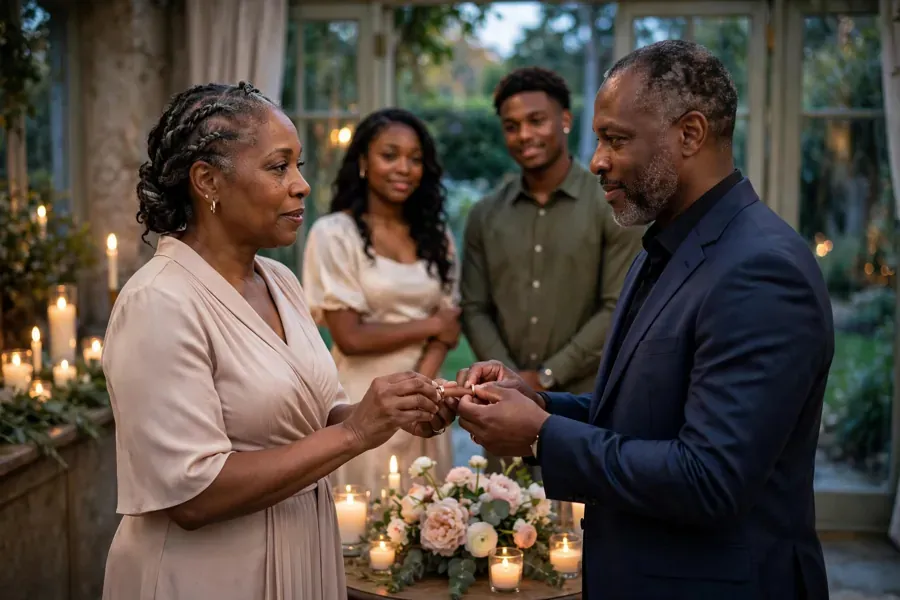
So keep the ceremony short, personal, and unmistakably about the years, not the day. Fifteen minutes is plenty. Walk in together, as you have done everything since.
Say new vows — written for this season of life, mentioning the children, the tests, the gratitude that only time teaches; renewal planners note that fresh vows let you promise the things you could not have promised then, because you did not yet know what marriage would ask.
Exchange the original rings, re-polished, or add a new band to the hand that already wears the first — jewellers see both, and either is correct. Skip the bachelor and bachelorette parties, skip the shower, and let the invitations say, plainly, that your presence is the gift.
Guests who insist on giving will give anniversary gifts anyway; receive them graciously and thank them promptly, the way you were raised.
Who hosts? You do. Unlike the wedding, a renewal is an event the couple hosts for themselves, and the couple pays — parents are not involved in the finances this time, and your children attend as honored witnesses, not as staff.
If an adult child offers to host the party afterward, accept with grace; it is one of the loveliest reversals in family life. But the ceremony itself, and its cost, are yours — that is precisely what makes it a statement of independence rather than a request for applause.
The Party That Honors the Witnesses
Build the guest list the way the marriage was built: from the witnesses outward. The couple who introduced you. The friends who sat in hospital waiting rooms and church pews and airport terminals with you.
The siblings. The children and, if fortune has been kind, the grandchildren, who should see — at least once, in full dress — the family formally honor the union that produced them. A renewal party is not a networking event, and the business associate who would be hurt to be excluded from a gala will survive being excluded from this.
Keep it to the people who can testify.
Choose the room for memory, not capacity. The restaurant where you celebrated the tenth. The club where you have spent twenty New Year's Eves.
The garden of the house you finally bought, with a tent, a string quartet, and the photograph wall — decades of framed pictures hung where guests can walk the marriage like a gallery. That wall, more than any decoration money buys, is the evening's production design, and it costs nothing but the afternoon it takes to hang it.
Serve the food the two of you actually love, in the order you actually love it, and hire the musicians who play your song without being asked twice.
Then dance to it — the first dance of a renewal is a better dance than the first one ever was, because now you know what the song costs and what it is worth.
Gifts by Year, Translated to This Level
The gift chart is a prompt, not an assignment — the guides themselves say the themes are guidelines, and couples do best treating them as a creative language. Translated to this level, the language speaks beautifully. Ten years, tin; modern, diamond jewellery: the decade ring, or the first serious watch.
Fifteen, crystal: a full suite of fine crystal for the table you now own, engraved with the year. Twenty, china; modern, platinum: the formal service for twenty-four, finally, or platinum bands exchanged at a private dinner.
Twenty-five, silver: the milestone the tradition was invented for — silver in earnest, a tea and coffee service, candlesticks for the dining room, or a piece of silver hollowware engraved and dated, the kind of object grandchildren will polish.
Helzberg's guide calls the twenty-fifth the Silver Anniversary, celebrated with lustrous silver, and it remains the most gift-legible of all the years. Thirty, pearl: a strand chosen in person, not ordered. Forty, ruby: the stone whose deep red, as the same guide notes, stands for a passion that still burns — a ruby added to her hand or his cuff.
Fifty, gold: gold without apology, and the party of the decade. The full traditional and modern chart runs year by year for the smaller anniversaries, where the correct move is usually smaller still: paper at one year becomes a framed letter; leather at three, a travel case that will actually travel.
One rule governs all of it: the gift should be an object the marriage will use or keep, chosen by a spouse who has been paying attention. At this level, nobody needs another thing.
What lands — what always lands — is evidence of attention: the book she mentioned in March, the vintage he admired in a window two summers ago. The chart supplies the material; attention supplies the meaning. For the stones and settings themselves, our Vault guide to jewellery kept at this level is the companion read.
The Speech a Spouse Actually Gives
At some point in the evening, one of you must speak — and if children or friends toast first, all the better; their structure is a reliable one: welcome everyone and name the occasion, say why you are speaking, share one short memory that sums the couple up, thank the hosts and guests, and raise the glass.
One memory, note — not the whole biography. Guests came to honor a marriage, not to hear every chapter of it. The spouse's speech follows the same discipline at higher stakes.
It is not a history lesson and it is not a roast, however affectionate; the received wisdom on anniversary humour is to keep it brief, warm, and always on the couple's side — nothing that embarrasses either partner, nothing about arguments, in-laws, or merely surviving each other.
What should it contain? Three things, in about four minutes. Gratitude, named specifically — not "thank you for everything" but the actual thing: the year she carried the family, the decade he showed up at every recital from the back row of a plane.
One true story, told short, that the room has never heard. And a forward sentence — what you are looking toward together, said plainly enough that your grandchildren can repeat it at your fiftieth. End by saying, in whatever words are yours, that you would choose it all again.
Speech guides for golden anniversaries call that closing reaffirmation the most powerful line available to a spouse, because it converts fifty years of fact into a present-tense decision. Delivered standing, glass in hand, looking at your spouse rather than your notes, it does not need to be eloquent. It needs to be meant.
A last piece of choreography: whoever speaks, speak before the cake, while the room is still attentive and the children are still awake. Then let the evening loosen. The formal part of a kept anniversary should be unmistakably formal — dressed, seated, witnessed, spoken — precisely so the rest of the night can be a party.
That is the whole doctrine, and it is the same one running through our guide to the long marriage playbook: the rituals are protected so that the joy inside them can be unguarded. Ten, twenty-five, forty — mark them in a room, with the witnesses, in your own words. The years did the work.
The evening just says so.
The Long Marriage Playbook: What Couples Who Last Actually Do
The Proposal, Produced: Asking at the Level You Live
The Wedding Guest Standard: What to Give, Wear, and Never Do
Profiles: The Women of Black Excellence
I Do Still — "Vow Renewal Etiquette: Celebrating Love and Commitment"
American Marriage Ministries — "Everything You Need to Know About a Vow Renewal Ceremony"
Manly Bands — "Wedding Anniversary Gifts by Year: Traditional, Modern & Ring Ideas"
Helzberg — "Wedding Anniversary Gifts by Year: A Complete Guide"
Anniversary Ideas — "Wedding Anniversary Speeches & Toasts"
Historic Newspapers — "Anniversary Gifts by Year: The Guide"
Questions & Answers
Who will you meet on this page?
The definitive guide to 25th anniversary celebration ideas and vow renewal etiquette — which years deserve a room, how to renew vows without staging a second wedding, gifts by year translated to this level, and the speech a spouse actually gives. It links to 6 stories and articles — open any card to read the full piece.
What makes these stories worth reading?
The definitive guide to 25th anniversary celebration ideas and vow renewal etiquette — which years deserve a room, how to renew vows without staging a second wedding, gifts by year translated to this level, and the speech a spouse actually gives.
How do I read the full stories on Anniversary, Kept Properly: The Years That Deserve a Room?
Choose any card on this page. Each one opens a full page of its own — the complete story or article, with its sources linked.