
Cocoa Butter and Shea Butter: The Real Grades, the Real Rituals
Shea butter grades, raw vs refined, and cocoa butter skin benefits — what the grades actually mean, where these two ancestral butters come from, and the rituals that honour them.
Every dressing table in our world holds at least one of them, and most hold both: a jar of something golden and nutty, a block of something pale and faintly chocolate.
Shea butter and cocoa butter are the two ancestral staples of Black skin and hair care — carried across oceans, handed down through grandmothers, and now reformulated by luxury houses at luxury prices. And yet the questions a careful buyer types into a search bar are surprisingly basic: shea butter grades raw vs refined cocoa butter skin benefits.
What does Grade A actually certify? What does refining take out? What does cocoa butter do, beyond smell like a promise?
This article answers those questions the honest way — graded, sourced, and attributed, with the folklore separated from the findings and the rituals given their proper, honoured place.
Begin with a distinction the folklore blurs. These are two different plants, two different continents of origin in the jar, and two different textures in the hand. Shea comes from the nut of the shea tree — Vitellaria paradoxa, listed on compliant cosmetic labels by its INCI name, Butyrospermum parkii — a tree of the West African savanna belt.
Cocoa butter, also called theobroma oil, comes from the roasted cacao bean, and Cleveland Clinic's dermatology writing describes it as a yellowish fat that is high in fatty acids. One is soft and kneadable at room temperature; the other is hard enough to snap.
Everything else in this article — grades, rituals, claims — hangs on understanding each butter on its own terms first.
Shea, Graded Honestly
Grades are where the shea conversation either becomes honest or becomes marketing, so here is the classification the trade actually uses.
Ingredient reporting summarising the system explains that a five-grade classification associated with the United States Agency for International Development and industry bodies: A for raw, water-extracted butter; B for refined; C for highly refined, solvent-extracted material; D for the lowest uncontaminated grade; and E for contaminated stock. Read that ladder slowly.
Grade A is not a compliment; it is a process description — raw butter, extracted with water, minimally handled. Grade C is not a scandal; it is an industrial material, destined mostly for formulations where shea's own character is not the point. The grades below that are not cosmetic ingredients at all in any house this magazine would name.
Retail-facing guides translate the same ladder into buying language.
One such guide describes the commercial market as grading shea from A down to F, Grade A at the top: raw, unrefined, and purity-tested — and describes raw, unrefined shea as the version extracted by traditional methods without high heat or chemicals, carrying a yellowish or ivory tint and a distinct nutty aroma.
That aroma deserves a sentence of its own, because it is the buyer's fastest field test. A pronounced, earthy, almost smoky nuttiness is what unprocessed shea smells like; its absence is information, too. It does not make a butter bad.
It makes it a different product from the one the grade ladder's top rung describes — and a jar priced as Grade A should present like one.
Raw vs. Refined: What the Processing Takes
The cleanest comparison in the sourcing literature is a side-by-side one.
A producer-direct guide tabulates the two forms this way: unrefined Grade A shea is ivory to pale yellow with a mild, nutty, faintly smoky aroma and a dense, sometimes slightly grainy texture, its vitamins A and E retained and its unsaponifiable content put at 5–17 percent, cold-pressed and hand-filtered, with a shelf life of 18–24 months; refined shea, by contrast, is a uniform bright white with no aroma and a smooth, waxy texture, its vitamin content substantially reduced and its shelf life longer.
Neither column is a villain. The same guide concedes the trade honestly: refined shea is easier to work with, blends invisibly into a formula, and keeps longer — virtues a formulator may rationally choose.
What raw shea does on skin, in that guide's account, is a matter of mechanism rather than magic: it is described as both occlusive — laying a barrier over the skin that slows moisture escaping — and emollient, softening and smoothing the surface it covers — the combination it credits for shea's performance on genuinely dry skin, from hands and elbows to knees and cracked heels.
The same source is equally clear about the boundary, and this magazine will repeat its clarity rather than blur it: shea butter is a cosmetic, not a medicine, and its literature does not present it as a treatment for diagnosed skin conditions.
Refinement, then, is a trade of character for convenience — some of the very compounds that make shea shea are the price of the white, odourless, indefinitely stable version. A buyer who knows that is not being sold a story. She is choosing, which is the entire point of a grade.
The Shea Belt and the Women's Hands
Behind the grade ladder stands a landscape and a workforce, and no account of shea is complete without both. Ghana's National Commission for Culture describes shea butter — known locally as nkuto — as made from the nuts of a tree concentrated in Ghana's Northern, Upper East and Upper West regions, and used for centuries in skincare and cooking.
The traditional extraction it documents is a communal, multi-stage craft: harvesting, drying, crushing, roasting, grinding, kneading and boiling, carried out principally by women, with the knowledge passed down through generations and the work itself accompanied, in that account, by singing and storytelling.
The Smithsonian's Folklife Festival record of shea production tells the same story from Mali and Ghana alike — a craft handed from mother to daughter, in which women gather the nuts, shell them, crush them with mortars and pestles, roast and grind them to a paste, and draw off the oil that sets into butter.
The scale of that workforce is part of the grade conversation, because it is part of what a conscientious price pays for.
Ingredient reporting on the trade notes that the harvesting, sorting, crushing, grinding and whipping are work done mainly by women — with some 16 million women across Africa positioned to earn from it when trade practices are respectful and fair.
Development reporting on the sector describes the mechanism by which fairness is pursued in practice: cooperatives that raise members' incomes and skills, lift quality to export standard, and bargain collectively for price. When a house names its cooperative, its region and its grade on the same label, those three facts belong together.
The butter's quality, the hands that made it, and the terms on which it was bought are one story told in three lines.
Cocoa Butter, on Its Own Terms
Cocoa butter asks to be judged differently, because it is a different material. Where shea is soft, cocoa butter is structure.
A maker-focused guide to the raw ingredient puts the contrast in numbers: cocoa butter is the harder of the two at room temperature, melting higher — around 34–38°C — with stearic acid at roughly a third of its composition (33–38 percent in that guide's figures), giving it the firm snap that lip balms and body bars are built on.
The same guide completes the pairing from the other side: shea, softer and melting closer to body temperature, is the more flexible base for a whipped body butter or a hair-conditioning treatment. Neither is the lesser butter.
They are the two ends of a formulator's bench — one to build with, one to soften with — and the houses that use them well use them as complements, not substitutes.
On skin, cocoa butter's documented virtues are the moisturiser's virtues, stated by clinicians in appropriately measured language. Cleveland Clinic's dermatology guide reports that cocoa butter is credited with moisturising skin and lips — its fatty acids helping skin hold water — and with vitamin E, an antioxidant the guide says may help protect skin cells.
The application ritual follows from the material itself: solid at room temperature, a pure chunk warms and turns creamy against the skin because, as that guide notes, it melts at body temperature — which is why generations have applied it straight from the block to elbows, heels and any terrain that winter has roughened.
Measured language, real virtues: barrier, moisture, softness, and a texture that makes the ritual itself feel like care.
The Lore, Handled Honestly
Every ancestral staple accumulates lore, and shea and cocoa butter carry two famous claims — for scars, and for stretch marks — that an honest article must handle in daylight. The stretch-mark claim is the more beloved, and the more thoroughly tested. Cleveland Clinic's dermatology writing addresses it without flinching, in the words of dermatologist Dr. John Anthony, MD:
Despite popular belief, cocoa butter has not been shown to prevent stretch marks or even reduce their overall appearance.— Dr. John Anthony, MD, via Cleveland Clinic
The same source explains why the claim was always unlikely: stretch marks are scars in the technical sense — what forms when skin stretches or shrinks fast enough to break its collagen and elastin — and that in trials cocoa butter performed no better than a placebo.
Its verdict is not contempt for the butter — the same article notes cocoa butter is thought to be largely risk-free, high in fatty acids, and genuinely useful for keeping skin moisturised and feeling luxurious. The verdict is about categories.
A moisturiser is not a scar therapy, and a tradition of use — however beloved, however many grandmothers testify to it — is not a clinical finding.
The same discipline applies on the shea side, and to the related claims around itchy, eczema-prone skin, where Cleveland Clinic's guide notes plainly that the evidence behind cocoa butter for itchy conditions such as eczema is thin, even where individual readers find such products comforting. Comfort is a real benefit.
It is simply a different benefit from cure, and the houses worth buying from are the ones that never blur the line.
The Rituals: Where the Butters Earn Their Place
What remains, once lore is set in its place, is the ritual — and the ritual is not a consolation prize. It is the actual, daily, verifiable work these butters do, elevated by the standard of the house that performs it.
There is the ashiness standard, first of all: the unforgiving test of morning light on brown skin, by which a moisturiser in our world has always been judged.
Ashiness is simply very dry skin made visible, and it is precisely the terrain — hands, elbows, knees, heels, the long dry planes of shin and forearm — where the sourcing literature locates shea's strength as an occlusive, emollient barrier.
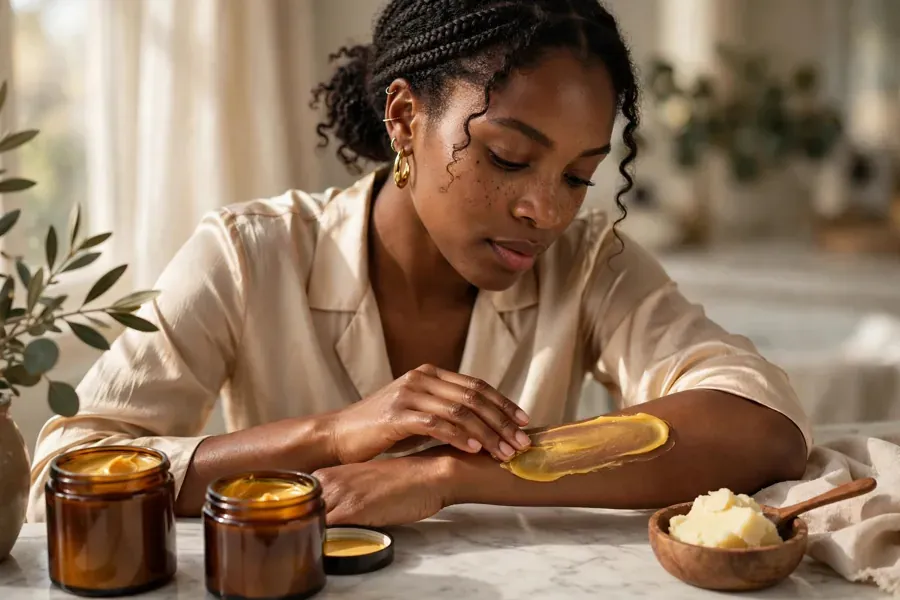
A Grade A shea, warmed between the palms until it turns to oil and worked in while the skin is still damp from the shower, passes that test the way it has passed it for generations: completely, and without a trace by the time the jewellery goes on.
Cocoa butter's ritual is the evening counterpart — the block or the bar drawn slowly over skin at the end of the day, melting on contact, leaving the faint chocolate warmth that no perfumer has ever improved on.
The hair ritual belongs mostly to shea: the same maker literature that assigns cocoa butter the structural role assigns shea the conditioning one, as the flexible base of whipped treatments and the sealant worked over moisturised lengths.
And the blended ritual — the whipped body butter in the amber jar, shea softened and whipped with cocoa butter's structure inside it — is where the two staples meet, in the proportions every family seems to keep as its own small inheritance. None of this requires a medical claim to justify it.
Skin that is kept supple, comfortable and cared for, by materials whose sourcing honours the women who made them, is the whole argument — and it is enough.
Buy, then, the way this magazine buys everything: by the verifiable facts on the label. The grade, stated. The process, stated — raw and water-extracted, or refined and proud of it, but never ambiguous.
The origin, stated, down to the region and, in the best houses, the cooperative. The claims, modest — moisture, barrier, softness, ritual — because the houses doing these butters at luxury level have learned what the folklore never needed to: that a staple which has kept its place on our dressing tables for centuries does not need to promise miracles.
It needs to be real, graded honestly, sourced fairly, and used daily. That is the standard, and both butters, at their best, meet it beautifully.
The Skin We're In: Hyperpigmentation, Melanin Experts, and the Dermatologist Who Gets It
The Beauty Standard: Skin First
Alopecia in Black Women: CCCA, Traction Alopecia Signs, and the Treatment Landscape
Hair as Signature
Women — Black Excellence Profiles
Baobab Mart — "Shea Butter Grades Explained: A, B, C and What They Mean"
Merida Skin — "Shea Butter for Skin: Top Benefits and Best Uses"
Cymbiotika — "How to Use Shea Butter for Glowing Skin"
Cleveland Clinic — "Cocoa Butter: What It Is, Benefits & Uses"
Cleveland Clinic — "Does Cocoa Butter Help With Stretch Marks?"
National Commission on Culture, Ghana — "Shea Butter in Ghana: A Cultural Heritage Rooted in Tradition and Sustainability"
Smithsonian Folklife Festival — "Shea Butter Production in West Africa"
Baraka — "Raw Unrefined Cocoa Butter DIY Guide"
Enhanced Integrated Framework — "Where's the money in shea?"
Questions & Answers
Who will you meet on this page?
Shea butter grades, raw vs refined, and cocoa butter skin benefits — what the grades actually mean, where these two ancestral butters come from, and the rituals that honour them. It links to 5 stories and articles — open any card to read the full piece.
What makes these stories worth reading?
Shea butter grades, raw vs refined, and cocoa butter skin benefits — what the grades actually mean, where these two ancestral butters come from, and the rituals that honour them.
How do I read the full stories on Cocoa Butter and Shea Butter: The Real Grades, the Real Rituals?
Choose any card on this page. Each one opens a full page of its own — the complete story or article, with its sources linked.