
Morehouse College: The Making of Morehouse Men
A Morehouse College history and notable alumni guide for families who believe a college should do more than educate a young man — it should make him.
Every family in our world keeps a short list of schools that are not really choices at all, but inheritances. This Morehouse College history and notable alumni guide exists because Morehouse sits at the top of that list for sons.
It is the college of Dr. Martin Luther King Jr., shaped by Dr. Benjamin E. Mays, set in the heart of Atlanta's Atlanta University Center — and it has spent more than a century and a half turning boys into what the world now recognises on sight: Morehouse Men.
Come with us through the story first, because at Morehouse the story is the standard.
A School Born in a Church Basement
Morehouse began in 1867, two years after the Civil War, as the Augusta Institute in the basement of Springfield Baptist Church in Augusta, Georgia — described in college histories as the oldest independent African American church in the United States.
Its founder, the Reverend William Jefferson White, a Baptist minister and cabinetmaker, set out to prepare Black men for the ministry and for teaching. HBCU Lifestyle's guide credits White alongside the Reverends Richard C. Coulter and Edmund Turney with building an institution committed to a comprehensive education for African-American men.
Twelve years later the school moved to Atlanta, taking the name Atlanta Baptist Seminary, and in 1913 it became Morehouse College, honouring Henry Lyman Morehouse, the corresponding secretary of the American Baptist Home Mission Society and a great benefactor of the school.
Under John Hope, its fourth president, the college shifted its focus toward liberal arts scholarship beginning in 1906, and that is the Morehouse the world knows: a liberal arts college for men, in Atlanta's West End, at 830 Westview Drive SW, a few miles southwest of downtown.
The distinction is precise, and it matters. Morehouse is, in the words of its college profiles, the nation's only private, historically Black, four-year liberal arts college for men — and Data.org's profile puts it plainly: founded in 1867, Morehouse remains the only all-male Historically Black College or University in the world. One school, one sex, one standard, uninterrupted since Reconstruction.
There is nothing else like it, anywhere.
The Standard: What a Morehouse Man Is
The college motto, carried in HBCU Lifestyle's quick facts, is Et Facta Est Lux — "And there was light." The mission, as the same guide renders it, is to develop men with disciplined minds who will lead lives of leadership and service. That is not brochure language at Morehouse; it is enforced by culture.
The suit is expected. The chapel is expected. The brotherhood is expected.
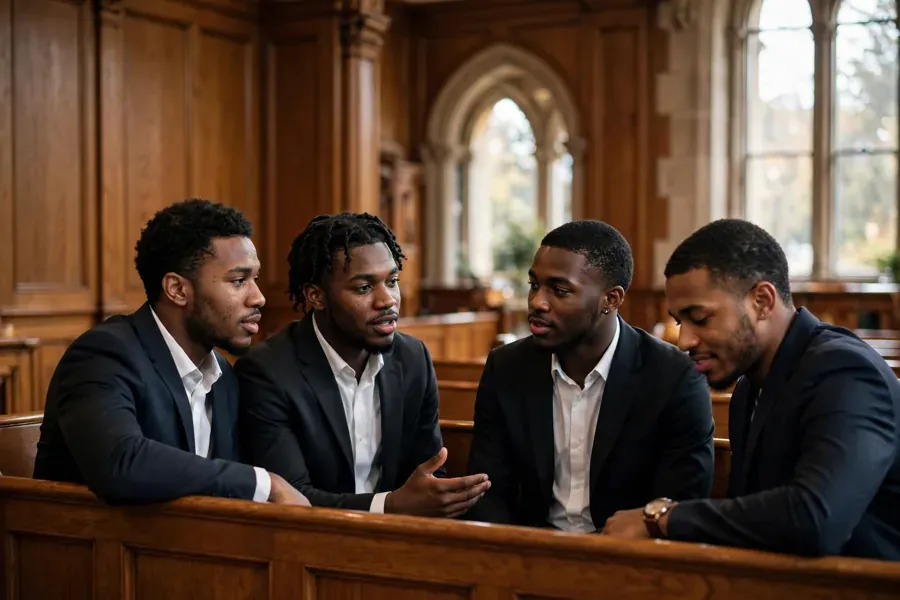
Students themselves, in The Princeton Review's student reporting, describe a campus linked by a sincere brotherhood feeling, where the typical student is ambitious and goal-oriented, and where a crowd leaving class will carry a conversation about social injustice, history or politics out onto the street.
Even though the school is predominantly black, great diversity is apparent within the school body.— A Morehouse student, via The Princeton Review
Hold that thought, because it is the part visiting families most often miss. Morehouse families come from everywhere — more than forty states and, in the college's own earlier profiles, some eighteen foreign countries — and what unites them is not sameness. It is the agreement, made on arrival, to be measured by the standard in public.
Benjamin Mays and the King Years
No account of Morehouse is honest without Dr. Benjamin E. Mays, president from 1940 to 1967. Mays instilled in Morehouse men a sense of social responsibility and transformed the college into a training ground for the leaders who would carry the Civil Rights Movement. His most famous student arrived in 1944.
Martin Luther King Jr. was a Morehouse student from 1944 to 1948, and he considered Mays his spiritual father — following him out of chapel, into his office, talking through the sermons for hours. King's mother, Alberta Williams King, said Mays was an example of what kind of minister Martin could become.
Read that slowly, because it is the whole inheritance in one scene: a president who preached on Tuesdays and expected excellence every other day, and a fifteen-year-old freshman who decided, in those pews, what a life of disciplined purpose looked like.
When your son walks the Yard, he is walking ground that has already produced the argument for what he can become. That is not marketing. That is the alumni roll.
The Names on the Wall
The roll is long, and every name on it is documented. Data.org's profile lists global leaders including Martin Luther King Jr., U.S. Senator Raphael Warnock, filmmaker Shelton "Spike" Lee, Samuel L. Jackson and John David Washington.
The Princeton Review's prominent alumni list adds Dr. David Satcher, the former U.S. Surgeon General; Olympic gold medallist Edwin Moses; and Maynard Jackson, the first African-American mayor of Atlanta. The University of Michigan's short history of the college rounds out the early generations with scholar Samuel Nabrit and civil rights lawyer and judge Horace T. Ward.
An alumni base of more than 17,000, per Data.org, carries the college's name into business, the arts, the pulpit, the Senate and the screen.
For our readers, the point is not celebrity. It is density. A Morehouse graduate does not enter a room as an individual applicant; he enters as the latest instalment of a known quantity.
Employers, congregations, admissions committees for the great graduate schools — they have met Morehouse Men before. Your son inherits their reputation on his first day, and spends four years learning he is expected to add to it.
Visiting: The Yard, the Chapel and the AUC
Visit properly. Morehouse sits inside the Atlanta University Center, the consortium it shares with Spelman College, Clark Atlanta University and Morehouse School of Medicine, and the neighbourhood is itself a syllabus in Black Atlanta.
Discover Atlanta lists Morehouse College tours by reservation on weekday mornings and afternoons, and the college's own admissions events page lists fall campus tours Monday through Friday — reserve ahead, dress as the family you are, and let your son see the students, not just the buildings.
Group visitors are offered 75-minute guided tours, according to Going On Faith's HBCU touring guide, which also makes the essential Atlanta pairing: lunch at the Busy Bee Cafe, once a gathering place for the city's civil rights leaders, and the Martin Luther King Jr. National Historical Park, honouring the college's proudest graduate.
And if your calendar allows one weekend above all others, make it homecoming — the joint Morehouse-Spelman celebration, SpelHouse, when the Yard fills with generations of alumni in maroon and white (the college colours, per HBCU Lifestyle) and a prospective family can watch the entire theory of the place performed live: the tailgate as family reunion, the alumni as proof.
Book rooms early; Atlanta fills.
Life on the Yard: The Year as Morehouse Keeps It
Understand the calendar and you understand the college. HBCU Lifestyle's campus-life listing names the fixtures: Homecoming, Spring Fest, and the Miss Maroon & White Pageant among them, with Greek organisations an established part of the Yard's life.
The Maroon Tigers compete in NCAA Division II, in football, basketball, baseball, golf, tennis, track and field and cross country by the same listing — which means the autumn belongs, as it should, to Saturday football and the band, and the whole AUC pours in.
But the texture of an ordinary week is what visiting families should study: young men in blazers crossing between classes, the conversations The Princeton Review's students describe spilling out of classrooms and continuing on the street, and a social contract in which how a man carries himself is treated as part of his transcript.
Morehouse men are greeted, corrected and celebrated by upperclassmen who regard the standard as theirs to defend. A shy boy can disappear at a big university. At Morehouse, of roughly two and a half thousand, he is seen — by his brothers first of all.
The city completes the education.
The Atlanta University Center sits in the West End, and Discover Atlanta's guide to the AUC points visitors beyond the gates to the Black-owned businesses of the neighbourhood — and the consortium's own address on Mildred Street places your son inside a working Black city, not a campus bubble: internships downtown, congregations across the South's capital of Black professional life, and Spelman College next door, with its own standard for its own students, sharing concerts, scholarship and the famous joint homecoming.
Families sometimes ask whether an all-men's college narrows a young man's world. At Morehouse the honest answer, visible on any visit day, is the opposite: it concentrates it for four years, inside the richest Black collegiate ecosystem in America, and then releases him into an alumni network that treats his success as a family matter.
That is the making the headline promises — slow, public, and by design.
The academic shape matches the ambition. Data.org's profile lists degrees across 27 concentrations — business administration, biology, pre-engineering, political science and computer science among them — and Going On Faith's touring guide describes Morehouse as known for producing the highest number of Black men who earn doctorate degrees.
That doctorate pipeline is the quiet headline under all the famous names: Morehouse does not merely graduate its men into first jobs; it graduates them, at unusual rates, into the graduate and professional schools where the professions are actually entered — medicine, law, the ministry, the academy.
A family choosing Morehouse is buying that pipeline as much as the diploma, and the alumni in the doctoral robes at commencement are its annual audited report.
Attending: The Honest Numbers
Now the practical page, with every figure attributed, because published sources differ and your family deserves the ranges rather than a single polished number.
Enrollment: HBCU Lifestyle lists a student population of 2,438, all undergraduate, while The College Monk, compiling IPEDS and NCES data, lists 2,844 — call it a college of roughly two and a half thousand men, small enough for the brotherhood to be real.
Selectivity: The Princeton Review lists 5,714 applicants and a 44% acceptance rate, with an average high school GPA of 3.56; AtlantaFi's guide gives a recent acceptance range of about 33–44%, so plan for a genuinely selective file.
Cost: The College Monk lists tuition of $32,893, while AtlantaFi puts recent tuition around $34,000 with a total cost of attendance often above $40,000 before aid — and notes that aid matters here, with an average first-year package supporting a large majority of students. The student-to-faculty ratio is listed at 13 to 1 by HBCU Lifestyle.
Verify the current cycle's figures with the college before you budget; that is what careful families do, and Morehouse respects careful families.
What no spreadsheet holds is the return. A Morehouse degree is a network with a dress code and a conscience, in the city that has become the capital of Black professional America. For the son who thrives on expectation — who rises when the bar is named out loud — there is no substitute.
That is why, generation after generation, our families keep sending their young men to Westview Drive, and why the young men keep coming home as something more than they left.
Howard University: The Mecca
Spelman College: The Sisterhood That Builds
Hampton University: The Standard of Excellence by the Sea
Fisk University: The Jubilee Standard
Choosing the School: Private, Boarding, and the Education That Fits Your Child
The First Gate: Preschool
Black Wall Street: Greenwood
HBCU Lifestyle — "Morehouse College: An HBCU Lifestyle Guide"
University of Michigan — "A Short History of Morehouse College"
The Princeton Review — "Morehouse College Rankings & Reviews"
The College Monk — "Morehouse College Admission, Cost"
AtlantaFi — "Morehouse College: The Ultimate Guide for Aspiring Students and Parents"
Discover Atlanta — "Historically Black Colleges & Universities: Atlanta University Center"
Morehouse College — "Admissions Events"
Data.org — "Morehouse College"
Listal — "Morehouse College"
Questions & Answers
How do families pass down wealth and values?
A Morehouse College history and notable alumni guide for families who believe a college should do more than educate a young man — it should make him. It links to 8 stories and articles — open any card to read the full piece.
How do you involve children in family wealth planning?
A Morehouse College history and notable alumni guide for families who believe a college should do more than educate a young man — it should make him.
How do I read the full stories on Morehouse College: The Making of Morehouse Men?
Choose any card on this page. Each one opens a full page of its own — the complete story or article, with its sources linked.