
Fisk University: The Jubilee Standard
A Fisk University history, Jubilee Singers and notable alumni guide to the small Nashville school that sang itself into survival — and educated Du Bois, John Lewis and Nikki Giovanni.
If this series has a jewel box, it is Fisk. This Fisk University history, Jubilee Singers and notable alumni guide is for the family who suspects — correctly — that the smallest school on the list may hold the deepest inheritance. Fisk University in Nashville has never had the largest classes or the loudest stadium.
What it has is a sound: the sound of nine young singers who took the songs of their enslaved parents onto the stages of two continents, saved their school from closure, and built its first great hall with the proceeds. Everything at Fisk since — Du Bois, John Lewis, a world-class art collection — stands in that sound's long echo.
Listen closely.
Six Months After the War
Barely six months after the end of the Civil War, Soul of America's Fisk profile records, three men established the Fisk School in Nashville, Tennessee, named in honour of General Clinton B. Fisk of the Tennessee Freedmen's Bureau.
Committed to educating the newly freed, whose ages ran from seven to seventy, the school held its first classes in 1866 in former Union Army barracks near the present site of Nashville's Union Station. Sit with those ages for a moment.
Fisk's first classroom held children and grandparents learning side by side, in army barracks, because the chance had finally come. The university has never quite lost that urgency — the feeling that education here is not a credential but a deliverance, taken seriously.
The Singers Who Saved a School
By 1871 the school was in debt and facing closure. The response became the most famous act of self-rescue in American education.
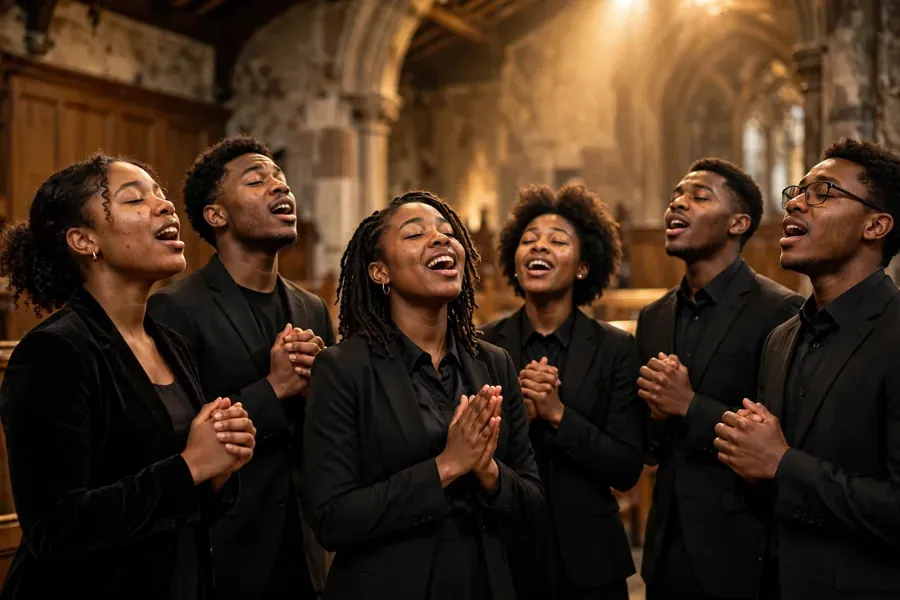
A student choir, led by George L. White, the university's treasurer and music instructor, went on tour to raise money — The EDU Ledger's account records that the school gave the singers the last $40 it had; that White named the group of nine young Black men and women after the biblical year of jubilee, the year of deliverance from slavery — fitting, since seven of the nine had themselves been enslaved — and that within months the singers had raised $20,000, enough to pull Fisk out of danger.
Then they kept going.
The Living Church's account of the Singers describes two years of touring Europe and the United Kingdom: Prime Minister William Gladstone hosting a private breakfast, Queen Victoria so delighted that she made a special request for "Steal Away" and commissioned a grand portrait of the group that still holds pride of place at Fisk.
The tours raised, in all, some $150,000 by The EDU Ledger's account, and the money built Jubilee Hall — the South's first permanent structure built for the education of Black students, now a National Historic Landmark and still the focal point of the campus.
The Singers' spirituals did something else, harder to price: they carried the music of enslaved people into the concert halls of the world and changed what the world thought that music — and those people — were. The ensemble performs still, and received the National Medal of Arts in 2008, carrying a tradition now more than 150 years old.
I would walk seven miles to hear them sing again.— Mark Twain, on the Fisk Jubilee Singers, via The Living Church
A Small School, an Outsized Mind
Fisk's scholarly harvest is, relative to its size, close to unmatched.
Climb the Ladder's profile of what Fisk is known for notes that W.E.B. Du Bois, the great social critic and co-founder of the NAACP, graduated from Fisk in 1888; that journalist Ida B. Wells-Barnett, whose reporting on lynching changed American public discourse, also attended; that historian John Hope Franklin became widely regarded as the most eminent historian of the African American experience; and that Charles Spurgeon Johnson, Fisk's first Black president, helped establish the modern field of sociology and founded the Race Relations Institute in 1945.
The same profile reaches into the sciences: Elmer Samuel Imes, class of 1903, whose work in high-resolution infrared spectroscopy provided early verification of quantum theory, and Saint Elmo Brady, among the first African Americans to achieve eminence in chemistry.
Du Bois himself devoted a chapter of The Souls of Black Folk to the Jubilee Singers — the scholar forever honouring the singers who had paid for his school's survival a generation before he arrived.
Conscience and Poetry
The line runs straight into living memory.
John Lewis held a bachelor's degree in religion and philosophy from Fisk, and Auburn University's laureate profile records that as a Fisk student he organised sit-ins at segregated lunch counters in Nashville and joined the Freedom Rides — the conscience of Congress, formed on this small campus and in this city, alongside fellow Fisk student Diane Nash, with whom he helped change Nashville itself.
And the poetry: Nikki Giovanni graduated with honours from Fisk University, her grandfather's alma mater, in 1968, publishing her first book of poetry that same year, as the Mississippi Senate's resolution in her honour records.
Add two-time Pulitzer Prize-winning author David Levering Lewis, and the pattern is unmistakable: Fisk takes in readers, singers and believers, and returns writers, organisers and scholars. For the child in your family whose gifts are verbal, musical or moral — which is to say, for most of our children at their best — Fisk is not a compromise choice.
It is the pointed one.
The Art on the Walls
A final distinction, and the one visiting families least expect: the art.
The Fisk University Galleries describe a permanent collection of more than 4,000 objects spanning three centuries — Cézanne, Picasso, Calder, Henry Ossawa Tanner, Elizabeth Catlett, Diego Rivera, Aaron Douglas, Georgia O'Keeffe and Alfred Stieglitz among the artists represented — shown in the Carl Van Vechten Gallery and the Aaron Douglas Gallery, with admission free. Read that list again.
A college of about a thousand students holds a modern-art collection that cities envy, in galleries named for a photographer-critic and for the great Harlem Renaissance painter who taught at Fisk. A Fisk student does not visit culture on field trips.
She lives inside it, on a 40-acre campus about two miles west of downtown Nashville, a mile from Vanderbilt and half a mile from Tennessee State — a small, dense, storied world in a music city.
The Yard, the Oval and the Rooms That Hold History
Fisk keeps its relics the way great families keep theirs: in use.
A Fisk alumnus's account of returning to campus, carried on the university's own site, describes being allowed — in white gloves, in the Special Collections — to hold one of the few remaining slave Bibles in the world, and to stand before the full Bible presented by Black people to Abraham Lincoln after the Emancipation Proclamation.
Let that settle: at Fisk, a student does not only read history in the library; the library hands it to her, carefully, and trusts her hands.
The same account records what the campus did with that inheritance in the twentieth century — Fisk played a major role in the Civil Rights Movement and in coordinating the Freedom Riders, the work for which Lewis and Nash were its students.
And the social memory is kept as faithfully as the scholarly one: the alumnus writes of returning to the Yard, walking the beloved Oval, the fence by the café, Crab Night and the fraternities' first march — the small liturgies of a small campus where everybody's family is, within a semester, partly yours.
This is the texture money cannot buy at scale: a thousand students, a 40-acre stage, and a past that keeps handing the present its lines. For the right child — the reader, the singer, the one who asks the table's hardest questions — Fisk's smallness is not a limitation to excuse. It is the entire proposition.
Why, then, do families with every option choose the smallest school in this class on purpose?
Partly for the fields themselves — Soul of America's profile lists study across the liberal arts and sciences, from biology, chemistry, physics and mathematics to business administration, computer science, criminal justice and social justice — and partly for a reputation that profile states in the strongest terms in this entire series: that Fisk has a standing for contributing alumni to the ranks of doctorally prepared African American scholars out of proportion to any institution of its size.
We carry that as the source's claim, not our arithmetic — but the documented names above, from Du Bois and Franklin to Imes and Brady, are what the claim rests on, and they are not in dispute.
A Fisk student is known by her professors, cast in the choir's long shadow, handed the gloves in Special Collections, and expected, by name, to become somebody the school will one day list. Some children are lost in that closeness. The right child catches fire in it.
Visiting and Attending: The Honest Numbers
Visit for Jubilee Hall first — stand in the building the songs bought — then the galleries, whose listed weekday hours make a weekday visit the richer one; confirm the current schedule with the university before you travel, as careful families do.
Hear the current Jubilee Singers if the calendar allows; alumni return for them the way other schools' alumni return for football. Nashville does the rest: stay downtown or in Midtown, and let your student feel how near everything is.
The numbers, attributed, with the sources' own framings kept intact. Scale: Money's profile lists undergraduate enrollment of 1,040, and CollegeTuitionCompare's at-a-glance lists total enrollment of 1,059 — genuinely small, by design and by history.
Selectivity: both Money and CollegeTuitionCompare list an acceptance rate of 37% — the most selective figure in this HBCU first class, and a fair reflection of the academic self-selection Fisk inspires.
Cost: CollegeTuitionCompare lists tuition and fees of $25,858 in its published at-a-glance figures; Money estimates a full price of $48,440 for its listed year and an average price after financial aid of $19,610, with 87% of undergraduates receiving grants.
That last pairing is the Fisk story in arithmetic: a serious private education whose published net price, after aid, lands within reach of the very families the school was founded in army barracks to serve.
Every series needs its standard of proof. Morehouse has the standard of the man; Hampton, the standard of the ground. Fisk's is the standard of the offering: nine singers, forty dollars, and a hall that still stands.
Families in our world, who know what it costs to build something meant to outlast you, will recognise the transaction instantly — and will know exactly why a child of theirs might belong inside it — and why the smallest door in this series sometimes opens onto the largest room of all: a life of the mind, earned in Nashville.
Howard University: The Mecca
Spelman College: The Sisterhood That Builds
Morehouse College: The Making of Morehouse Men
Hampton University: The Standard of Excellence by the Sea
Choosing the School: Private, Boarding, and the Education That Fits Your Child
The First Gate: Preschool
Black Wall Street: Greenwood
Soul of America — "Fisk University"
Climb the Ladder — "What Is Fisk University Known For: Art, Music & History"
The Living Church — "Fisk Jubilee Singers Keep History Alive"
The EDU Ledger — "Fisk University's Jubilee Singers Inducted into Gospel Hall of Fame"
Money — "Fisk University: Cost, Acceptance Rate, Outcomes"
CollegeTuitionCompare — "Fisk University At a Glance"
Fisk University — "Galleries"
Auburn University — "John Lewis, IQLA Laureate"
Mississippi Senate Concurrent Resolution 656 — "Recognizing Nikki Giovanni"
Questions & Answers
How do families pass down wealth and values?
A Fisk University history, Jubilee Singers and notable alumni guide to the small Nashville school that sang itself into survival — and educated Du Bois, John Lewis and Nikki Giovanni. It links to 8 stories and articles — open any card to read the full piece.
How do you involve children in family wealth planning?
A Fisk University history, Jubilee Singers and notable alumni guide to the small Nashville school that sang itself into survival — and educated Du Bois, John Lewis and Nikki Giovanni.
How do I read the full stories on Fisk University: The Jubilee Standard?
Choose any card on this page. Each one opens a full page of its own — the complete story or article, with its sources linked.