
Princeton: The Eating Clubs and the Open Door — Black Students, Alumni and a Visiting Guide
The eating clubs made Princeton's legend; the open door beside them made its Black alumni network. A princeton black students alumni visiting guide to the thesis, the clubs, the Fields Center, the aid — and the town.
If your family is building its own princeton black students alumni visiting guide — the honest one, not the brochure — start here. Princeton is the Ivy that puts the undergraduate at the very centre of the enterprise, and its social life runs through a row of mansions on Prospect Avenue that families either fear or misunderstand.
This guide walks the whole ground: the founding, the distinction, the eating clubs and the open door beside them, the Black students and alumni who built a home here, what admission and aid actually look like, and how to visit the town properly.
A College Older Than the Country
Princeton was chartered in 1746 as the College of New Jersey, founded at Elizabeth, New Jersey as an outgrowth of the Great Awakening, and it moved to Newark before settling in Princeton, where Nassau Hall was built in 1756.
That single building once held the entire college — classrooms, dormitories, library, chapel and dining room — and it still anchors the campus today. During the Revolution the Battle of Princeton was fought on the college grounds in 1777, and in 1783 the Continental Congress met in Nassau Hall and formally thanked George Washington for his service.
The college took the name Princeton University in 1896, and it stands as the the fourth-oldest university in the United States, open from its first charter, unusually for its era, to students of any religious denomination.
That is the inheritance every family walks into: a small, storied college town in New Jersey, an hour's world away from Manhattan, where the architecture does half the persuading before a single class is mentioned.
Read the full timeline and you will find the names that run through it — James Madison of the Class of 1771 became the first president of the Alumni Association — because Princeton has always treated its alumni as part of the institution itself, not as graduates who left.
The Distinction: The Undergraduate's University
Among the eight Ivies, Princeton's honest claim is focus. This is a great research university that behaves, day to day, like an undergraduate college. The signature is the senior thesis: every A.B. student completes a major independent project in the senior year, prepared by junior papers — the JPs — written the year before.
It is genuinely unusual among American universities; admissions guides note that Princeton requires all A.B. students to complete a senior thesis and independent work, and seniors even reduce their course loads so the thesis gets the spring it deserves.
Teaching follows the same intimate pattern. Large lectures break into precepts of five to ten students, where the real discussion happens and where students come to know the faculty who will one day write their recommendations.
Students live and dine in residential colleges for their first years — the system that advisers like the ones in the alumni profiles serve as resident advisers within — before the famous question of the upperclass years arrives: the clubs.
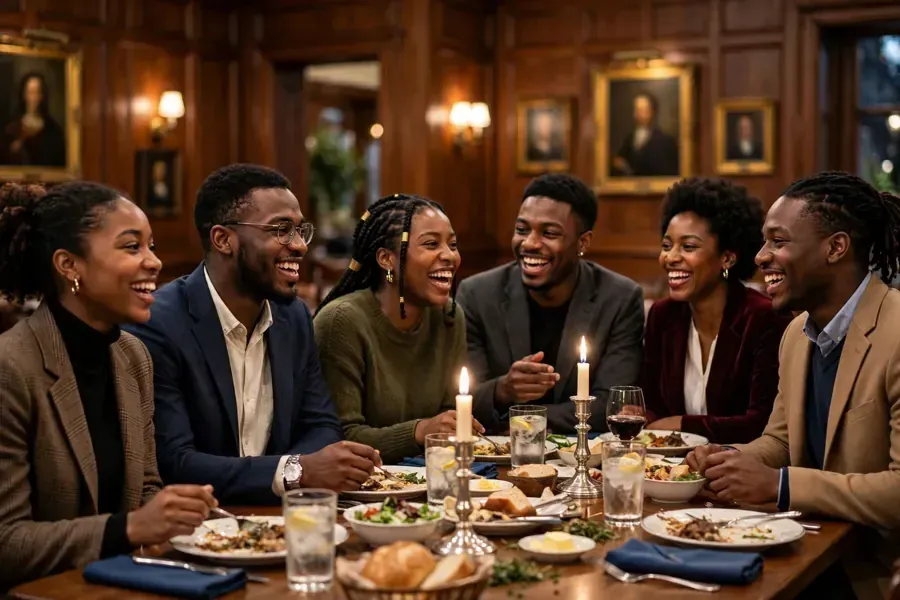
The Eating Clubs and the Open Door
No honest Princeton guide skips Prospect Avenue. The eating clubs are private dining and social houses in mansions along Prospect Avenue — "The Street" — where the majority of juniors and seniors take their meals.
In the classic count there are eleven: six choose their members through bicker, a selective round of conversations and deliberations, and five are sign-in clubs, where members are chosen by lottery rather than by judgement.
The clubs are the setting of F. Scott Fitzgerald's This Side of Paradise, and they have carried a charge of elitism for a century — a charge the record supports in part: the clubs were slow to open, and the cost gap between club membership and a university dining plan was a live controversy until the university raised upperclass aid packages to cover the difference.
But the door is wider than the legend. The sign-in clubs ask nothing but your name; a group sign-in system, introduced in 2024, lets friends sign in to a club together and be placed together, and roughly eighty-four percent of sophomores took part in Street Week in the most recent count the student paper reported.
Students who want none of it dine in the residential colleges, join a co-op, or cook independently — and the university's own cultural centre, as you will see, was quite literally built by Black students who wanted a house of their own. The clubs are a choice here, not a toll.
Black Life at Princeton: The Builders
The modern Black Princeton was built, deliberately, by named people. When Carl A. Fields arrived as an assistant director of student aid, there were twelve Black undergraduates in the student body; when he left in 1971, there were more than three hundred.
Fields became the senior-ranking Black administrator and the first Black dean in the Ivy League, and one of his last initiatives created the Third World Center — renamed in 2002 the Carl A. Fields Center for Equality and Cultural Understanding, the house Black students had asked for when the eating clubs were not their home.
It sits, fittingly, in a former club building on Prospect Avenue's edge.
The alumni built the rest of the scaffolding. The Association of Black Princeton Alumni was founded in 1972, among the first of the university's affinity alumni associations, and it now counts its members in the thousands.
Women were admitted as undergraduates in 1969, and Black alumni have been telling their own story back to the institution ever since — in oral histories recorded at Reunions with alumni like Robert Rivers '53, one of the first Black students admitted to Princeton, and in the Thrive conferences that bring Black alumni back to campus to connect and celebrate.
Princeton's own advancement history is candid that the student body was for much of its history exclusively male and overwhelmingly white, and that the change, when it came, was driven substantially by the students and alumni themselves. That candour is part of what your family is buying into: an institution that now prints its own unfinished work.
That network is not ceremonial.
When the ABPA's president Eric Plummer '10 — a managing director who interviews Princeton applicants as an alumni volunteer — describes his charge, he speaks of marshalling the association's 5,500 members toward community engagement that is "deeper, richer and more efficient," and his advice to the undergraduates he interviews is the builders' creed in one line: build what you would like to see.
His own family is the proof of concept — an uncle who was Princeton's first Black quarterback, a father from the Class of 1985 who brought him to ABPA Reunions cookouts at the old Third World Center as a small child, and a son who arrived on campus already knowing where his people gathered.
That is what legacy means at Princeton now: not a name on a gate, but a table already set.
"If there's one thing that I've learned since I've left Princeton, it's this: No matter what direction you're headed, nobody gets there alone."— Michelle Obama '85, in a welcome message to Princeton's Thrive conference for Black alumni, via Princeton's Department of African American Studies
Names to Know
Begin with the name every Princeton family knows. Michelle Robinson Obama graduated with the Class of 1985, a sociology major with a minor in African-American studies, and the University Archives still holds her senior thesis, "Princeton Educated Blacks and the Black Community" — a young woman studying, in her own moment, exactly the question this guide asks.
A generation later, Nicholas Johnson became the first Black valedictorian in Princeton's history, an operations research and financial engineering graduate who quoted Mrs. Obama in his commencement address and said he hoped his achievement would inspire the Black students coming up behind him.
Between those two bookends stand the Fields Center classes, the ABPA's five thousand members, and a Black alumni network that treats mentoring as a duty, not a favour.
Attending: The Reality and the Aid
The door is narrow and the welcome, once through it, is unusually complete. For the Class of 2029, Princeton admitted 1,868 students from a record 42,303 applications — an acceptance rate of 4.4%, with a mid-50% SAT range for enrolled students of 1510 to 1570.
Princeton is test-optional for the current cycle and will reinstate an SAT or ACT requirement for applicants from the 2027–28 cycle. Published tuition and fees stand at $62,688 a year in the federal College Scorecard figures — and the average net price after aid, in the same data, is $6,128, because Princeton's aid is grant aid, not loans.
The university's most recent expansion, reported in August 2025, covers the full cost of attendance for most U.S. families earning up to $150,000 and eliminates tuition for most families earning up to $250,000.
For a family weighing legacy against cost, those two numbers — the 4.4% and the grant — are the whole conversation: get in, and Princeton intends for money not to be the reason you say no.
Visiting Princeton
Do the visit properly. Princeton offers information sessions with student-led tours on weekdays and student-led tours on weekends, with registration required, plus virtual information sessions and a live virtual Tiger Walk tour if you cannot get to New Jersey.
Walk Nassau Hall and the chapel, stand under the arches, then do the two stops this guide exists to send you to: the Carl A. Fields Center, to see the house the builders made, and Prospect Avenue at mealtime, to see the clubs with your own eyes rather than through their legend.
Stay in town — the Nassau Inn sits on Palmer Square in the heart of Princeton, and the Graduate Princeton stands on Chambers Street, steps from the university gates. Give the town an evening: dinner on Palmer Square, the bookshops, the quiet of a college town that has been receiving ambitious families for nearly three centuries.
Round out the weekend with the university's quieter treasures. The Princeton University Art Museum, founded in 1882, houses a collection of more than 72,000 works of art — the kind of museum most universities would call a destination, sitting here as a student's everyday resource.
And plan the visit around how Princeton actually lives: housing is guaranteed for all four undergraduate years, and 98% of undergraduates live on campus, in a student body of some 5,800 undergraduates and 3,300 graduate students. This is a walking campus in a walking town; your child will not need a car, and neither will you.
Princeton asks a great deal of its students — a thesis, a precept, a self — and it gives back a network that answers for a lifetime. For the family that wants the undergraduate's university, with its eyes open about the clubs and its hand on the open door beside them, there is nothing else quite like it.
Pair this guide with our look at choosing the school itself, and with the other Ivy entries in this series, and walk the Street for yourselves.
Columbia: Harlem's University, Uptown's Stage
Brown: The Open Curriculum, the Open Mind
Howard University: The Mecca
Choosing the School
The First Gate: Preschool
Raising Heirs, Not Dependents
Encyclopaedia Britannica
Wikipedia
The Daily Princetonian — Princeton timeline
The Daily Princetonian — the senior thesis
College Transitions — Princeton supplemental essays and the thesis requirement
Unigo — Princeton academics and precepts
Wikipedia — Eating clubs at Princeton University
The Daily Princetonian — Street Week and club placement
The Daily Princetonian — Black History Month: looking back at the 1970s
Princeton Alumni Weekly — Under the Ivy: Carl Fields
Princeton University Advancement — Task Force on the Future of Affinity Programming report
Princeton Alumni Weekly — Black alumni tell their stories
Princeton Department of African American Studies — the Thrive conference
Princeton University Archives — Michelle Obama at Princeton
Good News Network — Princeton's first Black valedictorian
Oriel Admissions — How to Get Into Princeton University
EDsmart — Princeton University: acceptance rate, tuition and rankings
IvyWise — How to Get into Princeton (visiting)
Nassau Inn, Palmer Square, Princeton
UniPage — Princeton University: students, housing and aid
Princeton Alumni — ABPA President Eric Plummer '10: Be the Change
Questions & Answers
How do families pass down wealth and values?
The eating clubs made Princeton's legend; the open door beside them made its Black alumni network. A princeton black students alumni visiting guide to the thesis, the clubs, the Fields Center, the aid — and the town. It links to 7 stories and articles — open any card to read the full piece.
How do you involve children in family wealth planning?
The eating clubs made Princeton's legend; the open door beside them made its Black alumni network. A princeton black students alumni visiting guide to the thesis, the clubs, the Fields Center, the aid — and the town.
How do I read the full stories on Princeton: The Eating Clubs and the Open Door — Black Students, Alumni and a Visiting…?
Choose any card on this page. Each one opens a full page of its own — the complete story or article, with its sources linked.