Columbia: Harlem's University, Uptown's Stage — Black Students and a Visiting Guide
Uptown's stage and Harlem's university: a columbia university black students harlem visiting guide to the Core, the giants who studied here, the aid — and the walk north into Harlem.
Every family that comes uptown needs a columbia university black students harlem visiting guide that tells the truth about this singular place: an Ivy League campus set into Manhattan's Morningside Heights, with Harlem — the capital of Black America — as its neighbour, its teacher and, for generations of its students, its second classroom.
Columbia is the urban Ivy, the one where the city is not a backdrop but a curriculum. Here is the whole of it: the founding, the Core that defines it, the Black students who organised here and the giants who studied here, what admission and aid look like, and how to visit uptown properly.
King's College to Columbia
Columbia is the the oldest university in New York State — and the fifth oldest in America.
It was established under a royal charter from George II in 1754 as King's College, and it began as humbly as a legend can: a first class of eight students in a schoolhouse adjoining Trinity Church at the lower tip of Manhattan, taught by its first president, Samuel Johnson.
Among the early students were Alexander Hamilton, John Jay, Robert Livingston and Gouverneur Morris — a founding generation educated in one small room. The Revolution suspended instruction in 1776; the college reopened in 1784 as Columbia College, and in 1767 it had already established the first American medical school to grant the M.D. degree.
From that schoolhouse it grew into a great research university of some 36,000 students — yet the undergraduate college at its heart still runs on the intimate machinery it invented a century ago.
The Distinction: The Core
Ask what Columbia is, and every Columbian answers with one word: the Core. The Core Curriculum is the distinguishing characteristic and hallmark of an undergraduate education at Columbia — a shared set of courses every Columbia College student takes, whatever their major.
Its twin pillars are yearlong seminars: Literature Humanities in the first year and Contemporary Civilization in the second, flanked by Art Humanities, Music Humanities, University Writing and Frontiers of Science.
The reading is the point — a current Lit Hum syllabus runs from Homer, Plato and Augustine through Dante, Shakespeare and Austen to Woolf and Morrison, read closely, in rooms of about twenty-two students, four hours a week. Contemporary Civilization puts Hobbes, Marx, Du Bois, Arendt and de Beauvoir on the same table and asks students to test every claim.
A family choosing Columbia is choosing that common conversation: your child will argue the same books, in the same sequence, as every other graduate — including the ones in the next section.
The Core's architecture rewards a closer look, because it is the daily texture of a Columbia education. Beyond the two yearlong pillars, every College student takes Art Humanities and Music Humanities — the arts studied as seriously as the texts — plus University Writing and Frontiers of Science, and two Global Core courses that explore non-Western cultures and perspectives.
The whole structure dates to 1919, which makes Columbia the keeper of the oldest continuously running experiment in shared undergraduate learning in the Ivy League. Families sometimes ask whether so prescribed a curriculum leaves room for a student's own direction.
The Columbian answer is that the Core is the floor, not the ceiling: roughly a third of the degree is common ground, and the rest belongs to the student's concentration, the city's internships and the university's laboratories.
What the Core guarantees is that no Columbia graduate — engineer, poet or economist — leaves Morningside Heights unable to argue a text with a stranger who read the same page.
Harlem's University
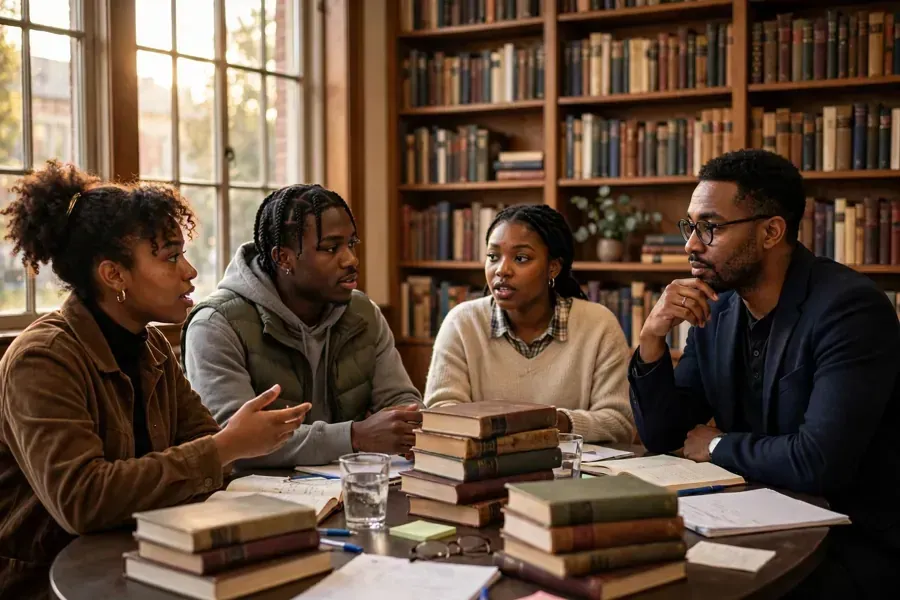
Geography is destiny here. The campus sits in Morningside Heights — bustling, bookish, full of cafés and bookstores — and just north lies Harlem, the heart of much of the city's art world for many years, with the great museums of the Upper East and West Sides just south. Black students at Columbia have never treated that geography as scenery.
The Student Afro-American Society was founded in 1964 by members of the classes of 1967 and 1968 to give the handful of Black students on campus a designated space of their own, and its alumni are still organising — the Society's successors have been working to strengthen the Black alumni network and deepen its involvement in Harlem-based initiatives.
When Columbia proposed a gymnasium in Morningside Park in 1968, it was the SAS, standing with the Harlem community that had traditionally used the park, that named the project "Gym Crow" and stopped it — a brief, factual chapter that explains why the university-community relationship here is negotiated, not assumed.
The university has since placed historical markers at residence halls acknowledging its early ties to slavery, including one at Hartley Hall, which housed a high percentage of Black students in the early twentieth century, among them Langston Hughes.
Another marker, at Furnald Hall, recalls Frederick W. Wells, the first Black student to live in Columbia's on-campus housing — the university placing its hardest chapters on the very walls its students pass daily, in the same spirit of record-keeping this magazine practises: the names kept, the facts plain, the story carried forward by the people who came after.
"I was one of only seven Black boys in my class at Columbia. Seven out of 750."— Ernest Holsendolph '58, recalling his undergraduate years, via the Columbia Spectator
From those seven, the line runs unbroken to the present institution: the Institute for Research in African-American Studies and its successor department in African American and African Diaspora Studies, whose development Columbia traces from courses taught by Harlem-based intellectuals through scholars like Charles Hamilton — one of the first African Americans to hold an academic chair at an Ivy League university — to the department chaired in our time by Farah Jasmine Griffin.
Black life at Columbia is not a programme. It is a faculty, a neighbourhood and an alumni network that expects its graduates to come back and be useful.
Names to Know
The roll begins with a transfer student who arrived from Occidental College in 1981 and, as the Miller Center records, graduated from Columbia with a political science major in 1983: Barack Obama, the first Columbia graduate to occupy the Oval Office. Before him came the scholars who built the house he walked into.
Arthur P. Davis, Columbia College 1927, became the first Black student awarded a Ph.D. in English from Columbia and went on to Howard University as a professor who spent his life lifting up Black writers.
Langston Hughes moved to New York in 1921 to attend Columbia and published his first poem, "The Negro Speaks of Rivers," while there, before Harlem's stages claimed him.
And at Barnard, Columbia's sister college, Zora Neale Hurston studied anthropology as the college's first African American student, graduating in 1928 and returning for graduate work at Columbia under Franz Boas; a Zora Neale Hurston Professorship of English at Columbia now honours her.
A campus that educated a president, a poet and the anthropologist of Black folklore — all within a few uptown blocks — is making a specific promise to your child, and it has the receipts.
The scale deserves a moment, because families misjudge it in both directions.
Columbia grew from fewer than 100 students in 1850 to more than 12,000 by 1914, with a faculty that expanded from 15 to over 900 — the small college became a research university in a single lifetime, and it has never stopped: the university today counts 11 global centers around the world alongside its New York schools.
Yet the undergraduate experience is deliberately kept at seminar scale. A Lit Hum section meets in groups of about twenty-two students for four hours each week, and Contemporary Civilization is built the same way — close reading, writing, and argument about how people build political, social, moral and religious communities, and which values shape them.
The Core is also a social technology: because every student reads the same books in the same order, the first-year from Harlem and the first-year from Houston begin with a shared library between them.
Alumni of the Student Afro-American Society told the Spectator they are working to grow exactly that kind of network on the alumni side — a standing web of Black Columbians, organised on purpose, into which each new class is received.
Attending: The Reality and the Aid
The selectivity is the sternest in this series. Columbia's own Common Data Set figures, as compiled by admissions trackers, put the acceptance rate at 3.9%, with 2,325 admitted from some 60,000 applicants and a mid-50% SAT range of 1510–1580.
Columbia is also, per admissions analysts, the only Ivy that is permanently test-optional — the application rests on the transcript, the essays and the student's evident appetite for the Core and the city.
The published cost of attendance runs to $99,774 a year in the 2026–27 figures — and Columbia meets the full demonstrated need of first-year students through grants and work study, without loans, with families earning under $150,000 a year generally not expected to contribute, and an average grant award of $76,503. About half of Columbia students receive grant aid.
The arithmetic is the familiar Ivy paradox, at Manhattan prices: the hardest part is the door, not the bill.
Visiting Uptown
Visit as you would visit a great city: on foot, with time. One-hour campus tours are offered free to prospective students, their families and educators, with prior registration required, and a self-guided walk around the campus is free — though campus access is at times restricted to students, staff and registered guests, so register before you come.
Stand on the steps of the great domed library, look south down Broadway, then do what this guide exists to send you to do: walk north into Harlem.
Have lunch on Lenox Avenue, stand outside the Apollo's marquee, visit the Schomburg Center's exhibitions, and let your child feel the difference between a university near Black culture and a university in conversation with it. Stay in Morningside Heights or on the Upper West Side so the neighbourhood, not a hotel district, is what they remember.
Columbia will tell you, correctly, that New York is its campus. Harlem is its conscience. A family visit should meet both.
For the student who wants the shared books, the seminar table and the city all at once — and who understands that Harlem is not an amenity but a responsibility and a gift — Columbia is the Ivy with its gates open to the avenue.
Read our companion guides to choosing the school and to its sister Ivies in this series, then come uptown and walk it.
Princeton: The Eating Clubs and the Open Door
Brown: The Open Curriculum, the Open Mind
Howard University: The Mecca
Choosing the School
The First Gate: Preschool
Raising Heirs, Not Dependents
Columbia University — Our History
Columbia University Faculty Handbook — History
WikiCU — the Core Curriculum
AdmitYogi — Columbia Core Curriculum explained
Shemmassian Academic Consulting — Columbia admissions guide
Columbia University Libraries — 1968: Columbia in Crisis (the SAS)
Columbia Spectator — Student Afro-American Society alumni and Harlem
Columbia News — Farah Jasmine Griffin and African American studies at Columbia
Columbia News — 10 Decades, 10 Black Columbians You Should Know
Miller Center — Barack Obama: Life Before the Presidency
Columbia Celebrates Black History — Zora Neale Hurston
Reading Is Fundamental — Artists of the Harlem Renaissance (Langston Hughes at Columbia)
AcceptanceRate.com — Columbia University admissions, Common Data Set figures
Oriel Admissions — How to Get Into Columbia University
BET — Columbia to acknowledge historic ties to the slave trade with campus markers
Priceline Experiences — visiting Columbia University
JobLoving — What is the Core Curriculum at Columbia University?
CollegeVine — Columbia University's Core Curriculum
Questions & Answers
How do families pass down wealth and values?
Uptown's stage and Harlem's university: a columbia university black students harlem visiting guide to the Core, the giants who studied here, the aid — and the walk north into Harlem. It links to 7 stories and articles — open any card to read the full piece.
How do you involve children in family wealth planning?
Uptown's stage and Harlem's university: a columbia university black students harlem visiting guide to the Core, the giants who studied here, the aid — and the walk north into Harlem.
How do I read the full stories on Columbia: Harlem's University, Uptown's Stage — Black Students and a Visiting Guide?
Choose any card on this page. Each one opens a full page of its own — the complete story or article, with its sources linked.