Polo, Watched Properly: The Game, the Grounds, and the Afternoon Around It
Polo match etiquette, what to wear and how to watch — the chukkers and handicaps, the ponies and the patrons, the great grounds from Wellington to Cowdray, and the champagne hour that gathers around the fastest afternoon in sport.
There is a moment, late in a polo afternoon, when the light goes gold, the ponies are walking off breathing hard, and the rail is full of people who came for a game and stayed for a world.
Polo match etiquette begins there — in understanding that what to wear and how to watch are not decorations on the sport but part of its machinery.
Polo rewards the spectator who learns its language: a handful of terms, a sense of the grounds, and the easy rituals — the divot stomp, the coupe at halftime, the trophy presentation nobody rushes away from.
Learn those, and a polo Sunday stops being a picnic with horses in the distance and becomes what it has always been for the families who build their summers around it: a standing appointment with beauty, speed, and good company. This is the game, the grounds, and the afternoon around it, watched properly.
The Game Itself: Seven Minutes at a Time
Polo is played in periods called chukkers — chukkas, in the British spelling the older clubs use. Cowdray Park Polo Club's own guide puts the essentials plainly: a chukka lasts seven minutes, and most matches run four to six of them, low-goal matches at four and high-goal matches at six, the whole contest taking around an hour and a half.
Players change ponies between chukkers — a pony asked to gallop flat-out for seven minutes has earned its rest — and the string of fresh mounts waiting at the pony lines is your first clue to the scale of the enterprise behind a single team.
After each goal, the teams switch ends, so neither side keeps the advantage of sun or slope for long.
The second word to learn is handicap, and here polo inverts the sporting instinct: the number measures excellence, not deficiency.
As Wellington's polo primer explains, players are rated from minus figures up to a maximum of 10 by a committee judging horsemanship, hitting ability, quality of horses, team play and game sense — and the tiny company of 10-goalers worldwide can be named in a breath.
A team's rating is the sum of its four players' handicaps, and tournaments are set at a ceiling: the U.S. Open, in the primer's example, is a 22-goal tournament, so the four handicaps on a team may not total more than 22.
That arithmetic explains the sport's beloved structure — most teams field three professionals alongside a patron, an amateur who pays the other players and holds his own place in the line-up. The patron is not a mascot.
He — or, increasingly, she — is the team's owner, employer and fourth player, and the best patrons are respected competitors in their own right.
What you are watching, once the terms settle, is a game of lines and angles played at a gallop. The central idea is the line of the ball: the path the ball travels establishes a right of way, and crossing it carelessly is the common foul you will hear debated at the rail.
The mallet — bamboo, its length matched to pony and rider — does the striking; a defensive hook of an opponent's mallet does the disrupting. You do not need to follow every call to follow the match.
Watch the scoreboard between chukkers, watch which team is pressing, and let the commentator — every serious ground has one, and the good ones teach as they call — carry the rest. By the third chukker of your first match, you will be reading the game like a native.
The Ponies Are the Athletes
A word for the true athletes of the afternoon, because polo watched properly is polo watched from the pony lines as much as from the rail.
The animals are called ponies by tradition and are nothing of the sort — they are full-sized horses, bred and trained for a specification no other sport demands: flat-out speed, a stop that folds them onto their haunches, a turn at the gallop, and the nerve to ride shoulder-to-shoulder into contact while a mallet swings beside their heads.
A top pony is made over years, and the game's honours say so: the championship coverage of the high-goal season names, alongside its most valuable player, a Best Playing Pony — the equine half of the partnership receiving its own trophy, its own blanket, its own photograph.
The arithmetic of the string is why polo costs what it costs, and why the patron's chequebook matters to the spectacle you enjoy for the price of a ticket.
Because a pony plays one chukka at full stretch and rests, a four-player team needs fresh mounts ready for every period of the match — grooms walking them in the shade behind the boards, saddles changed at speed, a whole quiet industry of horsemanship running parallel to the game in front of you. Between chukkers, walk back there.
Watch a groom read a pony the way a caddie reads a green. Ask a question; horse people, like all people who are masters of something difficult, are generous with genuine curiosity.
You will return to your seat for the next chukka seeing the game at twice its previous depth — which is, in the end, all that watching properly ever means.
The Grounds: Wellington, Santa Barbara, Cowdray
Every sport has its cathedrals, and polo's are fields with histories. In America, the capital is Wellington, Florida, where the winter high-goal season gathers the world's best players and ponies.
The game's modern American home was built by amalgamation: Hurlingham Polo's history records that the International Polo Club Palm Beach played its inaugural season in 2004, created from the private grounds of four patrons, with a main stadium whose grandstands hold around 1,640 spectators — described in that history as the biggest polo viewing structure in the United States, and host to the American Triple Crown of high-goal polo.
The institution has since become the USPA National Polo Center, and its calendar still runs on the two great pillars: the USPA Gold Cup, first played in 1974, and the U.S. Open Polo Championship, first played in 1904, played back-to-back in Palm Beach County since 2004, as the U.S. Polo Association's own announcement of its championship season sets out.
A Sunday final there — stadium full, tailgates along the rail, the trophy presented as the light fails — is the American game's grandest regular afternoon.
On the Pacific, the Santa Barbara Polo & Racquet Club keeps the game's most gracious social rhythm.
The club's season runs May through October, and its insider guidance draws the distinction every newcomer should know: Friday Happy Hour matches are free, laid-back introductions, while Sunday Polo is the full occasion — arrive early, settle at the clubhouse or the stands, and let the afternoon build.
In England, the cathedral is Cowdray Park in West Sussex, which Pololine's history calls the home of British polo, founded in 1910, its main ground backed by the ruins of Cowdray Castle, and the Gold Cup — inaugurated in 1956, and still the British game's premier 22-goal prize — played there each summer before crowds who treat the final as a fixture of the season itself.
Three grounds, three temperaments: Wellington for the highest goal, Santa Barbara for the golden social afternoon, Cowdray for history you can touch. A family that loves this game plans its year around all three kinds of day.
The Afternoon Around the Game
Polo is the only major sport that invites its audience onto the field of play, and the invitation is the afternoon's social hinge.
At halftime, spectators walk onto the pitch for the divot stomp — treading down the chunks of turf the ponies have kicked up, as Cowdray's guide describes it, a tradition the club calls a social highlight of the day.
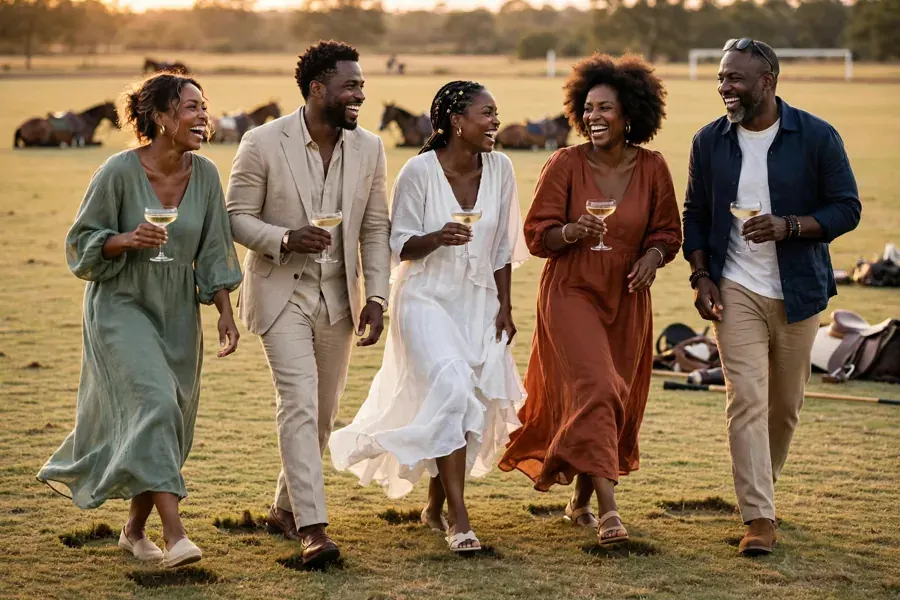
Santa Barbara's account catches the choreography: after the first three chukkers, the crowd pours onto the field, coupes in hand, and for ten minutes the ground belongs to conversation — old friends found, new ones made, children racing between the goal posts — before the ponies return and everyone drifts back to the rail somehow better acquainted than they were at the start.
It is the most charming piece of audience participation in sport, and it only works in flat shoes, which is why the dress guidance below is practical before it is fashionable.
Around the match, the afternoon assembles itself in layers. There is the tailgate and the picnic pitchside, where families park along the boards and lay out lunches that range from sandwiches to full silver-service spreads. There is the clubhouse terrace, where hospitality enclosures and private pagodas host the sponsors and patrons whose names carry the teams.
There is the boutique, the pony lines — where grooms will happily talk you through a string if you ask with genuine interest — and, at the close, the trophy presentation, when the winning patron lifts the cup, the best playing pony is blanketed and photographed, and the champagne that has been circulating all afternoon finds its ceremonial purpose.
Stay for it. Leaving before the presentation is the spectator's one true solecism; the game's people notice who honours the ending.
What to Wear, and How to Behave
Polo dress is a negotiation between elegance and grass. Cowdray's guidance is the sensible baseline everywhere: there is no formal dress code for general admission — smart casual is recommended; for hospitality and enclosures, smart dress is expected; and flat shoes are advisable, because the grounds are grass. Build from there by the day's level.
Friday polo takes linen, sundresses and sunhats at their ease. Sunday polo — the occasion game — asks more: a summer dress or tailored linen for her, a blazer over an open collar for him, a hat that means it.
Heels that spear turf are the classic beginner's error; a wedge or an elegant flat keeps you mobile for the stomp and the long walk to the pony lines. Bring binoculars — the field is vast and the far end is genuinely far — and bring a layer for the hour when the sun drops and the final runs long.
Behaviour at polo is mostly hospitality extended in both directions. Arrive before the throw-in and stay for the trophy. Keep well behind the safety zone that runs around the pitch, and never cross the boards during play.
Dogs, where a ground welcomes them — Cowdray does, on a lead — are part of the furniture, kept close and calm. Applaud good play from either side; polo crowds are partisan about teams but generous about brilliance, and a great backhand from the visiting 10-goaler earns its roar.
And if you are a guest in a box or an enclosure, behave as you would at any table where you hope to be asked again: thank your host specifically, learn the names of the staff who looked after you, and let your enjoyment be visible. The patron culture that funds this game runs on exactly that currency.
Patrons, Players, and a Door Opening Wider
It is worth ending where the game's future is being written, because polo's newest chapters belong to people who were once assumed to be outside it entirely. In Philadelphia, the Work to Ride programme has for decades taught young people from the city to ride and play, and its graduates now appear at the game's highest levels.
Shariah Harris, a Work to Ride alumna, became the first Black woman to play in the U.S. Open Women's Polo Championship — and her account of those early high-goal invitations is the honest sound of a door opening:
“Just give us a chance. That's really all we need.”— Shariah Harris, via Grand Champions Polo Club
The college game tells the same story.
ESPN's reporting on the Ride to the Olympics foundation records that in 2019 Morehouse became the first historically Black college to create a polo club and be declared a member of the United States Polo Association, with Spelman's riders alongside — young players whose founder, Wilson, states the mission without adornment: he wanted, in his words, to create an environment where African Americans can go to a polo event that celebrates our culture.
That is the note to end on, because it is the same note this magazine sounds across the whole social season. The grounds at Wellington, Santa Barbara and Cowdray were not built for us, but the afternoon absolutely can be ours — coupe in hand, flats on the turf at halftime, children learning the chukkers by number.
Watch it properly once, and you will understand why the families who love polo never really leave it. For the wider map of the sporting-social calendar, see our overview of polo, racing, and the sporting season, and for Louisville's great weekend, our companion guide to Derby Day and the racing season.
Polo, Racing, and the Sporting Season in Good Company
Derby Day and the Racing Season: Louisville First, Then the Calendar of the Track
The Black Gala Circuit: A Field Guide to the Season
Sports Collections — Bourgeois Society Profiles
Cowdray Park Polo Club — "Guide to Polo"
Wellington The Magazine — "Polo 101: All You Need to Know"
Santa Barbara Polo — "Complete Insider's Guide to Polo in Santa Barbara"
Hurlingham Polo — "From High Goal to Hollywood: The History of Polo in the USA, Part 7"
U.S. Polo Assn. / USPA Global — "USPA Global and ESPN Expand Relationship for the High-Goal Polo Championships"
Pololine — "British Open for the Cowdray Gold Cup Celebrates 70 Years of History and Tradition"
Grand Champions Polo Club — "Shariah Harris, Work To Ride/Grand Champions Make History at U.S. Open Women's Polo Championship"
ESPN — "Ride to the Olympics CEO on Increase in Black Polo Players"
Questions & Answers
Who will you meet on this page?
Polo match etiquette, what to wear and how to watch — the chukkers and handicaps, the ponies and the patrons, the great grounds from Wellington to Cowdray, and the champagne hour that gathers around the fastest afternoon in sport. It links to 4 stories and articles — open any card to read the full piece.
What makes these stories worth reading?
Polo match etiquette, what to wear and how to watch — the chukkers and handicaps, the ponies and the patrons, the great grounds from Wellington to Cowdray, and the champagne hour that gathers around the fastest afternoon in sport.
How do I read the full stories on Polo, Watched Properly: The Game, the Grounds, and the Afternoon Around It?
Choose any card on this page. Each one opens a full page of its own — the complete story or article, with its sources linked.