
The Family Portrait: An Annual Tradition Worth Framing
Large family portrait tips for the tradition that matters: what to wear, how to choose the photographer, the elders seated first, and the finished portrait printed big enough to hold a wall — and a family.
Every family has the photograph. You know the one — it lives above a fireplace or commands a staircase wall, twenty faces arranged like a small nation, the elders enthroned in front, and it stops visitors mid-sentence.
The large family portrait is the oldest luxury our people practise: these large family portrait tips — what to wear, which photographer to trust, how the arrangement is built — exist because the portrait is not really a picture. It is a document.
It says who we were, all together, in the year it was taken, dressed as the family we intended to be. The families who look inevitable in those frames did not improvise them. They kept the tradition annually, the way you keep anything you refuse to lose.
Here is the practice, whole.
The Tradition We Inherited
We come from people who understood the camera as an instrument of record. For generations, the pages of Ebony and Jet functioned as what one celebrated essay called our Black family photo albums — the place where our families saw themselves in their full glory, dressed, composed, and taken seriously.
The Johnson Publishing archive behind those magazines, now held jointly by the Smithsonian's National Museum of African American History and Culture and the Getty Research Institute, runs to more than four million images, with a $30 million commitment to digitise the collection, per the MacArthur Foundation's account of the transfer. Institutions do not spend at that scale on snapshots.
They spend it on a people's visual memory.
The archive's scale tells you what is at stake in the household version.
Reporting on the collection in the Columbia Journalism Review describes some four million images, appraised at $46 million — and notes that their worth runs far past money, because across seven decades those photographs showed Black Americans as politicians, professionals, homemakers, scientists, artists and families, in full and ordinary dignity.
That is precisely the work a family portrait wall does at home: it is the counter-record, the proof of presence, kept by the people it belongs to.
Your family's wall is the same archive at household scale — which is why the annual rhythm matters more than any single session's perfection. Children grow an inch between portraits. Elders hold the centre while they can.
New spouses appear at the edges and migrate inward, year by year, in the most honest diagram of belonging ever drawn. Miss five years and the record has a hole no retake can fill. Keep the appointment annually and the wall becomes a history book that writes itself.
Choosing the Photographer
A large family portrait is a logistics exercise wearing an art costume, so hire for both halves of that description. The right photographer has run extended-family sessions before — twenty people, four households, three generations, one toddler with opinions — and can show you full galleries of them, not three flattering frames.
Ask how they plan the groupings in advance; the good ones arrive with your shot list already sequenced. Ask about turnaround, about the full-resolution files, and about print rights, because this portrait will be reprinted for decades by people not yet born.
Published pricing gives the honest range. Southern California portrait photographer Mary Claire Roman lists extended family sessions at $1,100 for multi-generational groups — an hour's session with a minimum of eighty edited images and full download rights.
At the white-glove end, Christian Michelle Photography offers extended family sessions only as an all-inclusive experience priced at $2,400, covering pre-session planning, a preparation guide and the complete edited gallery, with half due as a retainer to reserve the date.
Between those poles sits every sensible arrangement; what you are buying at the higher end is not pixels but calm — a photographer who has already solved your family's chaos a hundred times. Book the same artist annually if the work pleases you.
A returning photographer knows the children's names, the patriarch's good side, and exactly how long Grandmother's patience runs — knowledge that compounds like interest.
What to Wear: One Palette, Twenty People, No Matching Outfits
The single most-repeated instruction across every serious photographer's wardrobe guidance is this: coordinate, never match. Identical outfits date a portrait on sight; a shared palette keeps it timeless.
Boundless Joy's family wardrobe guide puts the working rule plainly — build from a palette of three to five colours, neutrals first (cream, tan, oatmeal, soft brown, olive), then one or two accent colours drawn from the season and the setting, and allow one or two "star" patterns while everyone else supports in solids.
For large groups specifically, HeadshotPhoto's large-group colour guidance recommends earth tones with cream — terracotta, olive, camel, ivory, sage — as the most reliable scheme across skin tones and ages, assigning each household a primary and secondary colour from the palette so families read as branches of one tree, and asking for outfit photographs in advance to catch clashes while they are still fixable.
Three refinements from the same body of guidance, each worth the family's compliance. Cream, not pure white — white blows out in bright light and steals the face's authority; charcoal, not pure black, which swallows detail.
Texture over print at scale: linen, knit, corduroy and lace photograph with depth, while logos, neon and shiny fabrics fight the lens and each other. And begin with one anchor outfit — traditionally the matriarch's — and build every other look outward from it. She is the centre of the composition; the palette should confess it.
The Arrangement: Elders First, Built Like a Triangle
Grandparents are the emotional and visual anchor of the family.— Zesty Orange Photo, on posing large families
Every professional method for the large group converges on the same architecture, and Zesty Orange Photo's large-family posing guide states its foundation outright: the arrangement begins with the grandparents, seated first — on chairs, a bench, or the steps themselves — because they anchor the family, emotionally and visually, and their placement gives the whole group its focal point.
From that anchor, the composition is built in triangles rather than rows: adult children standing behind and angled slightly inward, grandchildren on laps, stools and the step below, so the eye travels a living pyramid instead of scanning a choir.
Layered heights do the quiet work — some seated, some standing, some leaning — keeping twenty people relaxed instead of ranked.
Sequence is the other professional secret.
Multi-generational session guidance advises taking the most important group photographs inside the first fifteen minutes, while every generation is still fresh and the toddlers are still ambassadors rather than negotiators — then breaking the assembly down into its smaller portraits: each household, the siblings together, the grandparents with the grandchildren, the cousins in a pile.
Shoot the monument first and the jewels after, and no meltdown can cost you the portrait the day was for. Between the arranged frames, let the photographer steal the candid ones — the laughter while the next grouping forms is frequently the image the family ends up loving most.
The Sitting Itself: A Run of Show
Treat the annual sitting like the small production it is, and it will feel like a pleasure instead of a roundup. One person — never the matriarch — owns the day: confirming the photographer, holding the palette photographs everyone sent in advance, and keeping the shot list.
That list follows the photographer's standard grammar for extended sessions, which E-Squared Photography's extended-session guide sets out in full: the complete extended family first, then each individual family unit, the sibling group, the grandparents with the grandchildren, and candid moments woven throughout.
Agree that list with your photographer before the day, in writing, with names attached to every grouping — a session that hunts for combinations in real time burns the children's patience on administration.
Light decides the hour. The same professional guidance favours the soft ends of the day — mid-morning or the early evening golden hour — over the hard middle, and shade over direct sun when midday is unavoidable.
Build the session at the house or the place the family actually belongs to, if you can: a staircase, a garden, a porch with history in it will mean more in the frame than any rented backdrop, and it roots the portrait in the family's real geography. Feed people before, not after.
Keep water and a steamer within reach, a lint roller in somebody's pocket, and the playlist the family actually listens to playing low — twenty people relaxing to familiar music arrange themselves into better triangles than twenty people standing in silence.
Finally, plan for absence with grace, because across the decades of an annual tradition, absence is guaranteed.
The son posted overseas, the daughter in the hospital with the new baby, the elder whose health keeps her home this year: the produced family photographs them in anyway — a framed portrait of the missing one held by the branch they belong to, or their place in the arrangement left honourably open and noted in the year's caption on the back of the frame.
It reads as love, never as a gap. The tradition's promise is not that everyone is always present. It is that everyone is always counted.
Print It Big, Hang It Once, Keep It Forever
Here is where most families quietly betray the whole enterprise: a magnificent portrait, printed at drugstore size, apologising on a side wall. The annual portrait is made to be printed big.
Sizing guidance for statement prints puts the honest territory at 24×36 and upward — Shutterfly's large canvas guidance describes the 30×40 as the size that delivers gallery presence in a room with real walls, while 24×36 anchors above a sofa or fireplace without overwhelming it.
For a formal framed piece — and the annual portrait deserves the formal treatment at least once in a generation — a wide gilt or dark wood frame and a proper mat turn the photograph into the heirloom it already is in the family's mind.
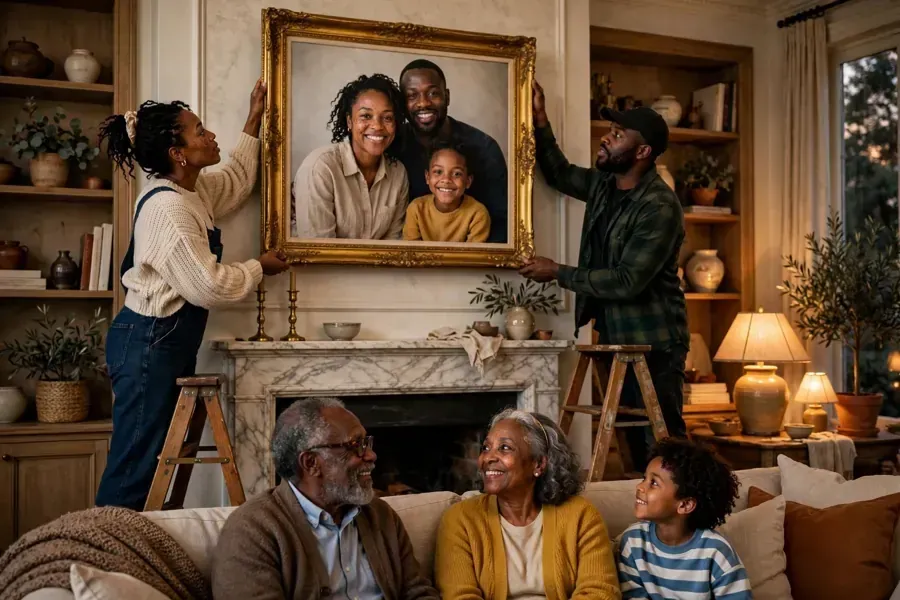
Hang the year's portrait where the family actually gathers, and let the staircase or the long wall accumulate the years in sequence: the visual parade from toddlers to graduates to grandchildren is the single most eloquent wall a house can wear.
Give every household a framed copy of the full portrait each year — the gift that quietly standardises twenty living rooms into one family's distributed gallery — and archive the full-resolution files with the same care you give the deeds and the wills.
The portrait tradition pairs naturally with its painted cousin, the family reunion produced as a full occasion, where many families now schedule the sitting inside the one weekend the whole clan is already gathered. However your family assembles, assemble.
The wall is waiting, the elders are ready to be seated first, and this year's twenty faces will never be exactly these ages again. That is not sentimentality. That is the whole argument.
The Family Reunion, Produced
Family Reunions
Marking Milestones Properly
Profiles: Empire Makers
Profiles: The Women of Black Excellence
Andscape — "'Ebony' and 'Jet' Are Our Black Family Photo Albums"
MacArthur Foundation — "Ford, Getty Trust, MacArthur, and Mellon Transfer Ebony and Jet Photo Archives to Getty and Smithsonian"
Mary Claire Roman Photography — "Portrait Session Pricing"
Christian Michelle Photography — "Extended Family Session Information"
Boundless Joy Photography — "What to Wear for Family Photos"
HeadshotPhoto — "Large Group Family Photo Color Schemes"
Zesty Orange Photo — "Large Family Photos Posing: Simple Ways to Look Natural"
Nerdbot — "10 Tips for Perfect Multi-Generational Family Photos"
Shutterfly — "Large Canvas Prints for Every Space"
E-Squared Photography — "How to Run an Extended Family Session: A Complete Guide for Photographers"
Columbia Journalism Review — "Historians Breathe a Sigh of Relief at the Sale of the Ebony and Jet Photo Archives"
Questions & Answers
Who will you meet on this page?
Large family portrait tips for the tradition that matters: what to wear, how to choose the photographer, the elders seated first, and the finished portrait printed big enough to hold a wall — and a family. It links to 4 stories and articles — open any card to read the full piece.
What makes these stories worth reading?
Large family portrait tips for the tradition that matters: what to wear, how to choose the photographer, the elders seated first, and the finished portrait printed big enough to hold a wall — and a family.
How do I read the full stories on The Family Portrait: An Annual Tradition Worth Framing?
Choose any card on this page. Each one opens a full page of its own — the complete story or article, with its sources linked.