
The Family Reunion, Produced: How to Plan a Large Family Reunion — Budget, Program and Run of Show
How to plan a large family reunion — budget, program and run of show included: when 200 cousins are coming, love needs a committee, a timeline and a producer's hand.
There comes a reunion — you will know it by the group chat reaching three hundred messages before breakfast — when the picnic logic stops working. The family has grown past one backyard, one cook and one cousin who somehow does everything.
That is the moment to learn how to plan a large family reunion, budget, program and all, the way our families produce everything else that matters: with a committee, a calendar and a run of show. This is not about making the reunion fancy.
It is about making it survivable for the organizers and unforgettable for everyone else — the elders honored properly, the children claimed by a hundred relatives, the ancestors named out loud, and nobody's resentment quietly seasoning the potato salad. Two hundred cousins deserve production. Here is the whole craft.
Why This Gathering Carries More Than a Picnic
The Black family reunion is not a hobby; it is one of our oldest institutions, and it helps to remember why before you price a single tent.
Study guides summarizing the tradition note that family reunions began after emancipation, as relatives separated by the domestic slave trade searched for one another through newspapers, word of mouth and the Freedmen's Bureau — and that what began as urgent reunification grew into a recurring celebration of family history, music and food.
The Great Migration scattered us again, across six million moves from South to North and West, and the summer homecoming became the technology that held the map together.
In 1986 the tradition put on national dress: the National Black Family Reunion arrived: Dorothy Height, the longtime National Council of Negro Women leader, launched it in 1986 as a multi-day cultural gathering built to celebrate and strengthen the Black family — the Council still coordinates it. When your family gathers, you are not throwing a party.
You are operating a small, beloved piece of that inheritance — and it deserves to be run like it matters.
The Committee: Nobody Produces Alone
Every successful large reunion begins the same way, and the planning guides agree on it. Discover Atlanta's reunion checklist puts it second only to the guest list itself: give the reunion a real committee, with one named owner for each part of the work — the place, the program, the money, the mailings and the records.
Take that structure and staff it like you mean it. A chair (the family's trusted organizer, not necessarily its eldest). A treasurer whose spreadsheets nobody questions.
A housing and venue lead. A food lead. A program lead, who owns the schedule and the microphone.
A history lead, who owns the family tree, the photo wall and the memorial table. And a communications lead, because half of reunion producing is simply telling 200 people the same true thing at the right time. Give each lead a deputy from the younger generation — the reunion that trains its successors never has to be rescued.
The Timeline: A Year of Gentle Inevitability
Genealogy Explained's planning guide states the governing rule plainly: success depends on starting early — ideally 6-12 months in advance for larger reunions — beginning with a small planning committee to share the work and prevent organizer burnout. Work backward from the date.
At twelve months: form the committee, survey the family on dates and budget comfort, choose the place, and set the preliminary budget. At nine months: sign the venue and the room block, and send save-the-dates, because elders and airline tickets both reward notice.
At six months: lock catering, book the photographer and the entertainment, and open registration with a deposit — a family that has paid a deposit is a family that is coming. At three months: formal invitations, the program drafted, T-shirts and the family book ordered.
In the final month: confirm every vendor in writing, print the run of show, and assign every cousin a job small enough to actually be done.
InteleTravel's step-by-step guide adds the detail the pros swear by: poll first, with real budget ranges and hard-no dates, because, as it puts it, the goal of the survey is data, not unanimous agreement that will never come.
The Budget Nobody Resents
Money is where reunions go to be resented, so handle it in daylight. Build the budget in the open, publish the per-person math, and separate the shared costs — venue, two or three group meals, the program, the photographer — from personal costs like travel and individual rooms.
EventCortex's planning guide describes the funding models most reunions combine: a flat per-person fee, a sliding scale with a published minimum, pre-event fundraising, and sponsorship by the senior generation; its industry guidance suggests $50 to $150 per adult for a one-day reunion and $200 to $500 for a weekend, as attributed ranges to plan against, not promises.
Three production rules protect the peace. First, elders do not pay full freight — build their courtesy into the budget as a line item and let the middle generation carry it proudly. Second, children are free or nearly so at the shared table; a reunion that prices out young families is a reunion choosing to shrink.
Third, keep a contingency — the guides put the honest cushion at five to ten percent — and report the final accounting to the whole family afterward, with thanks. Transparency is what turns a fee into a family custom.
The Program: A Run of Show for Love
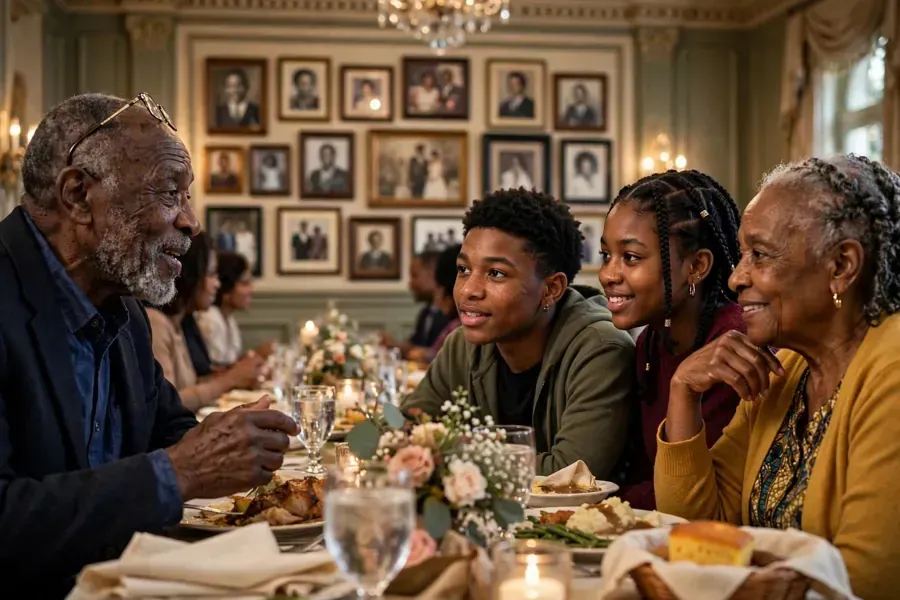
Now the weekend itself, produced hour by hour. Friday is arrival and softness: a welcome table with name badges that carry each person's branch of the tree — daughter of, grandson of — because at 200 people, lineage is the best icebreaker ever invented.
Keep Friday evening unstructured: a cookout, music, and time for the cousins who have not seen each other in a decade to find each other without a microphone interrupting. Saturday is the produced day.
A morning family meeting, kept to forty-five minutes and chaired with charm: the state of the family, the milestones — graduations, babies, promotions, retirements — announced and applauded.
Then the history hour, which is the soul of the whole enterprise: the family-history wall unveiled, the eldest living member interviewed on a real stage by a grandchild, the story of the family's founding couple told properly, with photographs. Afternoon belongs to the talent show, the games and the spades tournament, which is to say to joy with light supervision.
Saturday night is the banquet: dressed, seated by branch with generations deliberately mixed, the awards — furthest traveled, oldest, youngest, the family historian's prize — and the memorial table honored in a moment of genuine quiet, a candle and the names read aloud, so that who is missing is part of who is present.
Sunday closes the circle: worship together for families who do, a farewell brunch for all, and — before anyone's car leaves the lot — the group photograph, scheduled, announced twice, and taken while the elders are fresh and the light is kind.
Discover Atlanta's checklist ends the work the way every producer should: put the whole weekend into a printed program every guest can hold, thank the volunteers by name, and ask attendees for feedback while the weekend is still warm.
That feedback file, plus the treasurer's final report and the updated family directory, is the seed capital of the next reunion — hand it, formally, to the next committee before the year turns. One more craft note, learned by every family that has done this at scale: protect the elders' experience as fiercely as the budget.
Front-row seats that are actually comfortable, a shaded rest room with chairs and water, plates carried to them, and a driver assigned. Honor that is only spoken from a stage is rhetoric; honor with a chair, a plate and a ride is production.
Do all of this and something changes in the family's weather. The reunion stops being an event a few exhausted relatives survive and becomes an institution the whole family owns — the way the institutions in our companion piece on family reunions have always worked at their best.
Children who grow up inside a produced reunion learn their people's names, faces and stories as a birthright. Elders leave having been witnessed.
And the cousin who chaired it — tired, proud, already holding the feedback file — understands what every great host and every great committee eventually learns: love, at family scale, is a logistics problem with a sacred purpose. Solve the logistics, and the purpose takes care of the rest.
For the house-party scale of the same craft, see Being a Guest: Weekend Rules — and start your committee this month. The year goes faster than you think.
Food at Scale, and the Cousins Who Carry It
No section of the run of show gets more respect from experienced producers than the food plan, because food is where a reunion's love language and its logistics collide.
At 200 people, the answer is almost always a hybrid: cater the anchor meals, where timing and temperature matter and a missed hour unravels the schedule, and let the family's sacred dishes appear where they belong — the Friday cookout and the Sunday table — cooked by the cousins whose versions are the family's constitution.
Build the menu around the elders' and children's real needs, publish ingredients for the allergic without being asked, and schedule meals like curtain times: a banquet that starts forty minutes late is a program that ends in an empty room.
Assign a food lead with genuine authority, including the authority to tell a beloved aunt that her dish is Saturday's glory and Friday's traffic jam. And protect the cooks socially as well as practically — the family members who feed 200 people should be photographed, thanked from the stage by name, and relieved of every other duty that weekend.
A reunion that consumes its cooks will, in about three editions, have none.
When Cousins Disagree: Producing the Peace
Every large family contains at least one live disagreement — over money, over an inheritance, over who did and did not appear at a hospital — and a produced reunion does not pretend otherwise. It manages the room so the disagreement cannot hi-jack the weekend.
The committee seats thoughtfully at the banquet, mixing branches while quietly separating the two cousins who need distance to stay gracious. The program chair keeps the microphone on a run of show, which is the polite way of saying that open-mic grievance is not an agenda item; family business has its own meeting, scheduled, chaired and closed on time.
The family's elders are enlisted early, privately, as the peace's sponsors — most feuds cool measurably when the people both sides revere are visibly enjoying the same weekend.
And the chair holds one principle above all: the reunion belongs to the whole family, including the children meeting their cousins for the first time, and no two adults' history is allowed to tax everybody else's inheritance.
Families that produce this way discover something quietly wonderful — a well-run weekend gives old opponents new, neutral memories to stand on, and more than one family peace has begun as nothing grander than seating, scheduling and a very good Saturday night.
A last production note, on capturing the thing you have built. Hire the photographer — at this scale, the cousin-with-a-camera plan produces forty photographs of one table.
Brief the professional properly: the elders first, the whole-group portrait at its scheduled hour, each branch in turn, and candid coverage of the history hour and the talent show, where the reunion's real face shows. Then do what the families who keep their history well have always done: print.
A reunion book — the portrait, the tree, the memorial page, the directory — sent to every household while the year is still young turns one weekend into a permanent family asset, and gives the next committee a front cover to build toward. Production, in the end, is simply love with a memory and a mailing list.
Family Reunions
Being a Guest: Weekend Rules
Marking Milestones Properly
Home for the Holidays, Their House
Anniversary, Kept Properly
Women — Society Profiles Collection
Discover Atlanta — "Family Reunion Checklist: ATL Family Reunion Planning Guide"
Genealogy Explained — "How to Plan a Family Reunion"
InteleTravel Blog — "How to Plan a Memorable Family Reunion: Step-by-Step Guide"
EventCortex — "Family Reunion Planning Guide"
Wikipedia — "National Black Family Reunion"
Fiveable — "Family Reunions: AP African American Studies Definition"
Questions & Answers
Who will you meet on this page?
How to plan a large family reunion — budget, program and run of show included: when 200 cousins are coming, love needs a committee, a timeline and a producer's hand. It links to 6 stories and articles — open any card to read the full piece.
What makes these stories worth reading?
How to plan a large family reunion — budget, program and run of show included: when 200 cousins are coming, love needs a committee, a timeline and a producer's hand.
How do I read the full stories on The Family Reunion, Produced: How to Plan a Large Family Reunion — Budget, Program and…?
Choose any card on this page. Each one opens a full page of its own — the complete story or article, with its sources linked.