
Portraits of Us: Commissioning the Family Painting
How to commission a family portrait painting, properly: choosing the artist — Black portraitists first — the sittings with elders while you can, what the artist process honestly costs, an unveiling worth dressing for, and where the canvas should live.
Every family in our world owns a thousand photographs and, if it is honest, almost no portraits. The photographs live in telephones. The portrait — the painted one, life-size or near it, in a frame chosen like furniture — lives on the wall for a century and says what the photographs cannot: this family considered itself worth painting.
To commission a family portrait painting is not vanity, and it is not decoration. It is the family filing its own entry in the record, in the one medium that has always signified permanence.
This guide walks the whole commission: the tradition you are joining, how to choose the artist, how the sittings actually work, what artists charge in the open, how to stage the unveiling, and where in the house the finished canvas earns its keep.
Do it sooner than feels necessary. That is the first and only urgent sentence in this article. A portrait of the grandparents requires grandparents, present, rested, and willing — and the window in which all three are true is never as wide as the family assumes.
Artists who take commissions will tell you the saddest sentence in their trade is the posthumous commission, painted from photographs of someone the family meant to sit for years. Photographs can rescue a likeness; they cannot rescue a sitting, with its conversation, its laughter, and the way an elder holds a room when they know the afternoon is theirs.
Sit them while you can. Everything else in this guide can wait. That cannot.
The Tradition You Are Joining
A Black family commissioning its portrait is not borrowing a European custom; it is extending a Black one. When LACMA assembled its landmark exhibition of Black American portraiture — some 140 artworks across two centuries — its co-curators Christine Y. Kim and Liz Andrews described a body of work that, in the summary published by Culture Type:
centers Black love, abundance, family, exuberance, self-possession, and self-expression through over two centuries of African American portraiture.— Co-curators Christine Y. Kim and Liz Andrews, via Culture Type
Self-possession is the operative word, and it runs through the modern masters your artist will name in the first conversation.
Barkley L. Hendricks painted life-sized portraits of striking Black sitters with, as Victory Journal's profile puts it, Old Master virtuosity — ordinary people given the scale and finish once reserved for kings — and is widely credited with reviving portraiture itself, becoming a forefather to Kehinde Wiley, Mickalene Thomas and Amy Sherald.
When the Obamas chose Wiley and Sherald for the National Portrait Gallery, the two became the first African Americans to paint the portraits of a president or first lady for that institution — the tradition arriving, formally, at the summit of American portraiture.
The wall in the exhibition where Hendricks, Sherald, Wiley and Thomas hung together was described by Hyperallergic's reviewer as show-stopping, and it is the right mental picture for your own commission: your family, painted seriously, by a serious painter, in a lineage that is already ours. Commission in that spirit and you will choose well at every step that follows.
Choosing the Artist: Black Portraitists First
Start where the slate for this magazine always starts on art: with Black portraitists first. Not as a gesture — as a quality judgment.
The painter who has spent a career mixing the full range of our skin, reading our features without flattening them, and dressing a sitter's dignity the way our families understand dignity will simply paint your mother better. Look at full bodies of work, not single images: Do the sitters look like themselves, and like people?
Does the painter handle hands, grey hair, deep skin in low light — the three places weak portraiture fails? Ask how they work: from life, from photographs, or the common professional hybrid — sittings and studies first, the long painting hours done in the studio.
Ask what a commission includes, what it does not (framing, travel, delivery are usually separate), and how many commissions they carry at once. Then have the conversation that decides it: an hour with the artist and your elders. A portraitist paints the person they met.
You are hiring the meeting as much as the hand.
Agree everything in writing before a brush is lifted. Working artists formalize this as a commissioning agreement covering the scope — number of subjects, size, background and setting, delivery date, installation and framing options — and the money.
Deposits are standard practice across the trade: one established studio's published terms take a 30 percent non-refundable deposit with the commissioning agreement, with the balance due on completion; another widely published guide sets the deposit at 50 percent, securing the commission, balance at completion. Neither is unusual; what would be unusual is a serious artist asking for nothing in writing.
Treat the agreement the way you treat any other family contract: read it, keep it, and file it with the painting's papers, where your grandchildren will one day be glad to find it.
The Process: Discovery, Studies, the Painting, the Reveal
The shape of a commission is remarkably consistent from studio to studio, and knowing it in advance removes every anxiety sitters bring to the first session. One clear published model runs in four steps: discovery, studies, execution, and acceptance.
Discovery is a conversation of an hour or two — intent, vision, setting, scope, the size of the painting, where it will hang. Studies follow: sketches and color studies made with the sitter, supporting photographs taken of the person and the setting.
Execution is the long studio phase — in that model, ten to thirty days of painting with periodic reviews for the patron. Acceptance is the presentation of the finished work and its installation.
Another artist's published process adds the machinery in between: a professional photography session, composition sketches for your approval, regular progress updates, and a final glazing and varnishing — and notes that most portraits complete within eight to twelve weeks of the sitting or the reference photographs, with complex works taking longer.
A third, Nanette Fluhr's studio, describes a consultation, photography, sketches and a color study, then the final oil painted in the studio on fine Belgian linen with archival materials chosen for permanence. The details differ; the rhythm never does: talk, study, paint, reveal.
Budget your family's patience accordingly — a serious canvas is a season, not a weekend, and it should be.
The sittings themselves are gentler than elders fear.
Most contemporary portraitists no longer require a sitter to hold a pose for days; the standard method is a meeting, quick sketches, a careful photographic session, and then studio work from that material — with the sitter returning for a final sitting so the painter can correct the life back into the likeness.
Artists say plainly that this is a kindness as well as a technique: sitters may rest, talk, listen to music, take breaks.
Dress the sitting the way the family wants to be remembered — the suit that fits now, her good pearls, the dress in the family's color — and bring the objects that tell the story if the portrait is to include them: his watch, her mother's brooch, the book, the instrument.
A good painter will edit ruthlessly and keep only what serves the likeness. Trust the edit. You hired the eye.
What It Honestly Costs
Prices in portraiture are quoted the way prices in tailoring are quoted — by the size of the work, the number of figures, and the standing of the maker — and reputable artists publish their ranges, which is the surest sign you are dealing with a professional.
Rebecca King Hawkinson's studio lists a formal oil commission from $5,000 to $20,000 and above: a small cameo at $5,000, head and shoulders at $7,500, half length at $11,500, full length at $20,000, with additional figures adding about two-thirds again and completion inside roughly six months, built on two to three in-person visits and a final three-hour sitting.
Nanette Fluhr's commissions begin at $7,500 and rise with size, complexity and number of subjects, with institutional portraits — universities, courthouses, hospitals — ranging from $18,000 to $35,000 and above. At the more accessible end, Zuniga Studio publishes a range of $2,500 to $8,500 depending on scope.
Read those three ranges together and you have the honest map: a fine family portrait is a five-figure decision at the level most of our readers will commission, and the right comparison is not the cost of a photograph but the cost of the furniture the painting will outlive.
Pay the deposit, pay on completion, and keep the receipts with the deed papers — provenance begins at home.
The Unveiling: Make It an Occasion
A portrait this considered should not simply appear on the wall between Tuesdays. Unveil it.
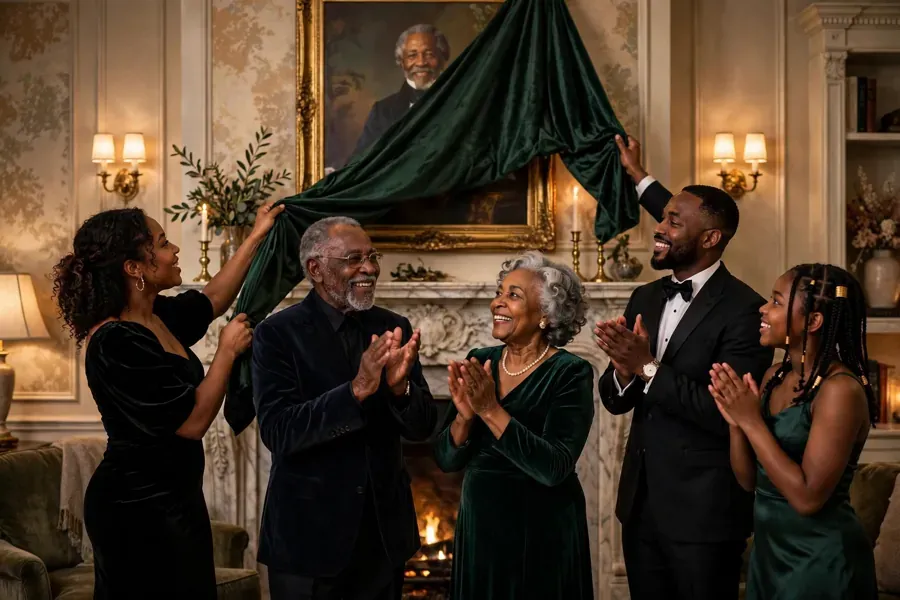
The unveiling is an old society form that costs nothing but intention: the canvas hung in advance and covered — a length of velvet or linen does the office beautifully — the family gathered in evening dress, the grandparents seated where they can see both the painting and the room. A few words from the child who commissioned it.
The cloth drawn. Applause, photographs of the applause, and then dinner, with the portrait lit above the table's end the whole evening. If the painting honors an anniversary, unveil it there — our guide to the anniversary kept properly and this one are natural companions — and if it marks the matriarch or patriarch, let them speak last and longest.
Record the evening on video, not for the internet, but for the same reason the painting exists: one day, someone who was not in the room will need to have been.
Where the Canvas Lives
Hang the portrait where the family actually gathers, at the height galleries use: placement guidance puts a picture's center at roughly 57 to 60 inches from the floor — gallery height — adjusted for the room.
Above a mantel, let the frame's bottom sit a few inches above the mantelpiece itself, and think honestly about heat and soot before committing an oil to a working fireplace; a chimney breast that is mostly decorative is a throne, while a roaring nightly fire is a conservator's invoice waiting to happen.
Light it the way museums light: a picture light or a directed fixture washing the canvas, never direct sun, which placement guides warn will fade pigment over time.
Scale is the last decision and the one families most often get timid about: guidance for art above furniture suggests a width around sixty to seventy-five percent of the piece below it — measure before the commission, not after, because the wall's dimensions belong in the discovery conversation on day one.
A portrait sized for its wall, lit warmly, and hung at gallery height does something no smaller gesture can: it makes the room's hierarchy clear. The ancestors preside.
Pair it with the house's other permanent decisions — the library every house should hold and the annual discipline of the family portrait photograph — and the house begins, unmistakably, to be a family seat rather than an address.
Our collectors' guide to art by Black masters, kept in the Vault, takes the story from the family's own wall to the market beyond it.
Begin, then, with the telephone, not the cheque book: one conversation with one painter whose sitters look back at you. The rest — the agreement, the sittings, the season of waiting, the evening the cloth comes down — unfolds the way all durable family things unfold, one deliberate step at a time.
A hundred years from now, the descendants who stand under that canvas will not know what the sitting cost or how long the studies took. They will know that when this family had the means and the moment, it did not let its elders leave the world unpainted.
Portraits of us, indeed — painted by us, of us, for whoever comes next.
The Family Portrait: An Annual Tradition Worth Framing
The Library Every House Should Hold
The Vault: Art by Black Masters
Profiles: The Empire Makers
Profiles: The Women of Black Excellence
Culture Type — "'Black American Portraits' Showcases 140 Artworks"
Hyperallergic — "A Survey of Black American Portraiture Is a Revelation"
Artsy — "The Obama Portraits and the National Portrait Gallery"
Victory Journal — "High Court: Barkley Hendricks"
Zuniga Studio — "Portrait Commission Process"
Rebecca King Hawkinson — "Classical Oil Portrait Commissions"
Nanette Fluhr — "Commission a Portrait"
Marcus Callum — "Custom Portrait Paintings: A Guide"
Homestyler — "Mastering Large Artwork Placement"
Questions & Answers
Why does Black cultural history matter today?
How to commission a family portrait painting, properly: choosing the artist — Black portraitists first — the sittings with elders while you can, what the artist process honestly costs, an unveiling worth dressing for, and where the canvas should live. It links to 5 stories and articles — open any card to read the full piece.
What should every house know about this history?
How to commission a family portrait painting, properly: choosing the artist — Black portraitists first — the sittings with elders while you can, what the artist process honestly costs, an unveiling worth dressing for, and where the canvas should live.
How do I read the full stories on Portraits of Us: Commissioning the Family Painting?
Choose any card on this page. Each one opens a full page of its own — the complete story or article, with its sources linked.