
Florida A&M University: The Rattler Standard
Florida A&M University history, the Marching 101 and notable alumni belong in one sentence, because on the highest of Tallahassee’s seven hills they have always been one story — a school built from fifteen students into a standard the whole country learned to watch.
If your family is beginning the college conversation, start here, with Florida A&M University history, Marching 101 and notable alumni understood together. Other universities ask a young person to imagine who they might become.
FAMU shows them, in orange and green, on a hill above Florida’s capital: the graduate who came before, the band that stops a stadium, the family on the walkway taking the same photograph their parents took. That is not marketing.
That is inheritance, and it is why Rattlers speak of this place the way other people speak of home — because for generation after generation, it has been exactly that.
A FAMU alumna and Delta member, Dr. Kelley Bolden Bailey, put the founding impulse plainly in a Juneteenth account of the university and its Divine Nine life:
“We have always found a way to educate each other, to educate our children, through our churches through our schools through our conversations as family members.”— Dr. Kelley Bolden Bailey, via My Fraternity Life / WCTV
Fifteen Students, Two Instructors, One Hill
The university’s own history tells the beginning without ornament. Representative Thomas Van Renssaler Gibbs, a Duval County educator elected to the Florida legislature, orchestrated House Bill 133 in 1884; the state relocated the school for African Americans to Tallahassee, and FAMU was founded on October 3, 1887, beginning classes with 15 students and two instructors.
Thomas DeSaille Tucker, an attorney from Pensacola, was the first president, and Gibbs himself joined him as the second faculty member. Picture it honestly: fifteen students, a white-framed beginning, and two men doing the teaching — and from that room, a university.
In 1891 the college received $7,500 under the Second Morrill Act for agricultural and mechanical arts education and became, in the university’s own words, Florida’s land-grant institution for African Americans, taking the name State Normal and Industrial College for Colored Students.
The names would change again — to Florida Agricultural and Mechanical College, and in time to the university it is today — but the land-grant promise never left: practical education, taught with care, in service of a people building their future on purpose.
The university describes its legacy in its own history as one of “academic excellence with caring,” and anyone who has watched a Rattler family move a first-year student into a residence hall has seen that caring operating at full strength.
Growth came the way it always comes at schools like this — president by president, building by building, against budgets that never matched the ambition. Nathan B. Young directed the college into a four-year degree-granting institution. Under J.R.E. Lee the campus added dozens of buildings and hundreds of acres.
Under George W. Gore the college became a university and held its ground as its own institution. Each era added professions — law, pharmacy, nursing and graduate study among them — until the small normal school on the hill had become a comprehensive university. The point for our readers is not the chronology.
It is the pattern: nothing here was handed over finished. It was built, deliberately, by people who expected their grandchildren to need it.
The Distinction: A Full University, Entirely Ours
What is FAMU, in one honest claim? Visit Tallahassee, the city’s own visitor authority, describes it as a university counted among the nation’s largest HBCUs, set on the highest of Tallahassee’s seven hills, the only HBCU in Florida’s twelve-member state university system, offering 97 degree programs to an enrollment of more than 10,000 students.
Read that slowly. A public university, at full scale — research, professional schools, Division I Saturdays — where Black life is not a programme, a centre or a percentage. It is the institution itself.
For a young person who has spent school years being the only one, or one of a few, that difference is not cosmetic. It changes what a Tuesday feels like.
The city’s guide also marks the symbols a visiting family should look for: the Eternal Flame, burning at the centre of campus as a symbol of Rattler excellence since Time magazine’s selection of FAMU as its 1997–1998 College of the Year, and the eight-foot coiled rattler sculpture that now greets visitors on Wahnish Way.
Take the tour, stand at the Flame, and understand what the Rattler posture really is: a snake does not apologise for striking when the moment requires it, and this university has never apologised for expecting its students to be excellent in public.
The Band That Became the Standard
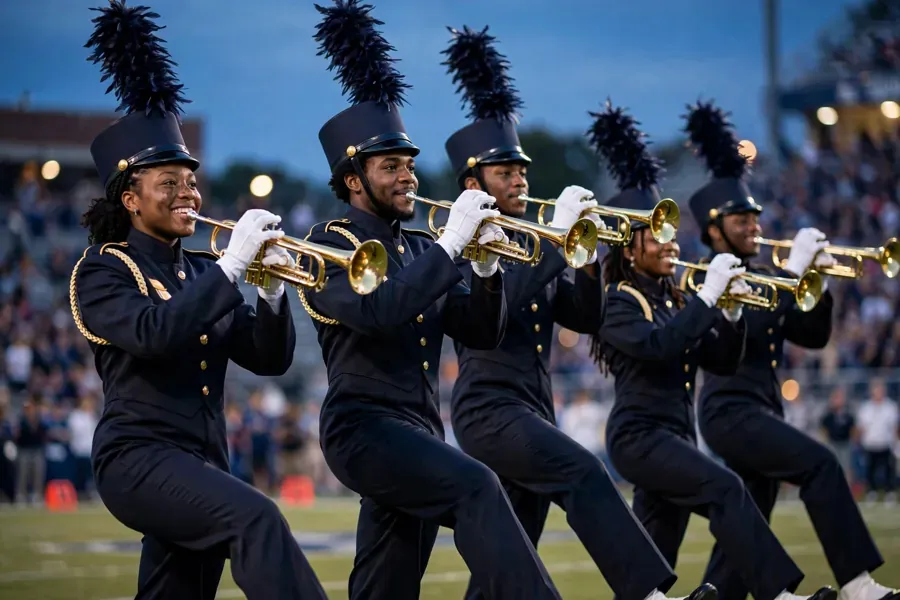
Now the band — and let us be precise about names, because Rattlers are. The slate in many a programme calls it the Marching 101; the university’s own band is the Marching “100,” and the story of that number is the story of the man who built it.
William P. Foster arrived in 1946 and, in the Savannah Tribune’s account of his eulogy, began with what he himself described as sixteen beat-up instruments. He called his musicians the Marching 100 because he envisioned reaching that number — a director naming his band for a future that did not yet exist.
It grew, by the same account, to some four hundred members, and the name stayed, the way a family keeps a nickname long after the child has outgrown it.
Foster, the Tribune records, created more than 200 halftime pageants and brought innovative marching techniques including high stepping, the slow death march and a fast step moving to about 320 steps per minute — a band that could play, in its words, any style from Bach to rock to Sousa.
Black America Web’s history adds the honours that carried the sound worldwide: France named the band the lone American representative for Bastille Day and the Bicentennial of the French Revolution, and to this day, its account says, the Marching 100 is still seen as the marching band gold standard.
Super Bowls, presidential inaugurations, the Grammy Awards — the Tribune lists them the way other schools list bowl games. When your child watches a halftime show anywhere in America now, they are watching, in part, what Foster invented on this hill.
Hold the distinction correctly for your family: the band is not an extracurricular decoration on the university. For many Rattlers it was the first sight of the place — a president of the university himself recalled that it was the marching band, at an Orange Blossom Classic in Miami, that first sparked his interest in attending.
Music here is recruitment, reputation and religion at once, and a student with an instrument and discipline will find no more demanding — or more visible — stage in Black college life.
Notable Alumni: The Roll, Read Slowly
The alumni list rewards slow reading. In music, the university’s alumni roll names Julian “Cannonball” Adderley, the jazz alto saxophonist, and his brother Nat Adderley, the jazz cornetist — two brothers from this campus who helped define the sound of an era.
In sport, HBCU Lifestyle’s roll of famous graduates names Althea Gibson, tennis and golf champion, and Bob Hayes, the Olympic gold medallist who went on to the Dallas Cowboys as Florida A&M men and women — Gibson a barrier-breaker on courts that had not welcomed her, Hayes a sprinter so fast the professional game had to redesign itself around him.
On screen and behind the microphone, HBCU Buzz’s entertainment roll names Anika Noni Rose, who took her bachelor’s degree in theatre at Florida A&M before Broadway and before voicing Disney’s Princess Tiana, and Pam Oliver, who graduated in broadcast journalism on her way to becoming one of the most familiar sideline voices in American sport.
The university’s fuller alumni list adds film producers Will Packer and Rob Hardy, comedian Roy Wood Jr., and the historian and author Ibram X. Kendi, class of 2004 — a spread that tells a prospective family the essential truth: this campus does not produce one kind of success.
It produces the boardroom, the bandstand, the broadcast booth and the bestseller list from the same hill.
Read the roll to your teenager the right way — not as celebrity trivia, but as evidence of range. A student can arrive here for pharmacy and leave for Hollywood, arrive for the band and leave for the boardroom, and nobody at FAMU will find either journey surprising. That is what a mature alumni culture does: it makes ambition ordinary.
Visiting: Do the Hill Properly
Visit Tallahassee like you mean it.
The city’s visitor authority lists the campus landmarks as must-see stops on any visit to FAMU — the Eternal Flame, the rattler sculpture, the historic core on the hill — and the university’s own family programming shows how the place receives parents: its Parents and Family Weekend exists, in FAMU’s words, to reconnect families, build a support network between them, share game-day traditions and explore the Tallahassee community your student will call a home away from home.
That is the visit to imitate even outside the official weekend: walk the hill in the morning when the light is honest, sit where students sit, eat where students eat, and let your child watch the band rehearse if fortune allows it.
Stay in the capital city’s comfortable centre, make a weekend of it, and if your calendar can bend toward homecoming, bend it. There is no recruiting instrument ever devised that matches a Rattler homecoming — the parade, the step show, the generations in orange and green returning to a hill that keeps its promises.
Go once as a prospect and you will understand why alumni plan their year around returning as family.
Time the visit to homecoming if you possibly can, and treat it as the full examination.
Visit Tallahassee’s homecoming guide describes a weeklong festival blending tradition, culture and community pride — coronation, concerts, the NPHC step show, the parade and the game at Bragg Memorial Stadium, with the Marching 100 Showcase among its signature events — and notes the city lighting up in green and orange as Rattlers return to the Hill from across the country.
The same guide reports FAMU named the No. 1 HBCU by Forbes Magazine — a ranking we carry exactly as that guide states it, attributed to Forbes as it reports it. Watch your teenager at that parade.
Families tell us the decision is usually made by noon, somewhere between the first drumline and the third generation of Rattlers who stop your child to ask where she is thinking of going, and then correct the verb: not thinking. Deciding.
Attending: The Honest Notes
Attending FAMU means choosing a public land-grant university at genuine scale — more than 10,000 students across 97 degree programs, as Visit Tallahassee reports — with the professional pathways this readership asks about first: pharmacy, law, nursing, business and the graduate school, alongside the liberal arts.
Because it is a state university, its published costs sit in the public-university register rather than the private one; read the university’s own current figures with your child, programme by programme, and weigh them against the alumni network you are actually buying into — one that is dense in Florida’s capital, in Atlanta, in Washington and anywhere Rattlers have struck, which is everywhere.
Black life here needs no brochure section, but one part of it deserves naming for families new to this world: the Divine Nine.
The Juneteenth account of FAMU’s Greek life records alumni describing membership as life-changing, and a fraternity member’s summary deserves the last word on belonging on this hill: brotherhood — and, across the nine organisations, sisterhood — brings everyone together, whatever walk of life you come from.
Add the band, the royal court traditions, the classics of a capital-city HBCU, and you have the real curriculum beside the curriculum: a young person learning, among thousands who look like them and expect much of them, exactly who they intend to be. That is the Rattler standard.
It has been rising on that hill since fifteen students sat down in front of two teachers — and there is a seat, if your family chooses it, still warm.
Howard University: The Mecca
North Carolina A&T: Aggie Pride, at Scale
Clark Atlanta University: Find a Way or Make One
Dillard University: The Jewel of Gentilly
Choosing the School
The First Gate: Preschool
Black Wall Street: Greenwood
Florida A&M University — “History of Florida A&M University”
Visit Tallahassee — “Florida A&M University (FAMU)”
The Savannah Tribune — “Legendary Band Director Eulogized”
Black America Web — “Little Known Black History Fact: Dr. William ‘The Law’ Foster”
Wikipedia — “List of Florida Agricultural and Mechanical University Alumni”
HBCU Buzz — “41 Noteworthy HBCU Alumni in Entertainment”
My Fraternity Life / WCTV — “Journey to Juneteenth: Florida A&M University”
Visit Tallahassee — “FAMU Homecoming: A Week of Events in Tallahassee”
Questions & Answers
How do families pass down wealth and values?
Florida A&M University history, the Marching 101 and notable alumni belong in one sentence, because on the highest of Tallahassee’s seven hills they have always been one story — a school built from fifteen students into a standard the whole country learned to watch. It links to 8 stories and articles — open any card to read the full piece.
How do you involve children in family wealth planning?
Florida A&M University history, the Marching 101 and notable alumni belong in one sentence, because on the highest of Tallahassee’s seven hills they have always been one story — a school built from fifteen students into a standard the whole country learned to watch.
How do I read the full stories on Florida A&M University: The Rattler Standard?
Choose any card on this page. Each one opens a full page of its own — the complete story or article, with its sources linked.