
Clark Atlanta University: Find a Way or Make One
Clark Atlanta University history and notable alumni start with two schools, two mottos and one instruction that has outlived every building on the yard: I’ll find a way or make one.
This Clark Atlanta University history and notable alumni guide is for the family that wants the intellectual capital of Black America, not just a campus. In Atlanta — in the Atlanta University Center, the densest concentration of Black scholarship on earth — Clark Atlanta carries a particular weight.
It is the university formed from the South’s first graduate institution for African Americans and the nation’s first four-year liberal arts college for African Americans, joined into one house. A student here does not simply attend a university.
They take a desk in a lineage that includes the professor who wrote The Souls of Black Folk in an office a short walk away.
The university’s art museum director, Dr. Danille Taylor, described what this house keeps, on the occasion of a Smithsonian-linked exhibition opening at the museum:
“We are excited to feature this exhibition that highlights how art can document history in ways not readily acknowledged.”— Danille Taylor, Ph.D., Director, CAU Art Museum, via Clark Atlanta University
Two Schools, One Consolidation
The facts, as the university’s own biographical summaries and Atlanta coverage agree: Atlanta University was established in 1865 and Clark College in 1869, and Clark Atlanta University was established in 1988 by their historic consolidation.
Praise Atlanta’s Founders’ Day account sharpens the superlatives, attributing them plainly: Atlanta University was the first HBCU in the Southern United States, and Clark College the first four-year liberal arts college for African Americans.
The graduate school came first in this family — Atlanta University built its name on advanced degrees when almost no door in the South stood open at that level — and Clark brought the undergraduate liberal arts tradition.
Joined, they made a complete university: bachelor’s, master’s and doctoral study under one name, in one neighbourhood, inside the Atlanta University Center beside Spelman, Morehouse and Morris Brown.
The mottos tell you how to read the merger. The university carries two inheritances: Atlanta University’s “I’ll Find a Way or Make One” and Clark College’s “Culture for Service” — the first a working instruction for any obstacle, the second a reminder of what the way is for. A Bourgeois Society family will recognise the pairing instantly.
Resourcefulness without service is mere hustle; service without resourcefulness is mere sentiment. Clark Atlanta was quite literally chartered, twice, to produce both.
Du Bois Was Here — and It Matters
Every great school has a professor in its past tense. Clark Atlanta’s is load-bearing.
Atlanta Magazine’s account records that W.E.B. Du Bois spent twenty-three years — the bulk of his teaching career — at Atlanta University, from 1897 to 1910 and again from 1934 to 1944, and that he wrote his most prominent book, 1903’s The Souls of Black Folk, while there, producing also his finest historical scholarship, 1935’s Black Reconstruction.
The New Georgia Encyclopedia adds the working detail: Atlanta University’s president brought Du Bois to Atlanta to establish a sociology programme, and his major work from the relationship was the famous Atlanta University Studies — conferences and research on Black social conditions that effectively invented a field on this ground.
Say it plainly to your teenager on the visit: the man who named the colour line, who gave the language of double-consciousness to the century, did the writing here — not as a visiting celebrity, but as a professor with an office, students and a typewriter.
That typewriter still exists in the university’s keeping, and we will meet it in the museum below. A school where that happened is not borrowing prestige. It is the address where some of the prestige was manufactured.
The Distinction: The Research House of the AUC
In one honest claim: Clark Atlanta is the Atlanta University Center’s comprehensive research university — the house that kept the graduate mission.
The AUC Library’s own consortium account describes CAU as one of the nation’s foremost research institutions, offering study at bachelor’s, master’s and doctoral levels across dozens of areas, from forensic debate to on-air broadcasting to cancer research with world-renowned investigators.
Its students — nearly 4,000 in that account — study in the historic heart of one of the world’s great international cities. For our readership the translation is direct: if your child’s ambition runs to a doctorate, a laboratory, a newsroom or a boardroom, this is the AUC door built for the longest climb.
And then there is the art — a distinction too few guides honour.
Explore Georgia’s listing for the Clark Atlanta University Art Museum, in Trevor Arnett Hall, records that beginning in 1942 the university hosted national exhibitions for African-American artists who did not have access to public or cultural institutions because of segregation, and over 29 years more than 900 Black artists sent works to compete in the Atlanta University Art Annuals.
The museum is home, the listing notes, to a historical collection of African-American art and Hale Woodruff’s “Art of the Negro” murals.
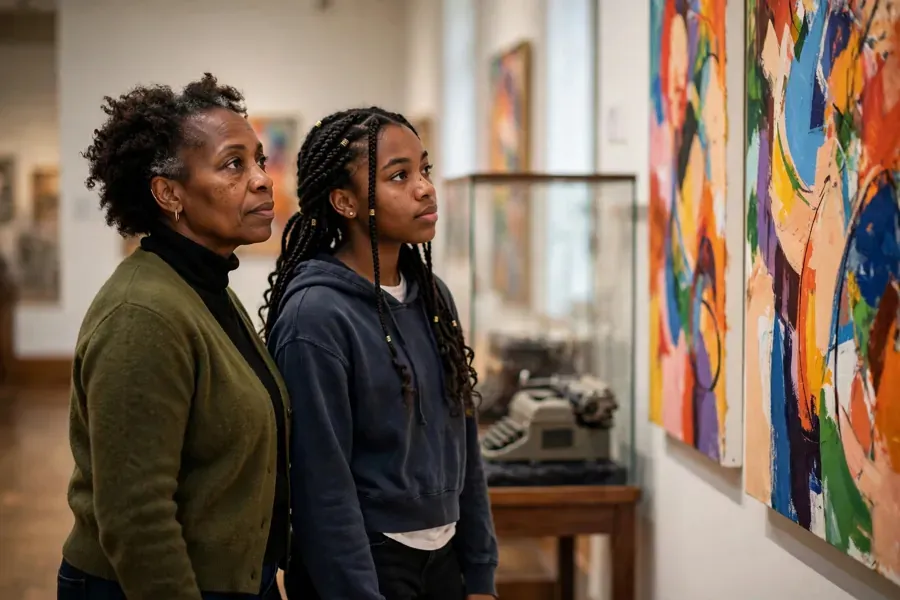
When the Smithsonian-linked “At the Vanguard” exhibition of HBCU collections began its national tour, it opened at this museum — with, among its highlights, first-edition works by Margaret Walker, art by Elizabeth Catlett and John Biggers, and the original typewriter Du Bois used at Atlanta University. That is not a gallery.
That is a vault of the culture, kept by the university that helped create it.
One more structural fact belongs in a family’s notebook, because it changes how a Clark Atlanta degree compounds.
Atlanta Magazine’s Du Bois account notes that Clark Atlanta, as part of the Atlanta University Center, also serves as the graduate school for Spelman and Morehouse — the young woman who takes her bachelor’s across the street at Spelman and the young man who takes his at Morehouse very often take their master’s and doctorates here, in the same few blocks, among the same families.
The AUC is not four rival schools sharing a fence. It is one extended household with four front doors, and Clark Atlanta holds the keys to the upper floors.
A legacy built here therefore runs in two directions at once: the parents who met on these yards, and the children who will climb from a sibling college’s freshman orientation to this university’s doctoral hooding without ever leaving the neighbourhood that raised them.
Notable Alumni: Lift Every Voice, Indeed
Praise Atlanta’s notable alumni roll reads like a syllabus of Black achievement across a century. It names James Weldon Johnson — educator, civil rights activist and songwriter of “Lift Ev’ry Voice and Sing,” the Black National Anthem — yes, the hymn your family stands for was written by a son of this house — and the Rev. Ralph Abernathy, civil rights activist and minister, former president of the Southern Christian Leadership Conference, Dr. King’s closest lieutenant, carrying the movement after Memphis. The same roll, echoed in the university’s own leadership-institute biography, adds Congressman Hank Johnson, Emmy-winning journalist Jacque Reid, Tony Award-winning director Kenny Leon, and Valeisha Butterfield Jones, whose career has run from Google partnerships to the leadership of the Recording Academy.
For the teenager whose dreams are set to music and film, the roll continues: Kenya Barris, the film and television writer, producer and director who created Black-ish, Grown-ish and Girls Trip; Bryan-Michael Cox, the award-winning producer and songwriter behind records for Usher, Mariah Carey and Jagged Edge; and R&B singer Bobby V. Put the generations side by side and the point makes itself, without a single adjective from us: the anthem, the movement, the Congress, the newsroom, Broadway, and the modern Black television empire — all drawing water from the same well on James P. Brawley Drive.
The consortium itself has a history worth teaching your child before the tour bus — forgive us, before the walking tour — begins.
A congressional statement preserved by Vote Smart recounts that the modern Atlanta University Center emerged in the 1930s as Atlanta University, Clark College and Morris Brown affiliated, that the boards of six HBCU institutions ratified new articles of affiliation in 1957 creating the present-day centre, and that the Atlanta University Center was incorporated in 1964 to provide shared services and programmes.
In plain family language: these schools decided, generations ago, that they would be stronger holding certain things in common — a library system, a calendar, a neighbourhood — while keeping their own names, mottos and mysteries intact.
It is the family-meeting principle from our Money & Legacy pages, practised at institutional scale for the better part of a century, and a student admitted to Clark Atlanta inherits the whole arrangement on day one.
Visiting: The AUC Is the Tour
No campus visit in America offers what an Atlanta University Center visit offers, because you are not touring one school — you are touring a civilisation in miniature.
Put the Clark Atlanta University Art Museum on the family itinerary first: Explore Georgia lists it on the second level of Trevor Arnett Hall at 223 James P. Brawley Drive SW, open Tuesday through Friday, 11 a.m. to 4 p.m., family-friendly and group-friendly.
Stand before the Woodruff murals, find the Du Bois typewriter when it is on view, and let your child absorb the lesson the building teaches without a word: this culture kept its own receipts, in its own house, for a hundred years.
Then walk the neighbourhood as curriculum. Spelman’s gates, Morehouse’s yard, the AUC Woodruff Library shared by the consortium — a student at any one of these schools lives among all of them.
Stay in Atlanta properly, dine in the city’s Black culinary rooms, and if the calendar allows, come at homecoming or during the AUC’s shared celebrations, when the whole centre dresses up at once. A young person deciding where to become themselves deserves to see the full ecosystem, not one brochure from it.
Attending: The Honest Notes
Clark Atlanta is a private university, and its published figures should be read from its own paper.
The university’s financial aid office lists, in its undergraduate packet, tuition of $27,962 with mandatory student fees of $3,578, room at $14,288 and a meal plan at $5,750 — a total cost for the year of $51,578 for a student living on campus.
CollegeData’s profile, for its part, describes admission as moderately difficult and reports that 64% of applicants were admitted in its data — figures we attribute to CollegeData’s profile, as every family should, and then verify against the university’s current published numbers before a single decision is made.
Aid is a real part of this school’s story — the majority of its students receive assistance in the published profiles — and the honest family conversation is the net price for your household, programme by programme.
Sport belongs in the honest notes too, because Saturdays shape a college choice more than any viewbook admits.
CollegeData’s profile lists Clark Atlanta’s Panthers in NCAA Division II athletics — the red, black and gray in a conference of peer HBCUs, with game days that function, as they do across this series, as family reunions with a scoreboard attached.
A student-athlete in the family should read that profile’s full athletics listing with a coach’s eye; a student in the stands will need no instruction at all.
Black life at Clark Atlanta is Atlanta itself: the AUC’s shared social calendar, the Divine Nine yards, WCLK — the jazz station that, as the station itself puts it, has served the Atlanta community for decades as the university’s radio voice, documenting and amplifying Black history, music and culture — homecoming in a city that treats it as a season, and internships in the corporate and media capital of the Black South a short ride from the classroom door.
Legacy families will feel the pull of the place immediately; first-generation families will feel something just as valuable — a ready-made village of alumni who consider your child’s success partly their own assignment. Find a way or make one.
Families have been doing exactly that on this ground since 1865, and the university their persistence built is still, deliberately, making room for yours.
Spelman College: The Sisterhood That Builds
Morehouse College: The Making of Morehouse Men
Florida A&M University: The Rattler Standard
Dillard University: The Jewel of Gentilly
Choosing the School
The First Gate: Preschool
Black Wall Street: Greenwood
The Habari Network / Clark Atlanta University — “Executive Leadership Institute for Next Generation of HBCU Presidents”
Praise Atlanta — “Always A Panther: Notable Alumni of Clark Atlanta University”
Atlanta Magazine — “W.E.B. Du Bois’s Legacy Deferred”
New Georgia Encyclopedia — “W. E. B. Du Bois in Georgia”
Explore Georgia — “Clark Atlanta University Art Museum”
Clark Atlanta University — “At the Vanguard: Making and Saving History at HBCUs”
Clark Atlanta University, Office of Financial Aid — Undergraduate Cost Packet
CollegeData — “Clark Atlanta University Overview”
Vote Smart — “National Historically Black Colleges and Universities Week”
WCLK — “Clark Atlanta University: First Stop on ‘At the Vanguard’”
Questions & Answers
How do families pass down wealth and values?
Clark Atlanta University history and notable alumni start with two schools, two mottos and one instruction that has outlived every building on the yard: I’ll find a way or make one. It links to 8 stories and articles — open any card to read the full piece.
How do you involve children in family wealth planning?
Clark Atlanta University history and notable alumni start with two schools, two mottos and one instruction that has outlived every building on the yard: I’ll find a way or make one.
How do I read the full stories on Clark Atlanta University: Find a Way or Make One?
Choose any card on this page. Each one opens a full page of its own — the complete story or article, with its sources linked.