Dillard University: The Jewel of Gentilly
Dillard University history and notable alumni belong to New Orleans the way the oaks belong to Gentilly Boulevard — and a family that walks the Avenue of the Oaks once rarely talks about college the same way again.
This Dillard University history and notable alumni guide is written for the family choosing intimacy over scale.
Dillard is a small, private, liberal arts university in New Orleans’ Gentilly neighbourhood, where the graduating class processes beneath live oaks older than the institution itself, where professors know a student’s name and a grandmother’s name, and where the city outside the gates — its music, its kitchens, its second lines — is not a distraction from the education.
It is half of it. If Florida A&M is the standard and Clark Atlanta the intellectual capital, Dillard is the jewel: smaller, gleaming, and cut to be held close.
A preservation writer quoted in the city’s own register history said what every visitor thinks, standing on that green:
“Dillard University surely has one of the country’s most beautiful and serene campuses.”— Donna Fricker, in Preservation in Print, via the Preservation Resource Center of New Orleans
Two Schools of 1869, One Charter of 1930
Dillard’s roots reach back to 1869, to two institutions founded to educate newly freed African Americans in New Orleans: Straight College and New Orleans University.
The African American Registry’s history notes that the university operated Flint-Goodridge Hospital, affiliated with Dillard, from 1932 until 1983 — a reminder that these schools were never classrooms alone; they were the hospital, the nursing programme, the whole infrastructure of a community the city around them declined to serve.
In 1930, after years of negotiation between the two institutions, Straight College and New Orleans University chartered Dillard University on June 6, 1930, named for James Hardy Dillard, an educator whose life’s work was the education of African Americans in the South.
The new university was created, in the words its charter history preserves, to offer a traditional liberal arts curriculum and emphasise close engagement with the Black community — and it opened its doors in the fall of 1935 on the Gentilly campus it still occupies, drawing prominent scholars from the start: Horace Mann Bond in psychology and education, St. Clair Drake in sociology and anthropology, Lawrence D. Reddick in history.
Honesty requires one brief note, in the register this magazine keeps for such things: the building of Dillard was tempered by its Jim Crow context, including local resistance to the very idea of the school.
What was built despite it — a liberal arts university, on a garden campus, for Black students in the Deep South — is precisely the inheritance we are describing.
The Preservation Resource Center’s history gives the campus its dates and its designer: the cornerstone was laid on May 27, 1934, the college opened on September 24, 1935, and architect Moise Goldstein designed the Classical Revival style of its stately main buildings. Hold those years in mind when you visit.
This was a campus designed — deliberately, beautifully — at the height of segregation, by people who believed Black students deserved gleaming white buildings and a formal green. They did not build down to their circumstances. They built up to their children.
The Distinction: Small, Liberal Arts, and First in Nursing
Dillard’s distinction, in one honest claim, is the intimate liberal arts education with professional teeth.
Greater New Orleans Inc.’s history of the university records that Dillard became the first Black university in the country to offer a bachelor’s degree-granting nursing programme — a first that still shapes its health-sciences strength — and that its pre-law programme has drawn notice in the same account: of the students in its Legal Education Advancing Diversity programme, 85 percent were admitted to law school, compared with 49 percent of African Americans nationwide, according to the university’s vice president for academic affairs as quoted there.
Physics, film, public health and urban water management all appear in the university’s modern story — including, GNO notes, a certificate in urban water management described as the only one of its kind in Louisiana. Small school, serious instruments.
And the city feels the school.
The same GNO history cites a United Negro College Fund analysis putting Dillard’s total economic impact at about $83 million for the local and regional economies, generating 778 jobs — figures we attribute to that UNCF analysis, as reported there — and quotes the university’s president calling Dillard, after Hurricane Katrina, “the economic engine that got Gentilly restarted,” the first entity to come back in a big way.
A jewel, yes. Also an engine. New Orleans understands both registers.
The Oaks, Katrina, and the Return
No account of Dillard is complete without the storm, told briefly and in the inheritance register.
Read that sequence twice. A flooded campus, classes in a hotel, a graduation marched through the oaks on schedule, and a full return within the year. When a Dillard family speaks of resilience, they are not quoting a brochure.
They watched the water, and then they watched the return.
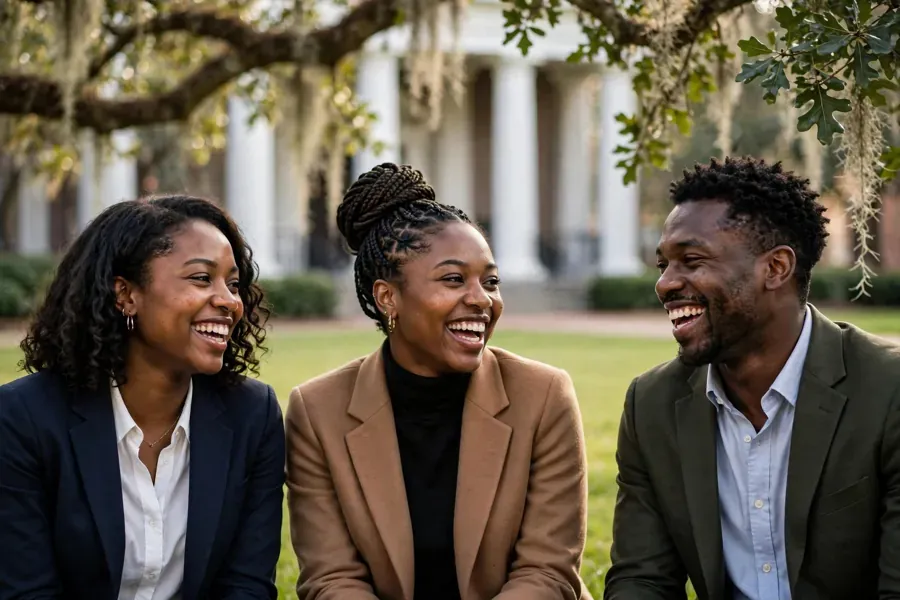
The oaks themselves are the campus’s signature. The National Register listing, quoted by the Preservation Resource Center, puts it exactly: “Dillard’s signature, besides its gleaming white buildings, is its landscaping” — a broad central green with a roughly 700-foot “avenue of oaks” reaching deep into the campus. Commencement processes down that avenue.
Orientation begins beneath it. A student spends four years walking a corridor planted by people who intended beauty to be part of the instruction — and in Gentilly, it is.
Two modern signatures deserve a family’s attention before the alumni roll, because they show where this small university chooses to be first.
Clio’s campus history records that in 2003 the musician Ray Charles added a provision in his will to endow a $1 million professorship of African-American culinary history at Dillard — the first such position in the country.
Sit with that for a moment, because it is the most Bourgeois Society fact in this entire series: a genius of American music endowing, at a small Black university in New Orleans, a chair devoted to the serious study of our foodways.
And the cameras followed the cooks: FilmSchool.org’s review of Dillard’s film programme describes a B.A. in Film combining liberal-arts film studies with hands-on production training by working filmmakers, in a city it calls “Hollywood South,” where students routinely gain professional credits on major features before graduation.
Culinary history with an endowed chair, cinema with working credits, nursing with a national first, law with a pipeline — this is what a liberal arts jewel does with its size. It concentrates.
Notable Alumni: Judges, Jazz and a University President
The alumni roll of a small school must be read for density, and Dillard’s is dense.
GNO’s history names Ellis Marsalis Jr., the famed jazz pianist and educator — father of a dynasty of New Orleans musicians — and Carl Stewart, chief judge of the 5th U.S. Circuit Court of Appeals, alongside Alice Dunbar Nelson, the poet and journalist of the Harlem Renaissance who came through the university’s predecessor line.
The university’s alumni list adds Garrett Morris, class of 1958, the comedian and actor of Saturday Night Live; Revius Ortique Jr., class of 1947, the first African American to serve on the Louisiana State Supreme Court; and P.B.S. Pinchback, of the predecessor institution, the first African-American governor in the United States.
The African American Registry’s founding history names among notable alumni Ruth Simmons — the Dillard graduate who went on to lead Brown University, an Ivy League presidency held by a daughter of Gentilly — a fact the university’s own Katrina-era accounts echo in describing Brown’s partnership in Dillard’s recovery, led by its Dillard-graduate president.
And the roll is still being written in the university’s own announcements: Dillard recently celebrated alumni Daphney Young, class of 1993, honoured for community service, and Dr. Warren Jones, class of 1971, honoured for medicine, on their induction into the National Black College Alumni Hall of Fame.
A small school whose graduates run federal appeals courts, jazz programmes, Ivy League universities and city lotteries — that is not range by accident. That is a liberal arts education doing exactly what it promises.
Visiting: Gentilly, Done Gently
Visit at the pace the campus teaches. The university stands at 2601 Gentilly Boulevard, as its own announcements give the address, in a residential neighbourhood that feels more garden suburb than city grid.
Dillard describes itself, in those same announcements, as a private four-year liberal arts historically Black institution with a history dating back to 1869 — and the visit should honour both halves of that sentence: sit in on the small classes if admissions invites it, walk the full Avenue of the Oaks slowly, and then go be a New Orleanian for the weekend.
Eat in Gentilly and beyond it, hear the music the Marsalis family’s city makes nightly, and let your teenager feel the particular truth of this place: here, Black culture is not the enrichment programme. It is the air.
One practical counsel from families who have done it: pair the Dillard visit with Xavier University of Louisiana, across the city, and read our companion entry in this series. Two distinguished New Orleans HBCUs in one trip will teach a student more about fit — intimate liberal arts against pre-medical powerhouse — than a month of websites.
Attending: The Honest Notes
Dillard’s scale is its method. Sallie Mae’s college profile lists undergraduate tuition of $22,194, an acceptance rate of 41.9 percent and just over a thousand undergraduates — figures we attribute to that published profile; families should confirm the current year’s numbers with the university directly, as with every school in this series.
Other published profiles put the student-faculty ratio at 14 to 1 and describe small classes, often under twenty, where professors know students by name — the profile’s phrasing, and the lived experience alumni describe when they call this campus a family with aunties and uncles on the faculty.
Varsity Tutors’ published profile of the university fills in the texture around those figures: it lists a student-faculty ratio of 14 to 1, describes small classes — often under twenty students — in which professors know students by name and push hands-on projects, and notes a campus alive with Divine Nine life, step shows and the Dillard University Concert Chorale drawing city crowds.
We carry those details as that profile states them. For the right student — the one who will be known, mentored toward law school, nursing, film or the laboratory by people who notice an absence by the second class — that intimacy is not a compromise against scale. It is the entire point.
The Bleu Devil tradition ties it together: the teams, the colours, the homecoming, the Divine Nine yards, the concert chorale drawing city audiences, and above all the walk — down the Avenue of the Oaks at the beginning as a new student, and down it again at the end in a cap and gown, past family lined beneath trees that were old when the charter was signed.
Some universities give a student a network. Dillard gives them a neighbourhood, a city, a sound and a shaded green they will measure every campus against for the rest of their lives. Bring the grandparents when you come.
Dillard is one of those rare campuses where three generations can walk the same green and each find their own reason to claim it — the elders in the architecture and the anthems, the parents in the outcomes, the student in the feeling, somewhere under those oaks, of being expected and being home at once.
That is the Jewel of Gentilly, and it has been gleaming — through flood, through history, through everything — since two small schools decided their children deserved one beautiful university.
Xavier University of Louisiana: The Pre-Med Powerhouse
Florida A&M University: The Rattler Standard
Clark Atlanta University: Find a Way or Make One
Choosing the School
The First Gate: Preschool
Black Wall Street: Greenwood
New Orleans, Lived Well
Greater New Orleans Inc. — “Dillard University Looks to the Future as It Celebrates 150 Years in New Orleans”
Preservation Resource Center of New Orleans — “Dillard University Celebrates 150 Years of African-American Higher Education in New Orleans”
African American Registry — “Dillard University Is Founded”
Black America Web — “Little Known Black History Fact: Dillard University”
Clio — “Dillard University”
Dillard University — “Alumni Inducted into the 2025 National Black College Alumni Hall of Fame”
Sallie Mae — “Dillard University Tuition, Acceptance Rate & Academics”
HBCU Buzz — “Dillard Celebrates 150 Years in New Orleans”
FilmSchool.org — “Dillard University”
Varsity Tutors — “Dillard University: Admissions, Rankings and Acceptance Rate”
Questions & Answers
How do families pass down wealth and values?
Dillard University history and notable alumni belong to New Orleans the way the oaks belong to Gentilly Boulevard — and a family that walks the Avenue of the Oaks once rarely talks about college the same way again. It links to 8 stories and articles — open any card to read the full piece.
How do you involve children in family wealth planning?
Dillard University history and notable alumni belong to New Orleans the way the oaks belong to Gentilly Boulevard — and a family that walks the Avenue of the Oaks once rarely talks about college the same way again.
How do I read the full stories on Dillard University: The Jewel of Gentilly?
Choose any card on this page. Each one opens a full page of its own — the complete story or article, with its sources linked.