The Gentleman at Sixty: Fit, Grooming, and Never Looking Retired
Men's style over 60 is not a younger man's wardrobe kept too long. It is a standard of its own — tailoring fitted to the man you are now, grooming kept like an appointment with yourself, and silver worn as a credential.
Somewhere around sixty, a man stops dressing for the job he wants and starts dressing as the man he is. That should be a promotion. Men's style over 60, done properly, is the most confident dressing there is: nothing to prove, nothing borrowed from a younger man's closet, everything chosen.
The rooms you walk into now — the board table, the gala, the grandchild's recital, the club where your name is on the wall — read you before you say a word. The question is only whether what they read is established or finished.
Those are two different silhouettes, and the distance between them is smaller than most men think: a jacket that fits the body you have today, a barber who knows your head, a pair of glasses treated like jewellery. This is the full standard.
Fit Is the Whole Argument
Bodies change across a decade — shoulders settle, the waist moves, posture tells its own story. A suit bought for the man of fifty and worn unchanged at sixty-two quietly argues against its owner.
The tailoring houses that dress older men well start from the same observation: structure has to do the work the body used to do on its own — a small, invisible amount of shoulder construction restores the clean line at the shoulder bone, and cloth with real integrity holds a silhouette instead of collapsing against it.
None of this is padding in the theatrical sense. It is architecture, and it should be undetectable.
The practical rules follow from that. Keep the front of the trouser clean and smooth; if you want adjustment, let it live invisibly at the back or in side adjusters rather than gathered elastic across the front.
Take every good suit you own to your tailor for a fresh fitting — not the fitting you remember, the one your body asks for this year — and let him tell you honestly which pieces have earned retirement.
Style guidance for men at this age returns again and again to the same plain instruction: layer for depth rather than bulk, thin layers building structure — a shirt under a fine sweater under a blazer — instead of one heavy piece doing all the work and doing it badly.
Shoes deserve the same honesty. Support and polish are not enemies.
The better makers now build genuine comfort into traditional silhouettes, and the detail that matters most is the shape of the toe: an almond or elongated toe continues the line of the leg, while a wide, rounded comfort toe cuts the leg short and announces itself from across the room.
Your shoes should look cared for and broken in with dignity — never worn out, never orthopedic in appearance, whatever engineering is happening quietly inside them.
“Dress the way you want. You’ve earned it.”— Scott Shapiro, stylist, via Taelor.Style
That is the spirit of the thing. At sixty the style wars are over and you won them. What remains is editing: fewer pieces, better ones, everything in the closet earning its place.
If you are rebuilding from the foundation, our guide to the suit as a system lays out the rotation the way a tailor would — start there, then have it fitted to the man standing in front of the mirror today.
The Wardrobe Edit: Fewer, Better, His
Open the closet of a well-dressed man of sixty and the first thing you notice is what is not there. The edit is the art.
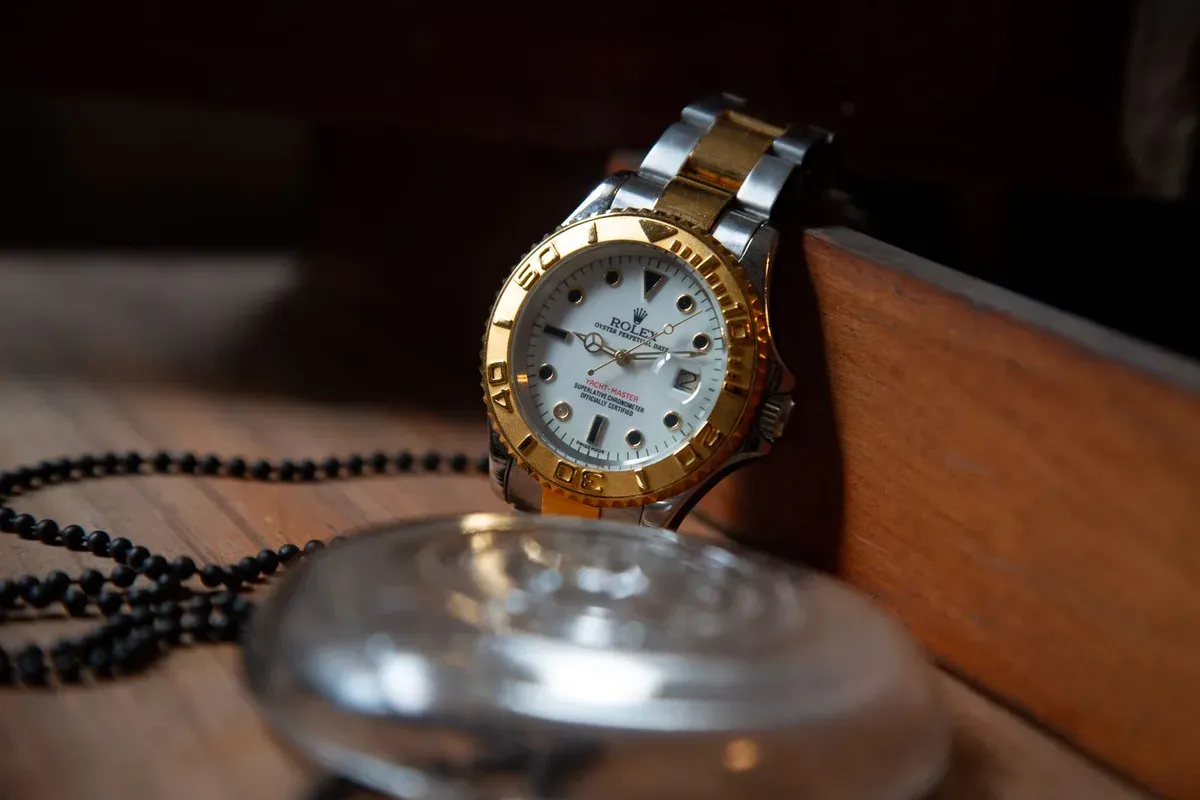
The foundation that stylists who dress men at this age return to is compact and deliberate: two well-fitted suits in navy and grey, a rotation of proper shirts in white and pale blue, fine knitwear that layers without bulk, trousers that hold their line, one pair each of black and brown dress shoes kept polished, and a watch chosen the way a signature is chosen — once, and for good.
Around that foundation, personality is permitted exactly where it belongs: a burgundy tie, a forest-green pocket square, a checked blazer over a plain shirt. Colour is an accent at this age, never the argument.
What leaves the closet matters as much. Loud logos, graphic prints, neon anything, thin clingy fabrics, distressed denim — the whole vocabulary of trying — goes, not because a man of sixty cannot wear what he likes, but because he no longer needs to borrow a younger man's signals. Accessories obey the same law: they support, they never shout.
One strong piece at a time. A good felt hat in a classic shape — a homburg, a porkpie — is the elder statesman's own accent, and a well-made overcoat in rich wool does more for a man's authority in a doorway than any new suit underneath it. Gravitas is a fabric weight, a colour discipline, and a fit.
Everything else is noise you have outgrown.
The Barber Relationship
A gentleman at sixty does not find a barber; he keeps one. The standing appointment — same chair, same day, same interval — is what separates maintained from merely cut.
Hair thins and greys unevenly, the hairline redraws itself, and a barber who has watched your head change over years knows where the line should sit now, not where it sat in the photograph you brought him a decade ago.
Shorter, structured cuts generally serve this decade best: a clean taper, a cropped top with texture, the classic side part kept precise. They read as decisions. Length kept out of habit reads as surrender.
The beard, if you wear one, follows the same discipline. Grey in a beard is distinguished when it is shaped and neglected when it is not — there is very little middle ground. Keep the edges defined, the length deliberate, and the colour question answered on purpose, which brings us to the silver itself.
Bring the barber into the larger plan, too. Tell him what is coming — the gala season, the family portrait, the grandson's graduation — and let the cut be timed so it settles a week before the photograph, never the morning of it. A fresh cut needs a few days to become yours.
And when the hair itself thins to the point where a style becomes a strategy, a good barber will say so honestly and walk you toward the shorter cuts that flatter what remains — or toward the razor, worn with pride, which has its own standard in these pages. The relationship is the product. The haircut is just the receipt.
Silver, Handled With Intent
Grey hair is not the absence of colour; it is a different material. Strands that have lost their pigment are coarser, drier, and prone to a yellow cast from sun, water, and the environment — which is why unmanaged silver can look tired while managed silver looks like money.
The care is simple and specific: moisture first, and a silver or purple-toned shampoo in the rotation to keep the tone bright and clean rather than brassy.
Cut matters more than product: shorter on the sides with a little length on top shows the variation of tone at its best, and for curly hair a touch more length lets the curl — and the silver moving through it — show properly.
And if you would rather colour it? That is a legitimate choice, made well or badly. Made well, it means staying close to your natural shade — colourists who work with dark hair counsel going a shade or two lighter than your original black rather than back to full black, which sits harshly against mature skin and announces itself.
Made badly, it means a hard, flat dye line and a standing appointment you resent. Either answer is respectable. What is not respectable is drifting — grey by accident, dye by default.
Decide, and let the decision look like one. Men deciding the larger question of hair itself will find the companion standard in our guide to Black hair for men.
Eyewear Is Jewellery Now
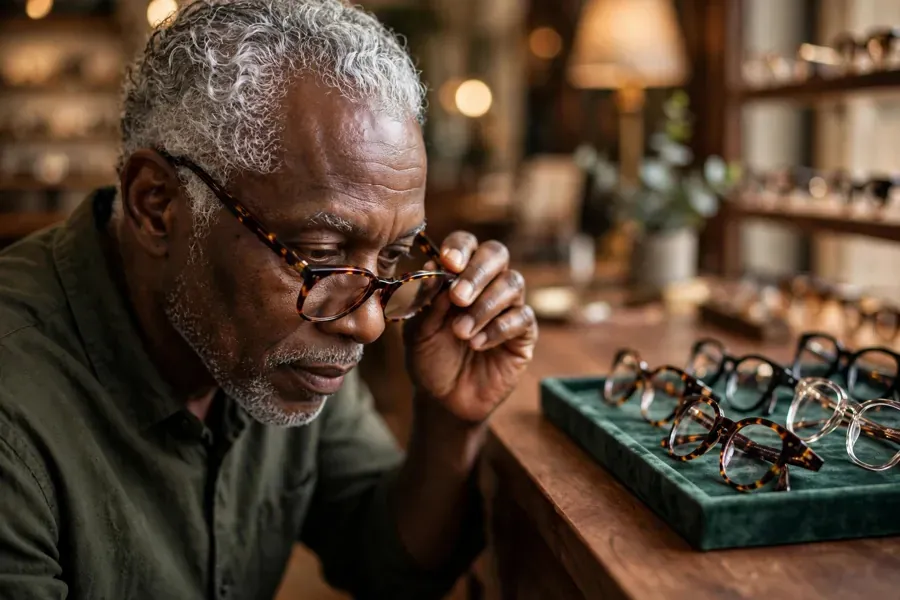
At some point the glasses stop being an appliance and become the most visible thing you own — they sit at eye level, in every conversation and every photograph. Treat them with the seriousness you give a watch.
The fitting guidance for men over sixty converges on a few durable truths: lightweight metal frames in titanium or steel for all-day comfort, and colours that work with silver hair — navy, gunmetal, and deep tortoiseshell against warm skin; silver and black against grey.
Rectangular frames sharpen a softening face; a fuller acetate frame gives the face the structure and contrast that age gently removes, and has the practical virtue of carrying a stronger prescription gracefully.
Buy two pairs the way you buy two good suits: one for the boardroom register, one with a little more personality for the evening. And have them fitted properly — a frame that slips or pinches will be fiddled with, and a man adjusting his glasses all through dinner looks uncertain, whatever he is saying. Sunglasses follow the same law.
The classic shapes — aviator, a clean rectangle, the dark tortoise frame — have never left, and a man who wore them confidently at thirty-five wears them with more authority now.
Skin, Hands, and the Details That Speak First
Clothing cannot carry an untidy man, and at sixty the margin is thinner: care shows as quickly as neglect does.
The grooming standard is not elaborate, but it is non-negotiable — skin kept moisturised and protected from the sun, nails clean and trimmed (a basic manicure is maintenance, not vanity), brows and ears kept in order by the same barber who keeps your cut, and fragrance applied with restraint, noticed when someone leans in rather than announced across the restaurant.
Our full treatment lives in the grooming standard, and the institution that delivers most of it is the subject of The Chair — the barber's chair as the real club of Black life.
Black Tie and the Big Rooms at Sixty
Evening is where this decade quietly outclasses every other. A younger man in black tie is wearing a costume he hopes to grow into; a man of sixty in a properly built dinner suit is simply dressed.
The fit rules tighten after dark — there is nowhere for an ill-fitting jacket to hide under gala light — and the rewards compound: silver at the temples against black cloth is one of the great colour combinations in menswear, and a pair of well-chosen glasses reads at a candlelit table the way cufflinks read at a handshake.
If your evening wardrobe predates your current body, have it refitted before the season, not after the first photograph disappoints you. Our full construction guide, Black Tie, Built Properly, covers the build itself; the point here is simpler.
The big rooms of Black society — the balls, the benefit tables, the anniversary dinners — are photographed rooms, and the men who look inevitable in those photographs are the men whose tailoring, grooming, and eyewear were all decided long before the invitation arrived.
Think of it as an annual rhythm rather than a daily anxiety: the tailor once a season, the barber on his standing interval, the dentist on his, and a dermatologist who knows your skin advising which products deserve your shelf — because skin changes with age, grows more sensitive, and rewards advice over experimentation.
Sunscreen outdoors is part of the uniform now, not a beach accessory. None of this is vanity and none of it is new to you; it is the same maintenance discipline you apply to the house, the car, and the portfolio, applied to the one asset that appears in every room you enter.
Posture finishes what the tailor started. Standing straight and moving calmly is the one accessory that cannot be bought, and at this age it is read — correctly — as the visible form of a life handled well. The gentleman at sixty is not dressing younger, and he is certainly not dressing old.
He is dressing exactly his age, at full quality, on purpose. That is what established looks like.
The Suit Is a System
Black Hair for Men: The Cuts, the Care, the Standard
The Chair: Barbers, Salons, and the Appointments That Run Black Life
Profiles: The Black Men Collection
Westwood Hart — "Style Mistakes for Men Over 60"
Modern Gentleman Magazine — "How to Dress Well in Your 60's"
Taelor.Style — "How to Dress Sharp Over 60"
Readers.com — "Best Glasses for Older Men"
The VOU — "Grey Hair for Men: Cuts That Suit It and Whether to Dye It"
Questions & Answers
What makes a gentleman in the modern world?
Men's style over 60 is not a younger man's wardrobe kept too long. It is a standard of its own — tailoring fitted to the man you are now, grooming kept like an appointment with yourself, and silver worn as a credential. It links to 6 stories and articles — open any card to read the full piece.
How should a gentleman dress and carry himself?
Men's style over 60 is not a younger man's wardrobe kept too long. It is a standard of its own — tailoring fitted to the man you are now, grooming kept like an appointment with yourself, and silver worn as a credential.
How do I read the full stories on The Gentleman at Sixty: Fit, Grooming, and Never Looking Retired?
Choose any card on this page. Each one opens a full page of its own — the complete story or article, with its sources linked.